ANDY HEDGECOCK and MARIA DUARTE review Late Fame, The Death of Robin Hood, Leviticus, and Gail Daughtry and the Celebrity Sex Pass


 Latest editorial

Rent - the original sin of capitalism
ALEX HALL is fascinated by a lucid and historically convincing account of how rent has dominated capitalist economies from feudalism to modernity
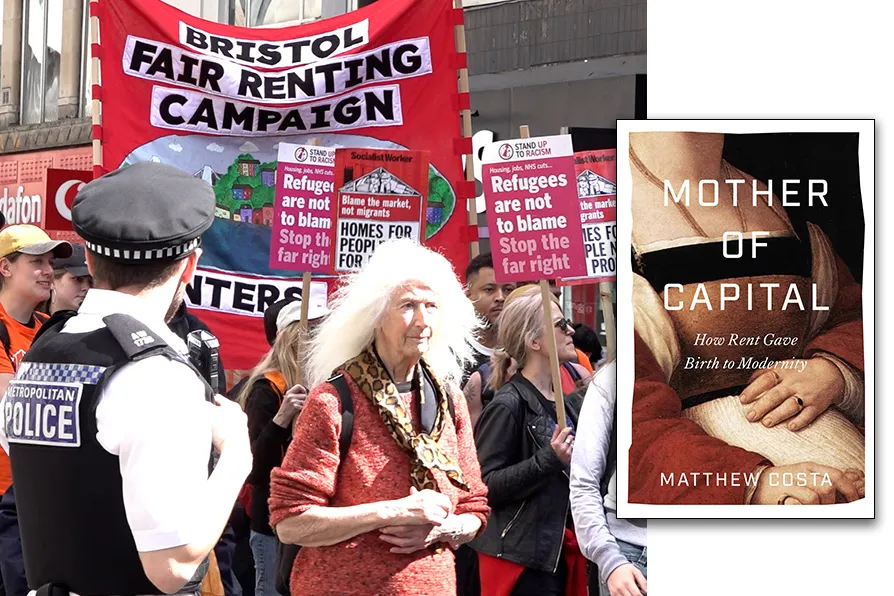 People take part in a National Housing Demo in central London, to demand better council housing and rent controls against "unaffordable housing", which is "destroying lives", April 18, 2026.

GORDON PARSONS enjoys Kant’s ‘mind-boggling’ theory of human reality: that we create the reality we experience
DAVID RABY welcomes a biography that emphasises how Fidel’s unique characteristics became hallmarks of the ongoing Cuban revolutionary process
IAN SINCLAIR recommends a readable, if partisan, account of the astonishing campaign of New York's new mayor
MATTHEW HAWKINS witnesses a contemporary ballet that represents human life as subjected to artificial intelligence
by Marwa Paikan





Mother of Capital: How Rent Gave Birth to Modernity
Matthew Costa, Pluto Press, £24.99
MATTHEW COSTA resists easy categorisation. His publisher’s biography places him in the University of Sydney’s political economy department, but the book blurb also locates him at the New South Wales Treasury, where he works as director of productivity reform.
A search of PhD theses reveals that Mother of Capital began as his 2020 doctoral dissertation. This is an unusual pedigree. Costa has published a thesis in the Marxist tradition while employed inside the state apparatus that manages that same system.
This does bear comparison with Michael Hudson, who worked for Chase Manhattan bank and also wrote Super Imperialism, which is often read as a working manual of American empire. Like Hudson, Costa looks closely at classical political economy. And like Hudson, he has produced a uniquely enlightening book, invaluable for understanding modern capitalism.
Costa traces several interlocking threads, all focused on the British birth of capitalism. First, he describes society in terms of its social-property relations: the rules, customs, and power structures that determine who has access to what, and under what conditions. Transformation happens through what Costa calls endogenous transformation: circumstances reproduce themselves, but never in a perfect circle. It is a spiral and contradictions force change.
The processes of external shock, or the grand strategic visions of princes and kings are described, discussed, and debunked. Costa argues, for instance, that even the Black Death was a result of endogenous transformations. The conditions that brought plague-carrying fleas to Britain were part of the system itself. For Costa, history is not made by great men or external catastrophes, it is made by the internal, often contradictory, reproduction of everyday economic relationships.
Tributary rent defined feudalism: peasants paid rent to the lord for the use of land, not for profit but for subsistence. Contradictions in the reproduction of tributary rent meant that eventually lords were better off renting out farms on tenures for profit, and promoting the enclosures of common land. This proletarianised former agricultural workers, alienating them from the means of production, and birthing the capitalist system. Tributary rent became capitalist rent.
Critically, for Costa, rent was not a by-product of capitalism but the mechanism of its birth, which was peculiar to the British system at that time. This is where he departs from both mainstream economics (which treats rent as a minor market distortion) and much Marxist theory (which treats primitive accumulation as a one-time event). For Costa, the rent-relation is not a pre-capitalist remnant. It is the original engine, and it never went away.
As part of his thesis, Costa delivers an excellent history of the evolution of power in Britain. For anyone who has ever felt that school-level history — with its kings and great deeds — was lacking, or who found Anthony King’s Who Governs Britain unenlightening, the clarity Costa provides in this history is a truly illuminating part of the book.
Finally, Costa examines the traditions of political economy immediately prior to Marx. He finds a substantial body of critique of social-property relations, some of which sounds distinctly Marxist, and places Marx himself as the heir to an existing tradition. Much of this pre-Marxian critique was grounded in two principles: equal access to the earth (the world’s resources belong to all equally) and the right to receive the full value of one’s labour.
These critics provided considerable resistance to exploitation under the emerging system. Costa argues that Marx, by centring the capital-relation, inadvertently made these earlier critics appear anachronistic. In recovering their voices, Costa offers not just a history of rent but adds to the body of economic thought from below.
For Costa, rent is the original sin that allowed capitalism to flourish. This of course leaves open the question of how it, too, might be transformed out of existence.

Similar stories
SETH SANDRONSKY recommends a Marxist critique of the ‘race-first’ views of the influential black US theorist Cedric Robinson

Nature as well as society works dialectically, asserts the Marx Memorial Library and Workers’ School
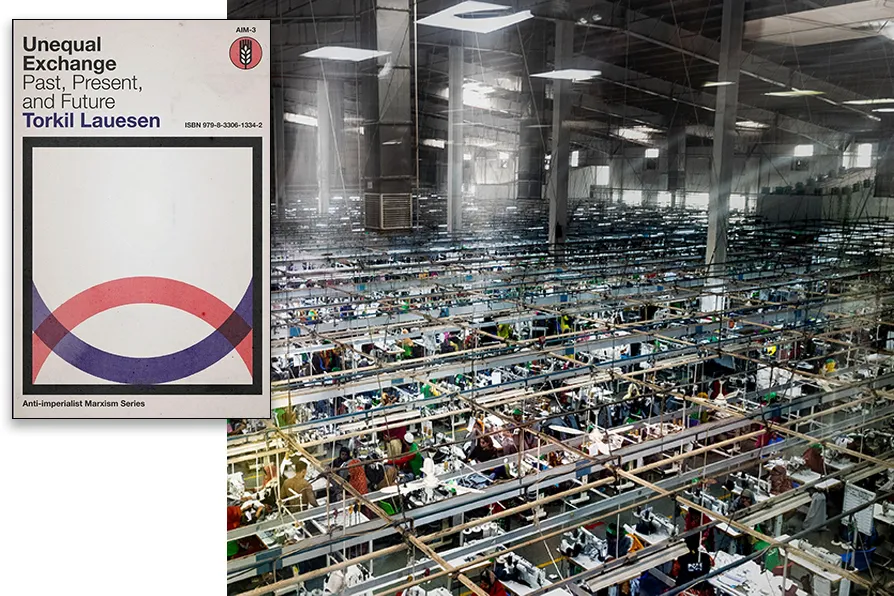
MARTIN GRAHAM welcomes, with reservations, a scholarly addition to the unfinished business of understanding how capital works on a world scale

In Part 4 of her look at the Chinese revolution JENNY CLEGG addresses the relationship between the Peasant Movement and the National Movement