WILL STONE samples the 20th anniversary atmosphere of this eclectic end-of-season indie festival


 Latest editorial
Miracle game from a country under siege
SCOTT ALSWORTH revels in the political subtext and exquisite visuals of Cuba’s first-ever videogame
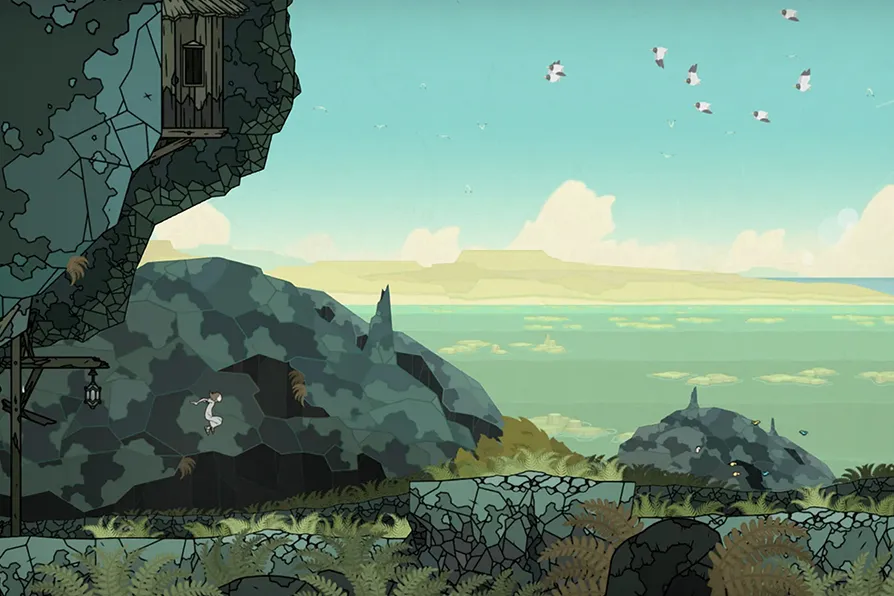 CARIBBEAN GAME-SCAPE: a still from Saviourless [Pic: Courtesy of Empty-Head Games]

Comics are not just superheroes and spandex – it can be public art, telling public stories, suggests HARRIET EARLE
The bard serenades the Diggers of Wigan and their festive followers
ALEXEI SAYLE speaks to Angus Reid about a lifetime of protest, how to hone political art – and what to do now
ANDY HEDGECOCK, JAMES WALSH, LEO BOIX and MARIA DUARTE review Just An Illusion, Everybody Digs Bill Evans, Blue Film, Oasis: Don’t Look Back in Anger, and Runner
MARIA DUARTE recommends a nerve-wracking reconstruction of the 72 hours before the Normandy landings





Saviorless
(Empty Head Games)
PC (Windows, Mac, Linux) / Playstation 5 / Nintendo Switch
⭑⭑⭑⭑☆
THERE’s a magic about Cuban creativity you won’t find elsewhere. It entails a rare way of looking at the world, of seeing as a child does, as if anything were possible, and then, against all odds, realising a vision with a quiet, unshakable confidence.
Often, it’s an artfulness inspired by nature — nature and human resilience. The sea as well as the seawall, the storm and the concrete of the Malecon. As the nation’s revolutionary poet, Nicolas Guillen, had it that Cuba, together with the whole of the Caribbean, is like a coral-scaled fish that “bites.” It’s always resourceful, always surprising. And indeed, it’s these exact same qualities that we find in the island’s first-ever video game.
Image
Developed over eight years by Havana-based studio Empty Head Games, Saviorless is a 2D platformer set in a dark-fantasy realm of lush forests, crumbling ruins and vertiginous hellscapes. Its story — framed by an old narrator and his two proteges atop an Olympus-like summit — follows a young boy named Antar as he chases a mystical heron to the Smiling Islands, where he hopes to become an all-powerful protector, a so-called “Savior.”
This hero’s journey matters less for the many monsters, puzzles and boss fights it hurls our way, than for its political subtexts. Ideals, wherever they harden into ideology, are called out, alongside an outside savagery. The latter, a clear swipe at US imperialism, is cleverly positioned as an external, subversive force when the elder narrator, who seems to represent Cuba’s older generation, falls asleep and his “bored” understudies decide to change up the story. But they soon regret their meddling when they inadvertently unleash the game’s main antagonist, a horse-headed miscreant with an appetite for destruction.
Tellingly, players are tasked with collecting missing pages to complete the story being told, which are scattered across each of the game’s eight levels. Locate them all and you’ll eventually get to take a path leading left; the “good ending.” Fail, and you’ll end up turning right for the “bad ending.” Make of that what you will, but I’m reading a defence of historical materialism and a zero-sum choice. The one between socialism and barbarism.
However, to focus too much on what Saviorless wants to say would be to do it something of a disservice. And honestly, as much as I’d love to wax lyrical about the narrative, it’s not nearly as expressive as the sprite-based animations and the painstakingly hand-drawn characters and environments that have arguably made this title such a hit. The art style is not only original, it’s intimate, ingenious — dauntless even. And in admiring it, we cannot help but recognise it’s less an aesthetic choice and more a requirement.
The stunning graphics were rendered without 3D modelling tools, expensive PCs and technologically dependent workflows simply because they had to be. So too the music, delicately composed for piano. Now, this bears some thinking about. Many projects never make it out of development. As the journalist Jason Schreier hints in his book Blood, Sweat, and Pixels (Harper, 2017), owing to their enormous complexity, it’s a miracle games get made at all. This is doubly true for Saviorless, which was literally created in a country under siege.
According to the creators, they faced severe hardware issues and daily blackouts. Every time they needed internet access, they had to head off down the park, rain or shine, to use a wi-fi hotspot. Moreover, as a final blow, after their promotional materials had been prepared in the run-up to release, they were unexpectedly torpedoed by a last-minute trademark claim on their planned title, “Savior,” by a US studio of industry veterans.
And yet, despite all this, Saviorless is out there. Swimming like that fish in Guillen’s poem. A very fine specimen of Cuban creativity.
To buy, and download and play Saviourless see: store.steampowered.com.
