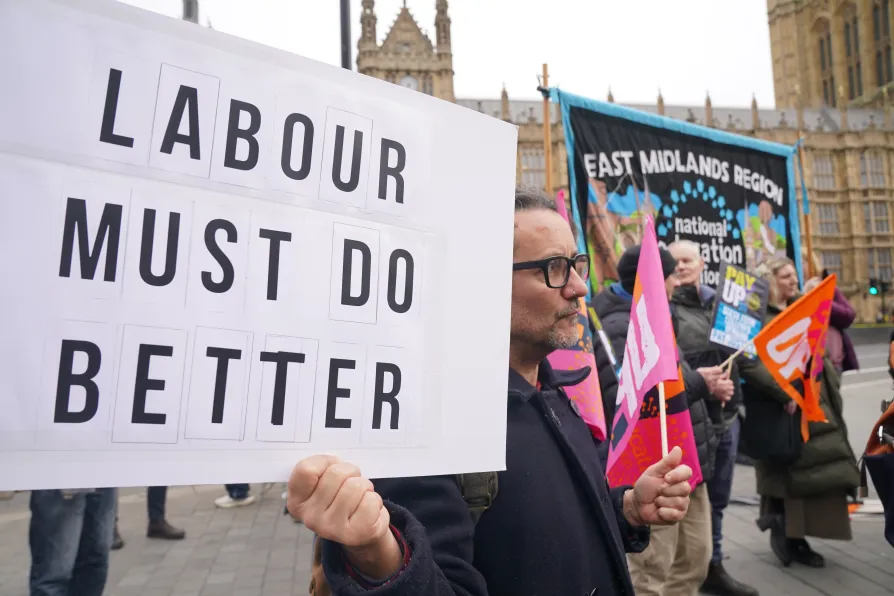
 Members of the National Education Union (NEU) hold a rally at Old Palace Yard, in Westminster, London, January 29, 2025






LABOUR should be very worried by the anger radiating from teachers’ conferences this Easter.
Governments like to present trade unions as sectional interest groups, whose demands must either be balanced against those of other such groups or overruled entirely in the so-called “national interest.”
It’s a public relations strategy designed to disguise how far mainstream union demands — from an end to privatisation of essential services to higher taxes on big business and the rich — reflect settled majority opinion in Britain, despite being dismissed as old-fashioned or extremist by Westminster elites.
And it rings especially hollow when it comes to teachers.
Here is a workforce that remains strongly unionised, whose representatives have a powerful democratic mandate to speak for their profession.
A workforce that is everywhere — because it serves schools in every corner of the country, in affluent and deprived neighbourhoods, in inner cities, small towns and rural areas. One which is in daily contact with the children of those communities, which means in regular contact with parents, grandparents, families.
So teachers see it all — the poverty that stifles learning, the lack of decent, secure jobs for students to go on to, the impacts of overcrowding or insecure housing, the resentment that grips whole generations at a system that is rigged against them.
It is no exaggeration to say, as National Education Union (NEU) leader Daniel Kebede does, that “the classroom has become the front line of every unresolved crisis in our society… hunger walks in with the children. Anxiety takes a seat at the back of the room.”
Schools are community hubs, and their intrinsic links across each community make teachers both receptive to local feeling and persuasive local voices.
So if a union the size of the NEU finds 65 per cent of its members who voted Labour less than two years ago would not do so again, MPs need to take note — especially since every opinion poll confirms this collapse in support for the party is general.
That it also found the most popular party among NEU members is now the Greens is another warning.
The conceit that the working class has nowhere else to go, that Labour can offend every one of its natural constituencies in turn while exclusively courting Tory — and more recently Reform UK — votes, should have died with the Scottish election wipeout of 2015, but remains the default setting of the zombie Blairites — whose long domination of the party has seen a steady decline in its vote, concealed at first by the initial size of the majorities that were shrinking but now threatening its future as a party of government. Peter Mandelson, a key author of that strategy, is gone: can the party escape his influence, and listen again to working-class people instead of the filthy rich?
They would find that the concerns fuelling teachers’ anger — from impossible workloads putting unacceptable pressure on family life to struggling to make ends meet while watching academy CEOs rake in fat cat remuneration packages, as described by teachers’ union NASUWT leader Matt Wrack in tomorrow’s Morning Star — are echoed in workforces in every sector of the economy.
Besides reflecting local opinion teachers can change it.
The School Cuts campaign, with its website allowing people to see how much their local school was set to lose in funding under Tory plans, was launched by the NEU’s predecessor the NUT alongside the NAHT and GMB unions. Pollster Survation later found that almost 800,000 voters switched to Labour because of school funding policy — a swing that cost Theresa May her majority.
Ministers may turn a blind eye, keep pursuing academisation and endless testing, keep privileging Big Tech profits over children’s wellbeing, keep to self-imposed fiscal rules that prevent proper investment.
But MPs who hope for a future for Labour — or their own careers— should know better.



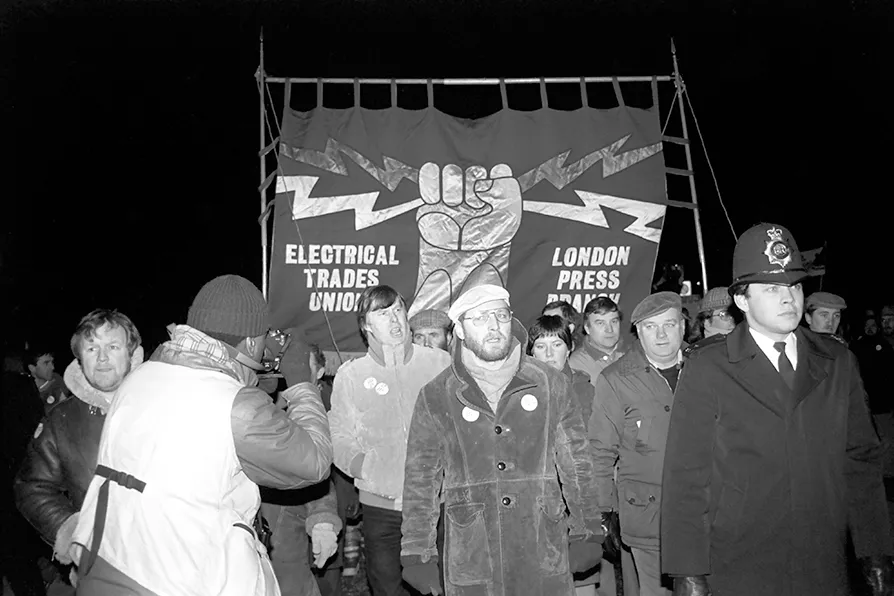
A past confrontation permanently shaped the methods the state will use to protect employers against any claims by their employees, writes MATT WRACK, but unions are readying to face the challenge