


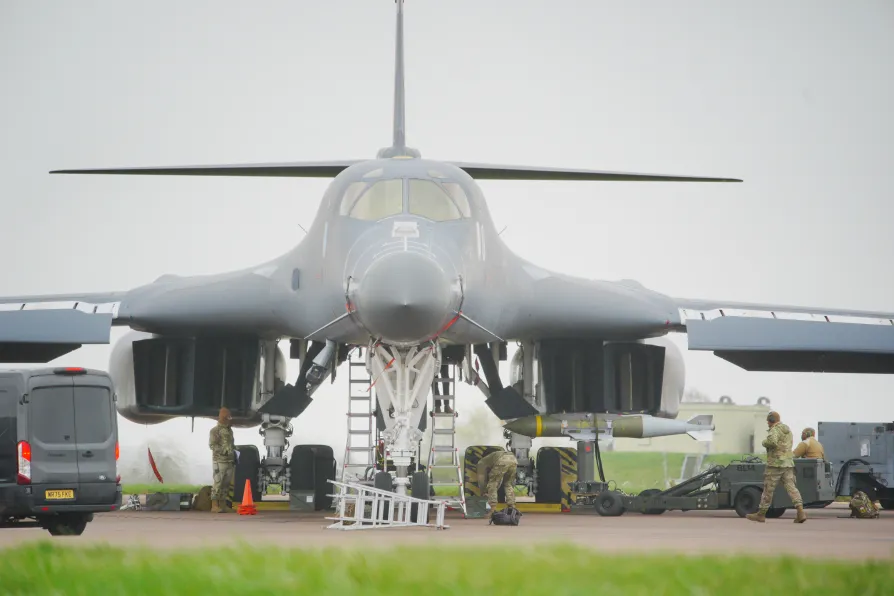
 A US Air Force B-1 bomber is loaded with bombs at RAF Fairford in Gloucestershire, March 16, 2026






IT IS welcome that the Scottish TUC has voted to oppose the breakneck increases in military spending championed by the Starmer government.
Its decision in Dundee follows a similar position taken by the British TUC at its conference last year. This new position — which followed a period when the TUC was notionally committed to campaigning for still-greater arms spending — is a positive development.
It opens up the possibility of the trade unions throwing themselves into a united campaign with the anti-war movement against the dangers threatening working people in Britain and around the world.
The policy is in no way directed against workers engaged in arms manufacturing. It is understandable that unions should prioritise saving the jobs of all their members under threat.
Work in the arms sector can be preserved by directing the existing defence budget towards firms in Britain, rather than the US or elsewhere, as well as conversion to civilian purposes in some cases.
However, there must be a better plan for growing the manufacturing sector than turbocharging the war drive. Fighting to revive the £28 billion-a-year green industrial deal once advocated, then abandoned, by Keir Starmer would be a much better bet.
The jobs created would be more secure and the whole population, as well as the climate, would gain from the production thus developed.
The escalating arms bill will, however, come at the direct expense of the people’s welfare. The present increases have been largely funded through the ransacking of the overseas aid budget.
The further militarisation envisaged will take a similar toll on the health, welfare and education budgets. Already, significant Establishment elements are pressing the government to go further and faster than present projections.
The trade union movement cannot afford to align with such elements without losing the trust of working people. Nor can it indulge fantasies that Britain can have indefinite amounts of both guns and butter.
The most important reason for opposing the arms spending increases, however, is different. It is that the British ruling class cannot be trusted with the weapons it already has at its disposal, never mind more.
More arms will not make Britain more secure, they will make the rest of the world less safe. Time and again over the last 30 years, Britain has been a military aggressor — in Yugoslavia, Afghanistan, Iraq, Libya, Yemen and more.
And that does not take into account the weaponry supplied to Israel to assist in its genocide of the Palestinians, nor the furious and expensive efforts to keep the Ukraine war going at all costs.
The trade union movement must take its stand alongside those resisting imperialist aggression, including from Britain itself. This issue cannot be disentangled from the fact that the country already has a very different military configuration than would be required for purposes of straightforward national defence.
The military budget instead underpins the “global Britain” rhetoric of Defence Secretary John Healey and the like, posturing in the Pacific to confront China and Russia in spheres where the country has no business being at all.
More military spending can only encourage and enable this reckless policy, and make it more likely that Britain will be embroiled in an unnecessary war which will certainly have no winners.
It is now time for the TUC and the Scottish TUC to translate their policy into active campaigning on the slogan “welfare not warfare” alongside the peace movement.
As we approach May Day, all trade unionists should remember the words of Karl Marx that in the future the “international rule will be peace because the national ruler will everywhere be the same — labour!”
