Cuban trade union federation CTC leader OSNAY MIGUEL COLINA speaks to Ben Chacko about life and work under a crippling US siege


 Latest editorial
Build the broadest possible coalition to defend Cuba
DIANE ABBOTT says the socialist island has played an outsized role in the fight against racism worldwide — we must stand by it as Trump tries to choke it to death
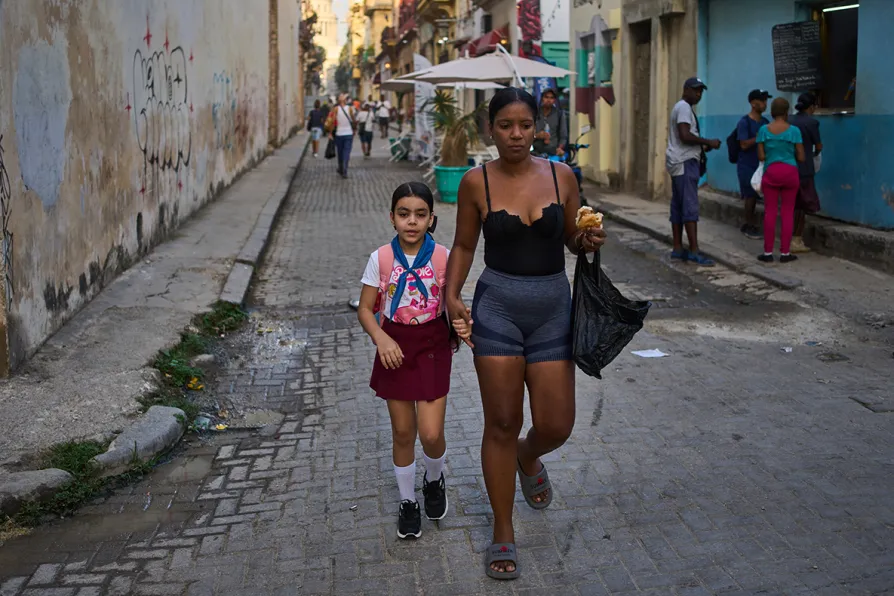 A woman accompanies a student to school in Havana, Cuba, March 13, 2026
A part of the British empire’s network of slavery, today the Caribbean island of Nevis faces a new form of exploitation in the form of crypto-colonialism, CLAUDIA WEBBE writes
A new book by Victoria Holmes illuminates the many hidden histories of the oppression experienced by Gypsy/Roma/Traveller community, writes ROGER McKENZIE
Even the oligarchs of the artificial intelligence industries are warning that their creations have the capacity for the ultimate destruction of the planet and its population. ANDREW MURRAY suggests that there might just be other solutions
The Labour government must deliver on its commitment to bring back privatised services into the public sector. This not only saves money but also creates accountability and generates wider social benefits, argues ANDY MCDONALD MP
Public ownership of Great British Railways has enormous potential to improve our railway network, but that can’t happen unless jobs, employee rights and union recognition is at the heart of the transition, argues MARYAM ESLAMDOUST
Challenges from the unscrupulous misuse of AI to steal actors’ voice and physical likenesses is being met with a firm union response, writes LYNDA ROOKE





I WAS recently invited to attend the funeral and homecoming of the Reverend Jesse Jackson. It felt like a piece of history and, as much as these things can ever be, a joyous occasion marking the life of someone who had lived it to the full in pursuit of justice and equality.
That justice and equality had a very strong international and internationalist dimension. We met several times because of that aspect of his politics, and he was a keen follower, and adviser of the struggle for equality and justice here in Britain.
One of the most significant of the many tributes to him came from the Cuban government, who might otherwise be forgiven for overlooking Rev Jackson’s passing given the current troubles of their own.
Miguel Diaz-Canel Bermudez, President of the Republic of Cuba, expressed condolences on social media, sending “heartfelt condolences to the family, friends and the people of the United States for the passing of one who was an active fighter for civil rights and justice in his country and a defender of just causes in other parts of the world.”
Cuba’s Foreign Minister Rodríguez Parrilla wrote: “Our people will remember Reverend Jesse Jackson for his respectful and friendly conduct towards Cuba, for his efforts in building bridges and his lifelong struggle in favour of justice. Our solidarity and condolences to his family and the people of the USA for his passing.”
These remarks are completely correct. Jesse Jackson was always a friend of Cuba.
He met Fidel Castro. The two men were instrumental in a mutual exchange of prisoners and he long argued against the US blockade of Cuba.
When others were baying for Cuban blood, and others still who should have opposed it remained silent, Jesse Jackson did not. He also took the same approach in other key struggles, where the fight against oppression took on global dimensions, notably for Palestine and against Apartheid South Africa.
In each case he was on the right side, no matter what the impact was on his short-term popularity or even his personal safety. This was his lifelong stance on Cuba.
His formative years were under the red scares of McCarthyism, and he was just a very young man when the Cuban Revolution happened, quickly followed by the Bay of Pigs invasion and the Cuban Missile Crisis.
In respectable circles in the United States of that era, Cuba was a synonym for godless communism and anti-Western sentiment. Those were the days when the US styled itself “leader of the free world.” No-one outside a few cranks in the US uses that expression anymore, although some of those cranks are employed by the current administration.
But that free world did not include the black population of the United States itself.
Slavery had been abolished almost a century earlier. It had taken a civil war to do it, but everywhere black people were less than second-class citizens because of the operation of the Jim Crow laws as well as violent, racist policing and the blatant racism of the judicial system.
The civil rights movement aimed to destroy all of that. One of its spin-off effects was to place supporters of the civil rights movement at odds with their own state and question the official propaganda about the United States’ role internationally.
This came to a crescendo in the Vietnam war, where young black men in huge disproportions were sent to fight for the free world, only for those who returned to face violent state racism still.
These were the formative experiences that led many US radicals and others to oppose the murderous actions of the US in Cuba, with a blockade that was aimed as a stifling punishment because repeated attempts at overthrowing the Castros had been thwarted.
Cuba had the effrontery to seize back its own resources from the United Fruit Company, Chase Manhattan, Citibank and the US mafia. Worse, it then offered the example of a truly independent country that put the needs of its own people first, introducing literacy, healthcare and decent housing where there had been virtually none.
It is perhaps a marker of the relentless and implacable reaction of US ruling circles that Jess Jackson died in the year that the US blockade has never been worse.
Blockade has turned into outright siege, where third countries are punished by the US for providing energy supplies. Just like revolutionary Haiti before it, Cuba is being punished because it refuses to bow down to those who believe they deserve to be its masters.
The situation now is extremely grim. Trump boasts that he will move on to Cuba once he has dealt with Iran and says, “I can do whatever I want with Cuba.”
There have been complete failures of the electricity system under the siege, and no new imports of oil have been allowed for months. This impacts every aspect of life: production, agriculture, tourism, healthcare and education.
Unlike Venezuela or Iran, Cuba has nothing that the US can steal. Instead, 11 million people are reduced to serving as an example and a warning to others. Without oil supplies, food and medicine cannot be distributed, fresh water cannot be pumped and operating theatres must close. What the US is doing is barbaric, morally and legally criminal.
The fact is that the world owes Cuba a debt of gratitude. It sent troops that fought and defeated the Apartheid South African Defence Force, marking the beginning of the end of the regime.
It has provided doctors and medical staff to the world for decades. This is especially true across the Caribbean, where teachers have been instrumental in raising literacy rates. Vast numbers of poor Caribbeans would never have received proper medical attention if it were not for Cuba.
So, even while the bombers operate over Iran and Maduro awaits a show trial in New York, we must not ignore the importance of solidarity with Cuba.
All of these actions (and many more) are illegal, but it is ordinary people, and the actions of their states, that can save Cuba. Large-scale aid, above all energy supplies, are needed.
Whether people are inspired by Fidel Castro or by Jesse Jackson, they can come together to break the siege and demand, Hands Off Cuba!
Diane Abbott is MP for Hackney North and Stoke Newington.
