A California union’s decision to host a meeting about US policy towards Cuba has prompted a congressional probe and renewed attacks on international solidarity, writes CAMERON HARRISON



Lebanon: Israel’s Next Genocide?
Don’t dismiss Lebanon as a side theatre of this war, warns SEVIM DAGDELEN — there are signs Israel has expansion in mind, and it has demonstrated its willingness to expel and kill whole populations
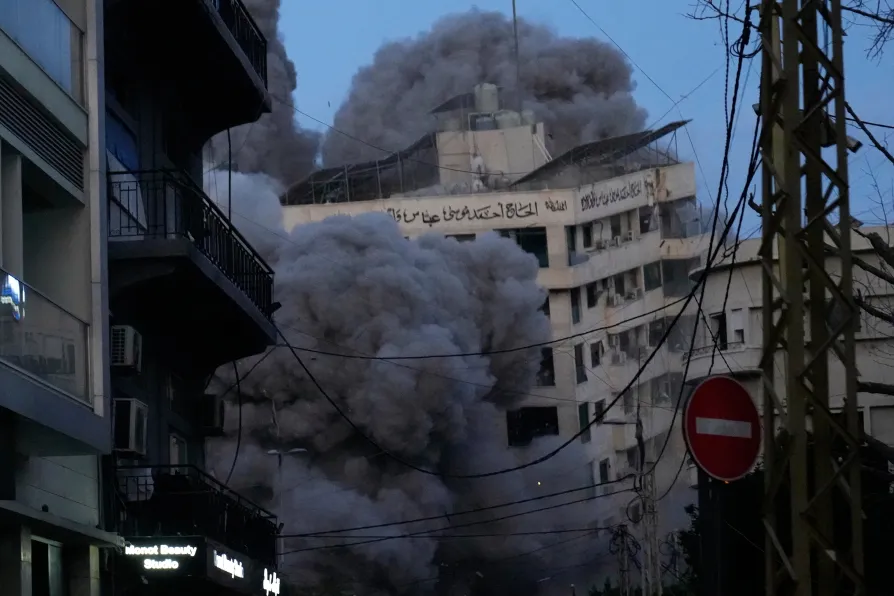
 A building collapses as smoke rises following an Israeli strike in central Beirut, Lebanon, March 18, 2026

The Baltic state is set to reverse its constitutional prohibition on nuclear weapons and foreign bases as part of accelerated Nato war preparations, warns TOM UNTERRAINER
Long-term underfunding and state neglect, while simultaneously probation services have been undermined, have intensified the prison crises, argues SOLOMON HUGHES
Holyrood incompetence has cost jobs and put the future of Clydeside’s Ferguson Marine shipyard into jeopardy. Its future should have been assured, argues KENNY MACASKILL
With the agitated debate now raging in the media about the early release schemes, Prison Officers Association general secretary STEVE GILLAN gives the view of those who work in the sector
The hounding of the late Jason Arday is an all too familiar experience for many black people. ROGER McKENZIE calls for collective action to combat what can feel like personal isolation





THE escalation in Lebanon follows a familiar pattern: military expansion, mass displacement, and an international policy of non-intervention.
According to the Lebanese Ministry of Health, the Israeli army has already killed more than 800 people since the start of the latest invasion and attacks, including over 100 children.
A further 2,000 have been injured. In response to Hezbollah attacks on northern Israel, the government in Tel Aviv has ordered the evacuation of all Lebanese south of the Litani River. Up to 300,000 people live in this area, a population similar to that of Newcastle.
According to the United Nations, a total of one million people in Lebanon have fled Israeli attacks — around one-sixth of the country’s population. The humanitarian disaster is so severe that even the German government, one of Tel Aviv’s largest supporters, together with four other Nato members, has warned against an Israeli ground invasion of Lebanon.
Gaza as a Blueprint
The Lebanese scenario appears to mirror the Gaza blueprint in every detail. What is evident is Israel’s willingness to permanently occupy new territories and, as part of its military operations, either kill or expel the population that has been living there.
In Germany, little attention has been paid so far to the fact that plans for the occupation of parts of Lebanon overlap in part with the ethno-nationalist vision of a “Greater Israel” cleansed of its population, stretching from the Nile to the Euphrates. Such a project appears too delusional to be taken seriously.
What is certain, however, is that at the top of Israel’s political leadership, the focus is no longer limited to the Gaza Strip and the West Bank.
Israeli Prime Minister Benjamin Netanyahu is regarded as an advocate of a Greater Israel and corresponding territorial expansion plans, which extend to parts of Egypt, Lebanon, Syria and even Iraq. Israel has influential supporters for these annexation plans, including the US ambassador to Israel, Mick Huckabee. As an evangelical Christian, he supports the idea of an Israel stretching from the Nile to the Euphrates. One should not overlook the fact that US President Donald Trump appointed this very man as his country’s ambassador to Israel.
Geopolitics and German Interests
Setting aside the religiously infused ethno-national romanticism used to justify conquests — conquests that can only be secured through genocidal acts — the question arises: what interest could the United States have in a Greater Israel? Here, Washington appears to follow a simple calculation: Israel is seen as an imperial outpost. Massive territorial expansion and greater access to resources are intended to ensure the country’s material stability as a military state and to facilitate its integration into US plans for controlling the Middle East.
The United States therefore continues to support Israel unconditionally. The mass killing of civilians does not weigh on it.
The population in the areas of conquest, however, becomes fair game; their displacement is part of the project. In Lebanon, the Israeli advance to the Litani River is therefore only a first step. The stakes in Lebanon go far beyond this.
Why, then, does the Merz government appear concerned? Does it not remain one of Israel’s largest supporters? It may be an awareness that, in the end, all those living in the territory of a Greater Israel could make their way to Europe — and to Germany in particular.
A military victory in Lebanon is not currently in sight. In modern land warfare, tank armies have become extremely vulnerable, and wars cannot be won from the air alone — even with the maximum destruction of all buildings, as seen in the Gaza Strip.
If the German government were seriously interested in a ceasefire, it would impose an arms embargo on Israel and push for the suspension of the EU association agreement with Tel Aviv. However, neither is likely with a government so willing to comply.
Sevim Dagdelen was a member of the Bundestag from 2005-25, for Die Linke and later Bundnis Sahra Wagenknecht.
