
Washington’s inability to subjugate Iran is an example of how it is trying to preserve a regional order that no longer exists, argues RAMZY BAROUD


Xenophobia rears its ugly head on South Africa's streets
Over 30 years since apartheid was abolished, nasty anti-migrant rhetoric sweeps the corporate media. The Commnunist Party is ready to fight back, says ROGER McKENZIE
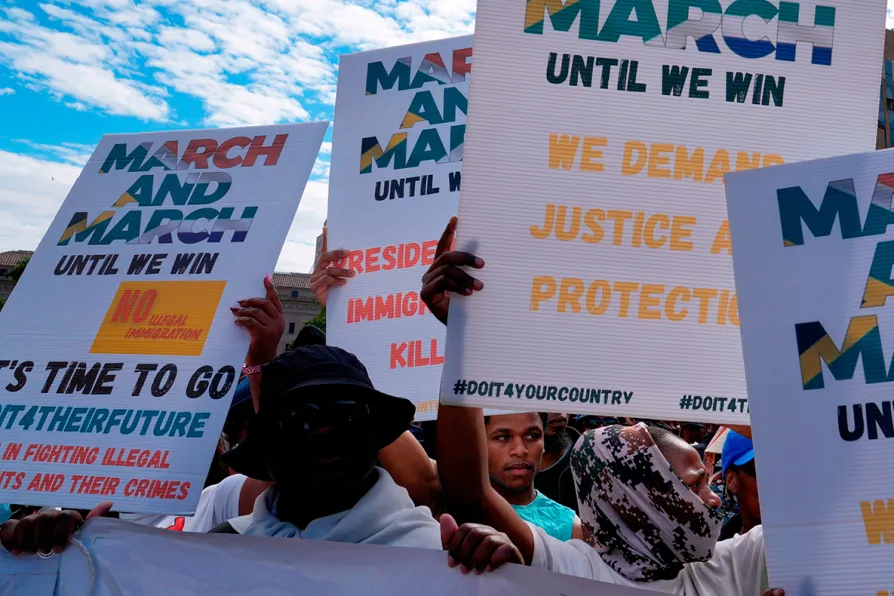
 South Africans protest against illegal migration, in Johannesburg, South Africa, April 29, 2026
US financial instability is exposing the limits of a dollar-dominated global economy — and giving the Global South a historic chance to build an alternative, says MURAD QURESHI
DOUG NICHOLLS says the parasitic finance markets must be challenged or another British government could be toppled
The late country singer’s Imagination Library has put hundreds of millions of books into children’s hands. We should build on that legacy by defending the libraries at the heart of our communities, says BRENDA AITCHISON
Deprivation is a fundamental factor in criminal behaviour that must be addressed but, KENNY MacASKILL argues, there needs to a major rethink in sentencing to tackle overcrowding
MML director MEIRIAN JUMP outlines the recently refreshed library’s busy autumn schedule that ranges from book sales, archival exploration, community work with online education and the ever popular site tours
TONY BURKE surveys the shifting political landscape and the challenges Labour needs to address if it is to prevail in the 2028 federal elections





SOUTH AFRICA has been swept by a wave of xenophobic marches.
This seems particularly strange in a country that suffered the brutal racism of the settler colonial apartheid era. But this is a growing phenomenon that needs addressing.
At the outset I have to say that I know there are some reading the Morning Star who really hate the fact that I sometimes write about race and racism. I know so because they let me know by email or by social media posts.
But maybe they will feel more comfortable that I am talking about xenophobia thousands of miles away. Either way I’m not stopping calling out discrimination wherever it comes from and whoever is doing it.
In South Africa, the so-called “Rainbow Nation,” is experiencing the sort of anti-immigrant sentiments and marches that we have also witnessed in greater numbers in Britain.
South Africa’s equivalent of Tommy Robinson and Nigel Farage — Jacinta Ngobese-Zuma and Zandile Ndlovu — leading marches against foreigners.
I saw the remnants of their latest march in Johannesburg as I headed towards The Forge, a progressive space in the centre of the city.
The contrast was immense. The protest was filled with an irrational hatred that centred on dividing people while at The Forge, we were looking for ways of bringing people together for revolutionary change.
This week, the very shadowy anti-foreigner movement marched through the city spouting vile anti-migrant hate.
Ngobese-Zuma and Ndlovu, like Farage in Britain, have, as far as I can see, received largely unquestioning coverage from the corporate media. This has helped to offer a level of legitimacy to the xenophobic campaigns led by these individuals.
The growing protests across South Africa have reached such a level that they have attracted a sharp warning from UN secretary general Antonio Guterres.
Speaking at South Africa’s Freedom Day on April 27, Guterres said he was “deeply concerned by report of xenophobic attacks and acts of harassment and intimidation against migrants and foreign nationals.”
He went on to “strongly condemn these criminal acts perpetrated by individuals inciting violence and exploiting socioeconomic conditions.
“Violence, vigilantism and all forms of incitement to hatred have no place in an inclusive, democratic society governed by the rule of law and respect for human rights.”
Guterres also recalled how “South Africa’s struggle against apartheid was sustained through international and African solidarity, and that the country’s social and economic development has long been shaped by the coexistence and contributions of people from South Africa, the African continent and beyond.”
He rounded off his comments with a call for the South African government to do much more to clampdown on the criminal acts. Hardly a demand you would have thought necessary in South Africa.
On Freedom Day, President Cyril Ramaphosa said South Africa was not a country of hate, and he cautioned against illegal action against migrants while hedging his bets by acknowledging that many people were unhappy at the pressures of illegal migration.
The hedging by Ramaphosa reveals a disturbing reluctance by the ANC to face up to its own responsibility for the rise of this xenophobic movement in South Africa.
I still find it hard to believe that the organisation that led the movement to free South Africa against the racist apartheid regime must be accused of bearing responsibility for creating the space for this sort of xenophobic trash to take hold.
But at the heart of this xenophobic lurch in South Africa is the breakdown in support for some of the institutions recognised as being at the forefront of the anti apartheid struggle.
The ANC has clearly lost the trust of the people. Many of the discussions I had with people in Johannesburg and in the rural areas of Natal revealed a deep dissatisfaction with the organisation that led the liberation struggle at the head of the triple alliance with South African Congress of Trade Unions (and later the Congress of South African Trade Unions) and the South African Communist Party.
The ANC is mired in corruption scandals and has clearly not done enough to tackle poverty levels of around 39 per cent, unemployment rates of over 33 per cent and the question of land ownership largely not dealt with.
The fact is that the ANC has failed to live up to the promises it made not just to win people the right to vote but to bring about a radical shift in South African society in favour of working class and peasant communities.
The people have grown increasingly dissatisfied and have increasingly either voted for other political parties or not bothered going to the polls at all.
The ANC, from soon after Freedom Day in 1994, was captured by monopoly capital. The only restraint on them, it seems to me, was the trade union movement and the SAC, the other triple alliance partners.
The trade unions, from their position as a vibrant and revolutionary movement during the liberation struggle, have been reduced to membership levels of around 27 per cent of the regulated workforce.
The fact that many workers in South Africa are also trapped in the informal economy, makes trade union activity as we know it in the north a significant challenge.
Most of the workers in the informal economy are operating on survival incomes. They face unpredictable markets, limited access to infrastructure, and constant uncertainty. This makes it difficult for unions to organise.
But rather than adopting imaginative measures to either regulate the conditions these workers face or to organise them for real power, many unions have moved towards the models of “business unionism” that have infected the unions of the northern hemisphere.
There are honourable exceptions, including the National Union of Metal Workers of South Africa, but the industrial militancy has been on the wane in recent years.
But dissatisfaction with the direction of the country saw a rise in strikes last year.
Official statistics for 2025 show a total of 117 strikes took place across the country, which is a sharp rise from the 87 recorded in 2024. But still, this hardly represents a huge total given the major challenges facing South African Workers.
It is these worsening conditions that has forced the SACP to make the historic decision to stand separately from the ANC in local elections scheduled for later this year.
The SACP is also at the heart of organising a conference to bring together the parties of the left in the country in a conference to explore how they can work more closely together to alter the course being taken in South Africa.
The SACP has around 300,000 members and is still by far the dominant force on the left of South African politics. It will be the decisive force in determining whether the conference of the left will be more than just a talking shop and will be able to defeat the rise in xenophobic politics across South Africa.
The sort of xenophobic politics that has emerged in South Africa has done so because the ANC has failed to deliver, causing foreigners and migrant workers to be targeted as convenient scapegoats for the country’s ills. This is something that sadly we are all too familiar with in Britain.
What I do know is that the SACP is well positioned to play a leading role in defeating the rising levels of xenophobia and of shifting the country back towards a course that actually delivers for the people rather than big business.
