Councillor SAM WHEELER says there’s a tangible shift in mood on the left in the city whose mayor has recently become PM — but there’s no room for complacency



What is (or was) ‘Western Marxism’?
Western Marxism is a particular version of Marxist theory developed in – and acceptable to – the capitalist nations of Europe and North America and largely divorced from political action, argues the MARX MEMORIAL LIBRARY
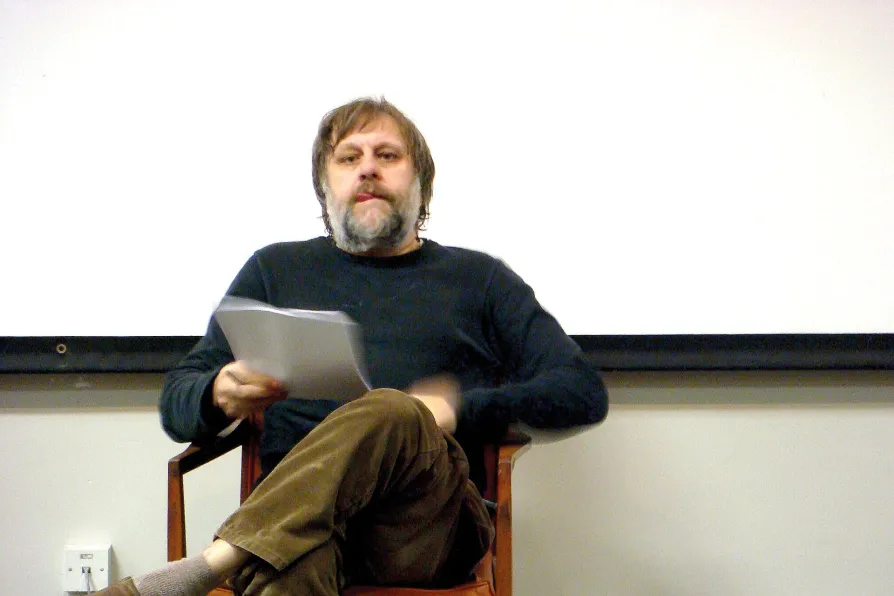
 FADING POPULARITY: Philosopher Slavoj Zizek has adopted pro-Nato positions. Photo: Andy Miah/Creative Commons
Communist Party leaders Alex Gordon and Lorraine Douglas deliver vital medicines in trip to besieged socialist island
TUC Cymru is playing a leading role in tackling far-right ideas in the workplace, says LAURA DOEL
A New Delhi press conference in which Sheikh Hasina and her son implied the new order in Bangladesh is a security threat to India has sparked fears she is planning a comeback. SIAM SAROWER JAMIL reports on the fallout
Two months of student unrest have forced out India’s education minister and rattled the BJP regime. Could this be the beginning of the end for Modi, asks Communist Party of India (Marxist) general secretary MA BABY
MAT COWARD says the heatwave is a testing time for gardeners — but he has some tips





MARX and Engels pioneered our understanding of the dynamics of human society and of the world in which we live. They emphasised the importance not just of interpreting that world but of action to change it — for the good of our planet and its peoples.
Subsequent to the first socialist revolution in what became the USSR and the defeat of workers’ movements in western Europe following the first world war, splits occurred in the development of Marxist theory.
What’s sometimes termed the “Western Marxist” philosophical tradition can be traced to the publication in 1923 of Gyorgy Lukacs’s History and Class Consciousness. Lukacs employed Hegelian dialectics to argue that the proletariat was the “identical subject-object” of history; that the working class was both the product of historical circumstance and its driver.
Antonio Gramsci developed this analysis, including the way that capitalism maintains its power through ideological dominance; its “cultural hegemony” as well as through coercion and force.
Both Lukacs and Gramsci were communists. Lukacs became minister of culture in the short-lived Hungarian Soviet Republic (March to August 1919). Gramsci was a leader of the Italian Communist Party until his imprisonment by Mussolini in 1926.
His Prison Notebooks remain an important contribution to Marxist theory and practice. Because their work dealt with the cultural “superstructure” of capitalism as well as its economic base, it was taken up particularly by academics — many of whom were anything but communists, and some distinctly anti-Marxist.
Shaped primarily by the failure of socialist revolutions in the metropolitan capitalist heartlands, which they saw as a refutation of Leninism, some subsequent “Western” Marxists became concerned less with the relevance of Marxism to economic and political struggle than with its philosophical interpretation.
In analysing the inarguable success of capitalist society, they focused on issues such as ideology, culture, class consciousness, hegemony and subjectivity. Mainly intellectuals and university-based academics, they saw dialectics as pertaining to the interactions between humans and their social environment (the “subject-object” relationship) and not to nature itself.
This led to something of a chasm within Marxist theory. Engels became sidelined as secondary to Marx, to whom he was portrayed primarily as an assistant. His Dialectics of Nature was considered at best an aberration. The subsequent development of dialectics within the Soviet Union, particularly under Stalin and its applications (for example in agriculture, cosmology and geology) was understood as mechanical, dogmatic and (in the Lysenko period) catastrophic.
The term “Western Marxism” was popularised by Perry Anderson, editor of the journal New Left Review, in his book Considerations on Western Marxism, published in September 1976. For Anderson Western Marxism was “a product of defeat”: of the failure of the Russian Revolution to spread throughout Europe and the impact on the Soviet Union’s development by its encirclement by hostile forces — before, during and subsequent to the second world war.
Some “left” intellectuals were unable to come to terms with the contradictory realities of building a state capable of withstanding the military and economic aggression of imperialism and dismissed or ignored the way that the consolidation of power in what became the USSR inspired anti-colonial revolutions elsewhere, not least in China, Vietnam and Cuba as well as Africa and Latin America.
Academics and political dissidents associated with the Frankfurt Institute for Social Research (founded in 1923) including Max Horkheimer (from 1930 its director, who relocated it to the US during the Nazi period), Theodor Adorno, Walter Benjamin, Herbert Marcuse, and Jurgen Habermas, retreated into an analysis of the social and political superstructure of western European society.
They withdrew from action to change the world into the academy; retreating from political and economic issues (especially those of class and imperialism) in favour of philosophic and aesthetic concerns typified according to Gabriel Rockhill, a prominent critic, by “Eurocentric social chauvinism […] the dogmatic rejection of actually existing socialism.”
An example is Hannah Arendt (one of the few women) in her switch from the left to cold war identification of the USSR under Stalin with Hitler’s Germany as equal in “totalitarianism.”
Some Western Marxists did contribute to Marxist theory though primarily within an academic context. Some did engage politically. Marcuse, sometimes termed “the father of the New Left” worked for the CIA’s predecessor, the Office of Strategic Services and the US State Department between 1943-53. Populariser of concepts such as repressive tolerance and desublimation, he also publicly opposed the US bombing of Vietnam and engaged with the student protest movements of the 1960s. Whether this encouraged activism or absorbed it in ineffectual debate is unclear.
Overall, argues Rockhill, Western Marxism is characterised by “a celebration of marketable novelty at the expense of practical relevance, and self-promotional opportunism that perpetuates cultural imperialism and disdain for Marxism in the global South.”
For its exponents, he argues, “the exchange value of Marxist theory,” augmented by “Western Marxism’s novelty and originality, is more important than its use value for human liberation.”
A current example is Slavoj Zizek whose (fading) popularity among students new to Marx and Marxism is sometimes held to be a revival of Western Marxism but which, together with his support for Nato’s proxy war against Russia and his dismissal of Cuba’s difficult task of building socialism is, Rockhill declares, Western Marxism’s “last gasp.”
Importantly there is today growing evidence of the CIA’s recruitment of intellectuals as instruments, whether they knew it or not, of America’s role in the “Western” development of Marxism itself, producing a “version of Marxism that is ultimately compatible with capitalist interests.”
The Frankfurt School was funded through the Rockefeller Foundation’s Marxism-Leninism Project and some of its most prominent representatives moved directly into the employ of the US government; their springboard into academia. US agencies such as the CIA, USAid, the Psychological Strategy Board, and corporate foundations, in particular the “big three” — Ford, Rockefeller and Carnegie — all played their part.
With the resurgence of a new “cold war“ that support continues. London University’s Birkbeck Institute for Humanities, founded in 2004 with Zizek as its international director, and its “Critical Theory Summer School” are funded by billionaire George Soros’ Open Society Foundations.
For Rockhill, “Western Marxism is not just an organic outgrowth of the imperial superstructure, it has been directly fashioned and promoted by the world’s leading imperialist state and its capitalist ruling class.”
However the term “Western Marxism” is a misnomer. The division wasn’t between “Western” and Soviet Marxists, but rather within “western” (little ‘w’) Marxism itself.
Alongside and largely ignored by these “Western” social theorists were Marxist historians and political economists including many famous names associated with the Communist Party Historians Group.
There were also radical physicists, chemists, biologists and polymaths; their work is now embedded in current mainstream science. All combined theoretical work with political commitment.
That remains the case with their successors today, on both sides of the Atlantic. Marxism in the west (little w) is alive and kicking but — vitally important — also in the south and east, giving hope that we may continue to change the world as well as understand it.
Gabriel Rockhill’s recent book, Who Paid the Pipers of Western Marxism? is reviewed in the current issue of the Marx Memorial Library and Workers’ School’s journal Theory and Struggle (free online to Library members) together with an edited transcription of an interview — tinyurl.com/Rockhill-PipersInterview on the MML website.
