TUC president and POA leader STEVE GILLAN speaks to Ben Chacko on the eve of Congress 2026


 Latest editorial
Lopsided Liberation: the hidden traps of hatred and division
ALAN SIMPSON says responses to the Golders Green attacks risk deepening divides across our country
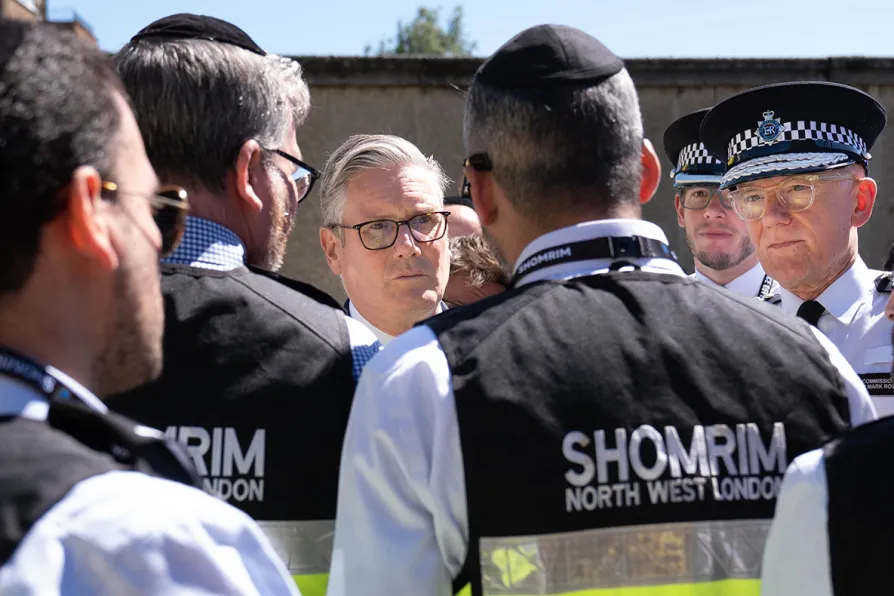 Prime Minister Sir Keir Starmer (centre) and Metropolitan Police Commissioner Sir Mark Rowley (right) meeting first responders from Shomrim North West London during a visit to Golders Green, north west London, April 30, 2026

DOUG NICHOLLS welcomes a turning point at this year’s Congress, where many motions call for a co-ordinated plan to revive British industry, a perspective outlined in his new book
HOPE VIRGO of campaign Dump the Scales warns MPs voting today they should be alert to the threat legalised assisted death poses to people with eating disorders
The Together Alliance is hosting two summits, North and South, to build power and plan action against the scourge of racism peddled by the right. DANIEL KEBEDE urges mass participation
The drift toward militarisation in Europe is not inevitable, left-wing and peace movements can preserve sovereignty and prevent war, says DÁIRE HUGHES MP
Whatever differences exist among international sympathisers of the Bolivarian revolution about its current trajectory, they should unite against the imperialist power that is the source of an enforced retreat, argues ROGER D HARRIS
Trade unions need to step up and force a turn in the policies of the labour movement to effectively confront the far-right threat, argues NICK WRIGHT





PAULO FREIRE spent a lifetime in Latin America’s liberation struggles. He worked with communities brutally divided and oppressed by the rich and powerful. Literacy was his starting point but ignorance was the bigger challenge.
In his book Pedagogy of the Oppressed, Freire argued that part of the problem was that the oppressed grow up with the oppressor as their “model of manhood.” It is a mindset that mistakenly puts “the ability to dominate” centre stage in the liberation struggle. Genuine liberation has to replace, not replicate, oppression.
Without getting drawn too far into Labour’s woes, this is a message worth sharing with Keir Starmer. In less philosophical terms, he could be told more simply — when you’re in a hole, stop digging.
Starmer’s response to recent racial attacks in London risks making matters much worse rather than better. It bears all the hallmarks of the cul-de-sac thinking his purgistas from Labour Together seem to have saddled Labour with. Confronting today’s antisemitism is critically important, but if you address the consequences and not the causes you only make matters worse.
Banning pro-Palestine marches is more likely to increase violence rather than reduce it. Britain should remember its own history in Ireland when peaceful protests were brutally put down. It took generations to reclaim a peace process from the conflict that followed. Banning expressions of solidarity with the Palestinian cause would have the same effect.
Globalising hope
Already the phrase “globalise the intifada” is trailed around as though it is an endorsement of terrorism or anti-semitism; a caricature that is itself racist. Step back and think about it.
Those involved in South Africa’s anti-apartheid struggles will remember how important international solidarity was to their cause. International trade and sporting boycotts formed key parts of a struggle that was always (ultimately) going to have to be resolved in South Africa. But the protests against arbitrary detention, torture and murder of black activists was really important. The international struggle against apartheid was a struggle against oppression; anti-inequality rather than anti-white. So it is with the treatment of Palestinians.
The Silence of the Lost
In contrast today, as Israel drifts remorselessly from apartheid into genocide, the absence of any coherent British challenge to it becomes increasingly polarising. The responsibility for this rests with Netanyahu, not Iran.
Pensioners aren’t turning out in protests because they are bored with what’s on telly. It is because they are appalled at Israel’s brutal bombing of whole Palestinian communities, its use of starvation to kill civilians, by the evidence of IDF snipers assassinating children on the streets, their denial of access to drinking water and the routine bombing of hospitals, schools and health centres.
Journalists brave enough to try to report on such atrocities are also being assassinated. International observers find their bank accounts frozen for daring to suggest that Israel should answer to an international court for its drift into genocide. And international volunteers are hijacked on the high seas by the IDF for the “crime” of taking food to starving Palestinian communities,
In the face of this, Britain’s political establishment remains largely silent. Our leaders can express outrage at the blocking of oil tankers through the Gulf of Hormuz but not a word of challenge about the flotilla of food relief being seized on the high seas by the Israeli regime. This is the Silence of the Lost.
Antisemitism: a rising tide?
Now connect this to the increase in attacks on Jews and synagogues in the UK. I do not condone any of them. But they also connect to increasing attacks (by the right) on migrant and Asian communities across Britain. In some cases it comes down to individuals with serious mental health problems, but in others it is the oppressor as “the model of manhood” that is taking over. The right exploit this more than the left. Fascism always does. But press and political criticism remains largely focused on the left. It always does.
The most recent attack on two Orthodox Jews brought forth a fresh storm of “antisemitism” claims. The Chief Rabbi was first out of the traps, with the Prime Minister (and a collection of other ministers) not far behind. All flagged up a growing fear that Jews are no longer safe in Britain.
My earliest campaigning work with the Anti Nazi League, was all about safety and inclusion. I want Jews to be safe here — in my city, on my estate, as my neighbours. And I want my other neighbours — black, Asian, Muslim or whatever — to feel just as safe. But creating no-go areas about challenging oppression always undermines such bonds.
After the last attacks, it was important that messages of support went out to Jewish communities. What seems bizarre is the marginalisation of others involved in the events. There was little mention of Essa Suleiman‘s third victim — Ishmail Hussein. Hussein had known Essa Suleiman for 20 years but was attacked by him before Suleiman set off for Golders Green. Nor was much made of the person who intervened to stop the knife attack on 86-year-old Moshe Shine. Ashkan Asadian simply said it was important that he “tried to save a life.”
It looks as though both Hussein and Asadian were stabbed for trying to do just that. Neither were Jewish. Neither made a big thing about their involvement. Neither became the focus of compassionate outpourings from the Chief Rabbi, the press or political leaders. Instead, the events were used mainly to stifle criticism of Israel, to redefine Palestinian support as antisemitic, and to restrict the right to protest against fundamental breaches of international law. These are dark shadows to shelter in.
Shining a different light
I am no lover of Iran’s ayatollahs but the chasms in today’s domestic and international politics are not down to them. They reflect a deeper fracturing of the international order and of any notion of inclusive peace-building.
There is little sign that Trump’s war on Iran is anywhere close to ending. His “ceasefire” was never even signed up to by Netanyahu, who continued to bomb and occupy southern Lebanon throughout. “You cease while we fire” seems to be his understanding of the term.
Meanwhile Gaza continues to be cleared, settlers continue to drive Palestinians from their homes on the West Bank and the US helps Israel to steal more Lebanese land than Putin is trying to do in Ukraine. If Keir Starmer wants to rebuild an inclusive, anti-racist, culture in Britain then the causes of today’s divisions have to be addressed, not just the divisive consequences.
At one level, this is already happening. In the US, Aipac funding of politicians of all parties may have bought uncritical support for Israel, but public opinion polls now show that US citizens are dramatically out of sympathy with Netanyahu. The same is true in Britain.
This is the uncomfortable truth behind the persistence of Palestinian protests. What Keir Starmer needs to recognise is that Jews, as much as non-Jews, are at the forefront of such protests. He needs to reach out to Jewish peace activists, inviting them to be at the core of today’s peace-building processes, in much the same way that they were in South Africa’s anti-apartheid struggle.
Things fall apart
Canada’s Premier, Mark Carney, was right to say that the current world order is broken. It is being replaced, not repaired. China will end the reign of the dollar as the world’s reserve currency. Europe may step in to ensure the euro (and not just the yuan) replaces it. Britain may be a part of this conversation, or we may not.
Climate upheavals will push food and energy security up the political agenda at the same rate that tech oligarchs seek to pocket wealth and push jobs out of the window. Both threaten the security of socially inclusive politics. But this is where our only “sustainable” future lies.
The challenge for Keir Starmer (and anyone else who wants to lead a major political party) is how to put social solidarity and mutual security at the centre of the only political choices worth making. Guilt, blame and proscriptions will not do so. It requires a different vision.
In the aftermath of Britain’s local and regional elections this, rather than the attribution of blame, is where a return to real politics must begin. Freire would expect nothing less.
