DAVE WARD of the Communication Workers Union says unions must step up to meet the challenges of a transformed world of work


 Latest editorial
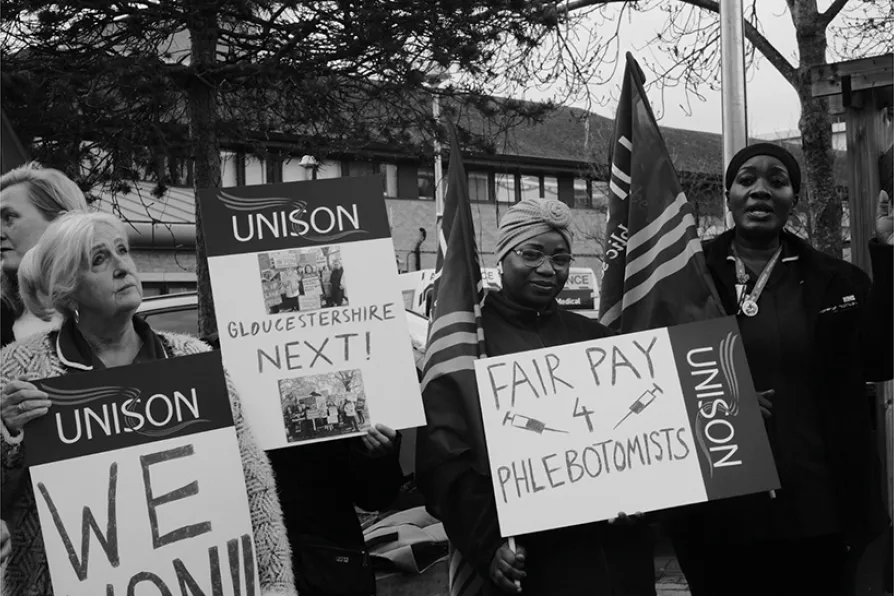
The Gloucestershire Phlebotomists set an example to us all
JORDAN RIVERA and DEANA BROOKS assess the recently concluded 358-day strike, related disputes at other hospital trusts and lessons for future action
 Callum Cant
Live music and musical education are both under attack and threaten to impoverish our culture. The Musicians’ Union seeks allies in the fightback, writes NAOMI POHL
Who should the trade union movement be fighting for: pimps or marginalised women, asks ANNA FISHER
This summer’s fire outbreaks highlighted once again the deadly cost of job, equipment and funding cuts to the fire service. Ten years after the Grenfell tragedy, serious lessons still need to be learned, says STEVE WRIGHT
As Cuba faces the most dangerous moment in its recent history, Britain must do more than condemn the US blockade at the United Nations, writes KEVIN COURTNEY, chair of the Cuba Solidarity Campaign
The events of 9/11 reverberated across the United States and then the world. JOHN WIGHT remembers the eerie atmosphere that exposed racial divisions at the heart of Hollywood





LAST Tuesday saw the end of the longest strike by directly employed staff in NHS history. Had it continued, today would have marked a full year of industrial action.
Instead, the Gloucestershire phlebotomists are back at work. Their 358-day strike for regrading and backpay has been the most bitterly fought of Unison’s flagship Pay Fair for Patient Care regrading campaigns, and the outcome at this point remains unclear still.
The specialist blood workers are not yet returning to the promotions they’ve fought for, nor a commitment on backpay.
Instead, they’ve accepted a review of their roles by an independent job evaluation panel, who will finally rule on their grading, and a six month job guarantee. In the meantime, the Trust will decide whether to keep the dedicated phlebotomy service or abolish it altogether. In spite of everything, after a year of relentless pressure, the phlebotomists have returned to work united and determined, awaiting the panel verdict and preparing to fight again to defend their jobs and the existence of the service. It’s hard to overstate the strength of will they’ve displayed.
And we would know. We’re Unison reps at Homerton Hospital in East London, where just two months ago we won our own phlebotomy regrading and backpay deal.
We made our first attempt back in 2015, which was unfortunately unsuccessful back then, but when the branch launched a regrading campaign for healthcare and maternity support workers in 2024, we revived the demand for phlebotomists too. We knew we’d need evidence of clinical duties, membership density, and a willingness to fight. The phlebs didn’t hesitate. They provided the evidence, 80 per cent density, and a determination to win.
We entered negotiations and the Trust accepted regrading almost immediately — but backpay was harder.
Because pay has gotten so low at the bottom of the NHS pay scale, there isn’t much difference between the lower grades, so regrading itself isn’t actually that expensive.
Backpay can add up to several thousand pounds per person though, so trusts tend to fight harder on that. Homerton tried to hold the line on a “final offer” of one year and two months’ backpay, but we told them we had the evidence, we had the density, and we were prepared to strike. They blinked first, and this January the phlebs voted by 100 per cent on 100 per cent turnout to accept an offer of up to four years and four months of backpay, almost three times the initial “final offer.”
And we were not the first. Last year phlebotomists at Mersey Care Foundation Trust won regrading and five years’ backpay. Phlebotomists in East and North Hertfordshire won regrading and two years’ backpay. Phlebotomists at Swansea and Barts have likewise won their own deals in the past. Things at Gloucestershire shouldn’t have been so hard.
Despite these precedents, Gloucestershire Hospitals Foundation Trust has fought them at every step of the way. Instead of resolving the matter, the Trust’s CEO, Kevin Mcnamara (a man described by an employment tribunal as having behaved in a “brutal,” “bullying” and “calculated” manner in a previous role), has dragged the dispute into the longest strike of directly employed staff in NHS history. Instead of recognising the workers’ specialist skills, they now seem to be deciding whether to eliminate them altogether.
The Trust was able to weaken the strike by reallocating their work to nurses and healthcare assistants, and this should be a lesson to future regrading campaigns.
If they undermine our industrial strength, we need to escalate. In Birmingham, the bin strike has spread to the very agency workers employed to undermine it, who’ve balloted themselves over toxic management practices and unsustainable workloads.
In Gloucestershire too, the strike did actually spread — to the phlebotomists’ supervisors — but not as far as the nurses and healthcare assistants carrying out the bulk of their work.
While it may not always be possible, in any situation where workers are bullied, pressured, or intimidated into assuming additional duties, and where this has an impact on workload pressures, we need to exhaust every possible means to organise these workers as well — and to actively prepare for this in campaign and escalation planning.
Beyond spreading the strike, the union could have applied reputational leverage tactics, applying targeted media pressure on the CEO and board to highlight their rogue behaviour and hard-line approach. Such tactics are well established and effective means of tipping the scales when a strike alone is not enough. We need to be prepared to use them.
Absent escalation from the union, the wider labour movement did what it could. Strike Map raised over £600 for the strike and co-ordinated support with NHS Workers Say No.
Most crucially, Strike Map mobilised supporters for mass rallies, first on the November 17 2025, and a second planned for today — cancelled only due to the return to work. It’s actions like this — going beyond statements and motions to boots on the ground — that represents our best hope.
The Gloucestershire phlebotomists are heroes and an absolute example to us all. Let’s learn the lessons of their dispute and make sure it’s the last that has to last so long.
