A California union’s decision to host a meeting about US policy towards Cuba has prompted a congressional probe and renewed attacks on international solidarity, writes CAMERON HARRISON



US bases in Germany are outposts of neocolonialism
SEVIM DAGDELEN argues that a legal framework exists for a closure of US and Nato military base in Ramstein
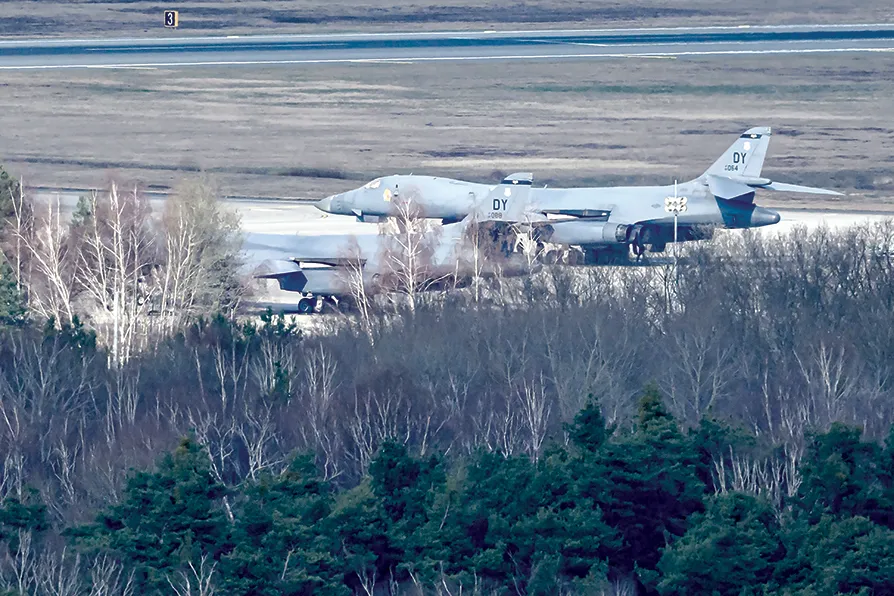
 Rockwell B-1B Lancer bombers, like those that arrived last week at RAF Fairford in Gloucestershire, are being used in the attack on Iran. Here two of those are seen at the Ramstein air base, Germany, last Monday

The Baltic state is set to reverse its constitutional prohibition on nuclear weapons and foreign bases as part of accelerated Nato war preparations, warns TOM UNTERRAINER
Long-term underfunding and state neglect, while simultaneously probation services have been undermined, have intensified the prison crises, argues SOLOMON HUGHES
Holyrood incompetence has cost jobs and put the future of Clydeside’s Ferguson Marine shipyard into jeopardy. Its future should have been assured, argues KENNY MACASKILL
With the agitated debate now raging in the media about the early release schemes, Prison Officers Association general secretary STEVE GILLAN gives the view of those who work in the sector
The hounding of the late Jason Arday is an all too familiar experience for many black people. ROGER McKENZIE calls for collective action to combat what can feel like personal isolation





THE US and Nato base in Ramstein is a central hub of US military policy in Europe. From here, wars are co-ordinated that not only challenge international law but also hold Germany politically and security-wise accountable.
The debate over Ramstein thus raises a fundamental question: What role do US military bases and Nato play in the US global power system — and what consequences does this have for peace and security in Germany?
Ramstein and Germany’s responsibility
The US is using the Nato base in Ramstein, Rhineland-Palatinate, in particular to conduct its illegal war of aggression against Iran alongside Israel. Although the US violation of the German Constitution’s peace mandate seems blatantly obvious, the German federal government sees no wrongdoing on Washington’s part.
Yet Article 26, Paragraph 1 of the Constitution is crystal clear: “Acts tending to and undertaken with intent to disturb the peaceful relations between nations, especially to prepare for a war of aggression, shall be unconstitutional.”
US military bases in Germany, while formally subject to the German Constitution, are de facto enclaves. In its ruling of July 15 2025 on drone operations via Ramstein, the Federal Constitutional Court’s Second Senate explicitly stated in its guiding principles that the Federal Republic of Germany has “a general duty of protection to ensure that the protection of fundamental human rights and the core norms of humanitarian international law is maintained even in cases with foreign connections.”
The court identified a “duty of protection under Article 2, Paragraph 2, Sentence 1 of the Constitution,” which “relates to compliance with applicable international law for the protection of life.”
This duty of protection, according to Karlsruhe [home to the Federal Constitutional Court], “also covers threats emanating from another state,” namely the US.
While the New York Times reports that the US attacked a girls’ school in Iran, killing 170 children, this must be regarded as a grave war crime. Yet Ramstein serves as the backbone for the US in this war crime of aggression, as well as for the illegal killings of innocent civilians under international law.
Just as with Nato as a whole, the narrative persists on US bases in Germany that these bases serve to defend a community of values. For Nato, secretary-general Mark Rutte has already shattered this myth: “Nato is a platform for the US to project its power,” as the honest Mr Rutte put it. This observation must apply in particular to US bases worldwide. Yet Nato plays a very special role in this.
Nato: Infrastructure of American Power
Through Nato, the US gains guaranteed access to a network of air, naval, and land bases across Europe. These serve as “springboards” for US operations in Africa, the Middle East, and Central Asia, as Europe is geographically closer to global crisis areas.
Without this stable legal framework, the US would have to negotiate bilateral agreements, which would be vulnerable to local politics and often require “rent payments.”
In Germany, Berlin covers up to 40 per cent of the stationing costs through indirect payments; for Ramstein alone, costs are estimated at up to €80 million per year. Ramstein’s legal security comes not only from the Nato Supplementary Agreement but also from the 1954 Status of Forces Agreement.
It is crucially important that Nato acts as a “force multiplier,” significantly enhancing US military capabilities without the US having to bear the full costs alone. We recall how the US has managed to saddle Germany in particular with ever more shared costs. The entire aim of the Trump administration is to burden Europeans with additional costs even within Nato.
The military pact also enables joint command and control structures that expand US capabilities worldwide. The US contribution to the Nato budget is only a fraction of the US defence budget (0.074 per cent for 2025), but it yields immense benefits through shared resources.
Ramstein, with the headquarters of the US Air Forces in Europe — Air Forces Africa and the headquarters of the Allied Air Command Ramstein — a Nato command authority for air forces — is a prime example of this expansion of US warfighting capabilities.
Without Nato, the US base system would be more expensive, unstable, and less efficient, as it would rely on bilateral deals. Nato is essential for the base system in Europe and for US global power projection.
It is worth noting here that Nato and the US base system are part of a colonial world system of the US that also responds to crises. For instance, if US bases in the Gulf states become increasingly threatened, efforts are made to transform British bases in Cyprus — already used by the Americans — into de facto Nato bases through the island’s Nato accession.
This would benefit the US by shifting more financing to third parties and clearing the way for massive base expansions. In the case of Cyprus, Nato accession would almost certainly lead to the island’s partition, as Nato partner Turkey — which occupies 37 per cent of Cyprus — would likely demand a high price for consenting to Cyprus’s Nato entry, such as US recognition of the Turkish occupation.
US Bases: Neocolonial War Enclaves
A question I have often asked myself, especially after US Secretary of State Marco Rubio’s Munich speech: Shouldn’t US military bases be seen as part of a colonial — or better yet, neocolonial — world system of the US?
The roughly 800 US military bases in over 80 countries are unique for a single nation.
First, there is the functional similarity to classic colonies. US bases serve power projection, resource control, deterrence, and intervention. They enable the US to maintain global hegemony without direct territorial annexation — just as the British empire did with its outposts (Gibraltar, Singapore, Malta).
US political scientist Professor Chalmers Johnson rightly called the US bases “America’s version of the colony.”
US bases exhibit numerous neocolonial features. Many arise through unequal treaties, pressure, or dependency (in countries with US-friendly regimes). They often cause environmental destruction, displacements, crime, prostitution, and violations of sovereignty — similar to colonial rule.
In Okinawa, Guam, or Diego Garcia, there are strong local resistance movements against this “military occupation.”
The 1954 agreement on the stationing of the US army in Germany is such an unequal treaty, not least because there are no comparable German bases in the US.
In the Aristotelian sense, one must speak here of an inherently involuntary voluntariness that conditioned the conclusion of the treaty from the Federal Republic’s side.
With the Agreement on the Presence of Foreign Forces in the Federal Republic of Germany of October 23 1954, Germany grants eight Nato member states (Belgium, Denmark, France, Canada, Luxembourg, the Netherlands, the UK, and the US) its international legal consent for the permanent presence of their stationed forces.
Through this treaty framework, even before the Federal Republic’s Nato accession, the occupation rights of the Allied troops were continued via a general consent law, while the Nato Status of Forces Agreement outlines the specific details of the presence.
This Status of Forces Agreement was confirmed for all of Germany in 1990 through an exchange of notes with the three Western Allies, though it does not apply in the new federal states.
The Status of Forces Agreement is a relic of the cold war. As a result of this treaty, US bases have the character of extraterritorial enclaves. Access is controlled solely by the US. De facto impunity applies to US actions, as the federal government apparently lacks the will to enforce the basic law and international law in these enclaves.
Contractual possibilities for the presence of German troops for training, say, are not comparable to the Status of Forces Agreement. The treaty is a classic example of how a cold war structure is being used to conduct the US’s global wars.
But the more the US wages illegal wars under international law from its bases in Germany worldwide — and even plans to station US missiles on these bases, missiles that can reach Moscow in minutes, threatening other countries from German soil — the more unstable the security situation becomes for the population here.
Germany will be held practically liable for US war decisions from German soil. It is now about much more than enforcing the principle that no war should emanate from German soil. It is about the security of Germany’s population, which a US government is willing to massively endanger by violating international law from Germany and targeting other states with its missiles.
Close and withdraw: for peace and security
Anyone who truly cares about peace and security for Germany today must therefore push for the closure of US military bases as well as withdrawal from Nato.
In an expert opinion from the Bundestag’s Research Service on the withdrawal question, the final sentence revealingly states openly: “Both the Status of Forces Agreement and the Nato Status of Forces Agreement can be terminated. Under No. 3 of the Agreement of September 25, 1990, on the Treaty on the Presence of Foreign Forces in the Federal Republic of Germany, the Federal Republic of Germany may terminate the Status of Forces Agreement with respect to one or more contracting parties subject to a two-year notice period.
Under Article XIX, Paragraphs 1 and 3 of the Nato Status of Forces Agreement, any contracting party may denounce the agreement with a one-year notice period after receipt of the notification by the government of the US. Although the possibility of termination exists legally, the likelihood of this taking place is not politically feasible.”
Spain has shown that it is possible to deny the US the use of its bases for wars that violate international law.
It is high time that we in Germany strengthen a movement to close these US war enclaves and to withdraw from a military pact that serves solely to secure US hegemony at our expense.
Sevim Dagdelen was a member of the German parliament for die Linke from 2005 to 2025. In October 2023 she joined Bundnis Sahra Wagenknecht party.
