
The US is hell-bent on dismantling the International Criminal Court as part of its assault on global legal systems, but others also have valid reasons to seek its demise. BEN CHACKO provides the analysis


Compassion or criminalisation? The Lords face a defining vote on abortion
As peers prepare to debate reform of the 1861 Offences Against the Person Act, Labour MP Tonia Antoniazzi leads a bid to end the criminalisation of women who end pregnancies at home. LYNNE WALSH reports
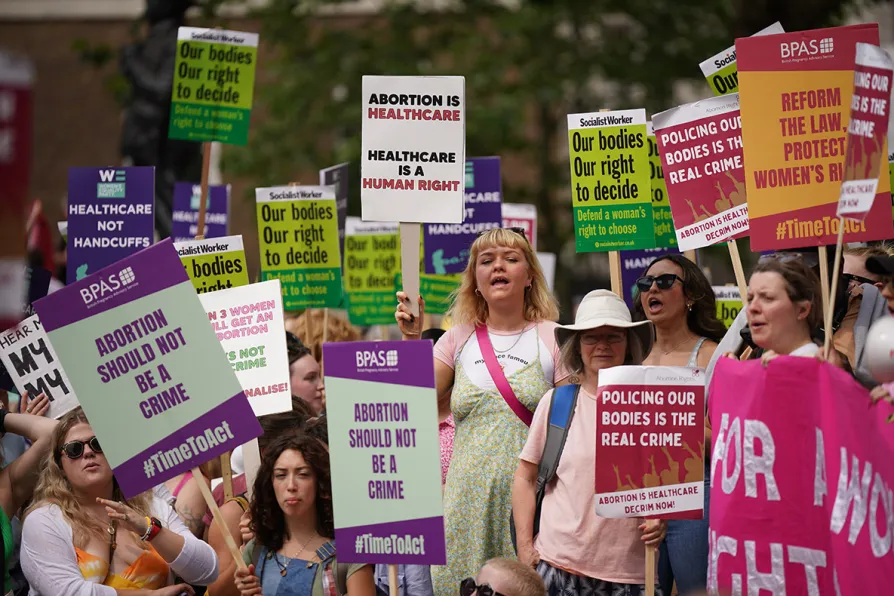
 Women's rights campaigners in Westminster, London after taking part in a march from the Royal Courts of Justice calling for decriminalisation of abortion, June 17, 2023

A small Palestinian village is under attack from illegal settlers and the Israeli state to forcibly extend their illegal settlements. It is a template for the future, writes RAMZY BAROUD
The fawning obituaries have painted a flattering portrait of Rod Liddle. STEPHEN ARNELL offers a rather less reverential view of the man and his legacy
Sovereignty and the rule of law are under threat from Trump’s attacks on Lula’s administration just as they have been across Latin America, argue CARLOS MARTINEZ and SARA VIVACQUA
Glasgow will remember the martyrs of the 1787 strike this weekend in speech and song, their spirit is sorely needed today, writes JIM LISTER





A LONG conversation on abortion recently got me thinking about how often women’s rights are hard won, attacked, undermined and must be fought for repeatedly, or else they slip through our fingers.
I started covering abortion rights in the late ’70s, in the face of David Alton’s private member’s Bill, aimed at cutting legal termination time to 18 weeks. He tried again in 1987, and is now in the Lords, railing against a Labour MP’s struggle to secure women’s freedoms.
The conversation started as a woman spotted the suffragette ribbons pinned to my bag. Rebecca had recently watched the film Suffragette, which brought a bit of an epiphany: “It dawned on me that we’d had all these laws, made by men, but they affected our lives, you know, our work, the right to own property, even rights over our own children — and women hadn’t played any part in making those laws!”
My quasi-maternal sense of “Welcome to the sisterhood” led to a two-hour discussion. I may have been two decades older, but Rebecca had years of experience on me, with several pregnancies and tough decisions about them.
We’re now both following the current debate, with campaigners hoping that peers support their struggle later this month, when a proposed law change goes to the House of Lords.
As the law stands, women who decide to end their pregnancies by using medication at home risk prosecution under the 1861 Offences Against the Person Act. Not only does that carry a maximum punishment of life in prison, but it’s a law enacted some 67 years before most women got the vote.
The amendment, put forward by Tonia Antoniazzi, MP for Gower, aims to halt a worrying trend in criminalisation of women who purchase pills online, referred to as telemedicine, to end a pregnancy. The change to the Crime and Policing Bill would not affect existing laws on abortion, so the limit of up to 24 weeks would remain, aside from some exceptional circumstances, and those procedures would still need the approval and signatures of two doctors.
In the past two years, six women have appeared in court charged with ending their own pregnancies. Before that, the UK had seen only three reported convictions for illegal abortion since the current law was introduced, in 1861.
According to the British Pregnancy Advisory Service (BPAS), abortion providers, in recent years, have received around 100 requests for medical records from the police in relation to suspected abortion offences.
Antoniazzi, who will see her proposal debated in the Lords around March 18, says: “This cruel Victorian-era law has seen women targeted, punished, imprisoned, dragged from hospital beds to police cells, publicly shamed — mothers torn from their existing children and new babies — at the worst moments of their lives.
“The House of Commons has been clear that this has no place in modern society. This change would bring us into line with over 50 jurisdictions worldwide, including Northern Ireland, which recognise that vulnerable women need support and compassion, not fear of criminal punishment.”
At the very heart of the debate are individual women, and their harrowing stories.
BPAS cites the story of Laura “who was at university and the mother of a toddler when she pled guilty to ending her own pregnancy using illicit medication. The prosecution told her that if she didn’t plead guilty, she would likely be jailed for life — she ended up being sentenced to more than two years in prison.
“She reports that at the time she was in a physically, sexually, and emotionally abusive relationship, and that her partner told her not to go to the doctor. When she was arrested, he told her that he would kill her if she told anyone he was involved. Her partner was never investigated by the police.”
Given the febrile nature of any debate on abortion, MPs are generally given a free vote on policy decisions. This is designed to enable them to vote with their conscience, rather than a party whip.
The Commons voted 379 to 137 in support of the amendment in June last year. The next hurdle comes in a couple of weeks when the proposal will be debated by the Lords.
The plan is supported by BPAS, Southall Black Sisters, Refuge, Rape Crisis, the GMB, Unison, NEU, TUC, the BMA and the Royal College of Obstetricians and Gynaecologists (RCOG).
Professor Ranee Thakar, RCOG president, said of Antoniazzi’s efforts, and most MPs’ support: “This sends a powerful signal that women’s rights and autonomy matter. The college has been campaigning to see this achieved for many years, and the decision reflects the voices of over 50 medical, legal and public health organisations. It also reflects the views of the public, who overwhelmingly support the right of women to access abortion care safely, confidentially, and without fear of investigation and prosecution.”
BPAS chief executive Heidi Stewart said, of MPs’ vote: “This is a landmark moment for women’s rights in this country and the most significant change to our abortion law since the 1967 Abortion Act was passed.
“There will be no more women investigated after enduring a miscarriage, no more women dragged from their hospital beds to the back of a police van, no more women separated from their children because of our archaic abortion law.
“This is a hard-won victory, and when we launched the campaign to decriminalise abortion in 2016, we could not have envisaged that within a decade such progress would be achieved.”
One organisation determined to scupper that progress is the Society for Protection of Unborn Children (SPUC). The group, which refers to this move as an expansion to “our already horrific abortion laws,” claiming it is “barbaric,” is circulating a leaflet featuring an image of a “baby girl born at sixth month of pregnancy.”
Such images will be familiar to many women who have had to run the gauntlet of protesters, as they attend appointments at clinics. The government introduced safe access zones around some healthcare services in October 24, though these form guidance rather than laws. Police may act if they feel there is contravention of public order.
Some anti-abortion demonstrators have filmed staff and patients, displayed graphic and distressing images, sung or prayed, and hand out rosary beads or so-called miraculous medals.
The SPUC leaflet uses a specific advertising technique of shifting perspective, to tug at heartstrings. Text below the baby image says Antoniazzi’s work “removes all legal protection from babies like me.”
I asked the MP what she thought of their tactics. She told the Morning Star: “This is misinformation designed to scaremonger at a time when emboldened pro-life organisations are attempting to undermine women’s access to healthcare.”
Campaigners and supporters have stressed that telemedicine for early medical abortion is safe, and means that women get access to treatment sooner.
A RCOG statement said: “This service has removed barriers to care and allowed women to access an essential form of sexual and reproductive healthcare safely and with dignity — particularly those in rural or isolated areas, women with disabilities, and those at risk of coercion.”
SPUC, on the other hand, has chosen to refer to this as “abortion up to birth.” I gave them the opportunity to defend their claims but had no response.
It seems self-evident, this moral choice of compassion over criminalisation. Yet I notice, once again, that there is plenty of misogyny in the dissenting voices. There is a subtext suggesting that women cannot be trusted to make rational decisions, or might endanger life by being unable to use medication properly.
Ex-Tory MP Alexander Stafford, writing in The Critic, said of the Conservatives and Reform: “Both parties should commit in their next manifestos to scrapping these extreme abortion laws. This is not only a moral imperative, but would also be a vote winner!”
We’ll see. I expect to be covering this issue when I’m in my eighties. Meanwhile, self-titled “born-again feminist” Rebecca texts me; she’s reading data on equal pay, and is outraged. Welcome to the sisterhood.

Similar stories
Gisele Pelicot said ‘shame must change sides.’ We may think we agree, but, argues LOUISE RAW, society still has some way to go
Legal frameworks designed to safeguard women are too often weaponised against them, reinforcing male power and entrenching injustice. The FiLiA Ending MVAWG Team highlight some of the issues

Sexual harassment on Britain’s railways is rising sharply, according to the British Transport Police, yet too many women still feel reporting is futile. LYNNE WALSH asks why the burden of safety all too often remains on women themselves