A California union’s decision to host a meeting about US policy towards Cuba has prompted a congressional probe and renewed attacks on international solidarity, writes CAMERON HARRISON



A one-minute hug, a lifetime’s fear
Sexual harassment on Britain’s railways is rising sharply, according to the British Transport Police, yet too many women still feel reporting is futile. LYNNE WALSH asks why the burden of safety all too often remains on women themselves
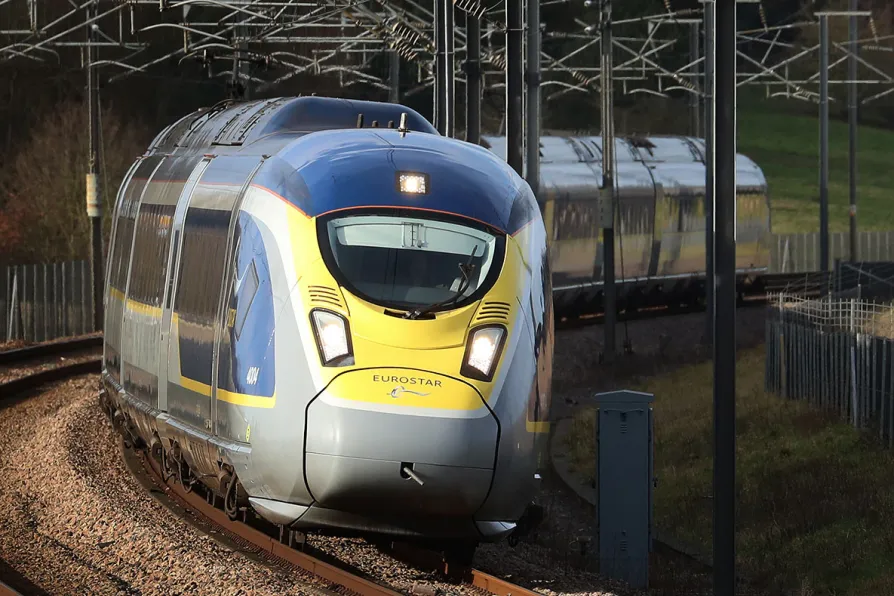
 A Eurostar e320 high-speed train heading towards France through Ashford in Kent
The Baltic state is set to reverse its constitutional prohibition on nuclear weapons and foreign bases as part of accelerated Nato war preparations, warns TOM UNTERRAINER
Long-term underfunding and state neglect, while simultaneously probation services have been undermined, have intensified the prison crises, argues SOLOMON HUGHES
Holyrood incompetence has cost jobs and put the future of Clydeside’s Ferguson Marine shipyard into jeopardy. Its future should have been assured, argues KENNY MACASKILL
With the agitated debate now raging in the media about the early release schemes, Prison Officers Association general secretary STEVE GILLAN gives the view of those who work in the sector
The hounding of the late Jason Arday is an all too familiar experience for many black people. ROGER McKENZIE calls for collective action to combat what can feel like personal isolation





IMAGINE you’re on a train, on your way to a meeting, minding your own business, and a strange man starts whispering in your ear.
He’s suddenly up close, wanting a hug — “a full, one minute hug” — he says. He’s right in your personal space, his demand increasing.
Do you freeze? Do you move away, shout at him, smack his hand away? Do you efficiently text the British Transport Police (BTP), or risk taking the aggressor’s photo? Do you ask for other passengers’ help?
This happened to a young woman recently, and the grim groper followed her off the train, grabbed her, for his “hug,” grinding against her. The detail that chilled me was that he counted down his asserted minute, from 60.
Sexual harassment on public transport has increased alarmingly. This is aside from the rapes and sexual assaults recorded, and includes men leering at women and girls, sometimes whilst masturbating, making sexual demands, groping, upskirting, catcalling and following or stalking.
The BTP’s data in 2024 showed a 50 per cent increase since 2021, with the number of sexual harassment reports doubling to 1,908, while the number of sexual offences suffered a 10 per cent increase.
More figures from the report show that overall crimes against women and girls in England and Wales rose to 11,357 in 2023, having previously been reported as 7,561.
If anyone needs a reminder that data such as this is always about individual women and girls traumatised, possibly for life, then I’d turn to my little vox pop this week with some 18-year-olds at my train station.
“You have to sit still, and put up with anything that happens,” said one, Pat, who’d looked formidable, I thought, with her scarlet boots and assertive body language.
“They can go from creepy to violent out of nowhere, and they’ve probably got knives, or something to spike you.”
This unshockable, ageing hack was shocked; was this paranoia, or experience?
But her friend Paula disagreed: “You have to call it out. What else will they do, if we let them get away with this shit?”
That’s more like it, I thought. But there was even more to come.
“Carry pepper spray or poke them in the eyes. Kick them in the balls. Get all the other women on the train to pile in,” advised Paula.
I ventured that there might be other, less violent tactics. Would they report incidents to the BTP, or a guard?
Pat was resigned, “Police — like Wayne Couzens? [the police officer who kidnapped, raped and murdered Sarah Everard in 2021], or some other dude who’s going to think it’s funny that some incel was wanking on your train?”
That latter incident had happened to her, she told me.
In the ensuing discussion, they resolved that CCTV was useful, and that incidents should be reported. We also touched on the plethora of campaigns, from the BTP, TfL (Transport for London), and local authorities.
The BTP launched “Speak Up, Interrupt” in 2022, and say this “aims to empower bystanders and witnesses of all forms of inappropriate sexual behaviour on the network to report incidents or safely intervene where they can.”
Similarly, local councils run “active bystander” online training, urging fellow passengers to intervene, while TfL has its “Act like a friend” public service announcements.
Siwan Hayward, TfL’s director of security policing enforcement, said: “Our new campaign shows how powerful it can be to strike up a conversation with the targeted person and treat them like a friend, to help them feel less alone and make the first steps towards reporting the incident.”
The campaign video does suggest it’s fairly simple to step in. The truth, I suppose, is that this may be successful, especially as it draws on human instincts towards altruism or solidarity. But the risk of being a good “active bystander” who then becomes a victim is ever present.
The fact is that, according to the BTP, only 20 per cent of passengers who witnessed incidents of sexual harassment reported it to the police.
The part played by CCTV is key to this problem — and that’s a controversial topic itself. Two big issues loom: ethics and efficacy. On the first, some civil liberties campaigners say that the use of facial recognition software is oppressive. On the second, it seems that cameras may not always be working, or recordings not kept, as victims have found. Big Brother may not always be watching; he might just as well be on a fag break.
In an excellent episode of the BBC’s File on 4 Investigates very recently, journalists Claire Jones and Nicola Dowling approached the CCTV problem with forensic skill.
They included the testimony of Beth Wright, who was sexually harassed by three men on a Tube train in central London.
“They started offering me sweets and then very quickly it progressed into, ‘would you like to have sex with my friend’,” says the 27-year-old. “One of them came over to me and tried to sit next to me and touch my leg. It was really intimidating.”
A significant problem for the BTP is that, although its jurisdiction spans more than 10,000 miles of railway track and 3,000 stations, platforms and transport hubs, it does not own or control any of the CCTV cameras in operation in these locations.
This recent broadcast followed Jones’s report last year, when results of her freedom of information request to the British Transport Police found a 37 per cent increase in reports of sexual offences across England, Scotland and Wales since 2015.
There were 2,661 incidents reported across England, Scotland and Wales in 2024, where one in 10 were children — with some younger than 13.
Victims reported getting calls from police, unable to proceed with their cases because the footage was so poor or had been wiped. Some have said that the use of facial recognition technology would make a dramatic difference, but there is dissent.
Commenting on the BTP deploying this at London stations, Big Brother Watch advocacy manager Matthew Feeney said: “We all want train passengers to travel safely, but subjecting law-abiding passengers to mass biometric surveillance is a disproportionate and disturbing response. Facial recognition technology remains unregulated in the UK, and police forces, including British Transport Police, are writing their own facial recognition rules, including those governing how they use the technology and who they place on watchlists.
“The use of this technology is especially offensive in a democracy where neither the public nor Parliament has ever voted on its use. Sadly, the UK stands out among democracies when it comes to the widespread use of live facial recognition. The government must take immediate steps to rein in police use of this technology.”
Fair enough. That said, the grim scenarios remain, and the question about what we should all do. So, what are we dealing with?
In England and Wales, the legal definition of sexual harassment is when someone carries out unwanted sexual behaviour towards another person that makes them feel upset, scared, offended or humiliated.
It’s also when someone carries out this behaviour with the intention of making someone else feel that way. This means that it can still be sexual harassment even if the other person didn’t feel upset, scared, offended or humiliated.
BTP Public Protection and Vulnerability Detective Superintendent Sam Painter said: “Making the rail network a hostile place for sexual harassment and sexual offences is a key priority for us, and we encourage bystanders to step in when comfortable to make the individual being targeted feel supported and hopefully deter the offender, and to report to us as soon as possible. This intervention could be as small as a smile to the victim, asking the time or, if safe to do so, moving physically to interrupt the moment.”
Well, a smile isn’t asking much. We can all do that. Meanwhile, perhaps the government would get on with upgrading cameras on trains and platforms, as well as prosecuting perpetrators, paying for more police resources, and supporting victims. We can all be your altruistic active bystanders, but you are the elected politicians. It’s your job, not ours.

Similar stories
Gisele Pelicot said ‘shame must change sides.’ We may think we agree, but, argues LOUISE RAW, society still has some way to go

ANNA FISHER explores what would it mean for women’s equality and public safety if Britain embraces full commercialisation of the sex trade
EDDIE DEMPSEY explains why the RMT is calling for urgent action against assaults on staff and passengers on our public transport system