
The UK Prime Minister may have the regal touch in northern England, but he’s been wrong-footed on the constitutional challenges posed by the Celtic Alliance of first ministers from Scotland, Wales and Northern Ireland, argues KENNY MacASKILL

Wapping was never about technology: it was a state-backed assault on trade unionism
Forty years on, TONY DUBBINS revisits the Wapping dispute to argue that Murdoch’s real aim was union-busting – enabled by Thatcherite laws, police violence, compliant unions and a complicit media
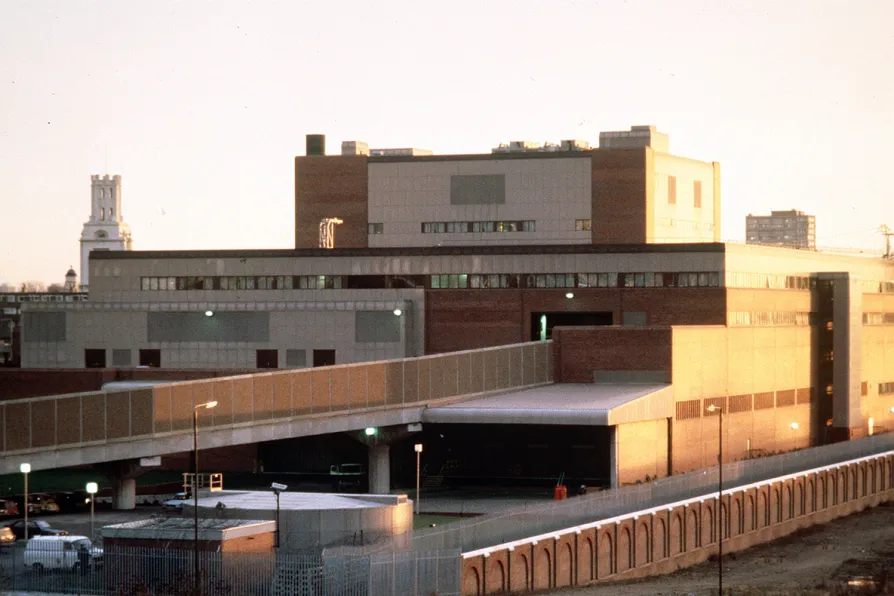
 News International Print plant at Wapping, East London, January 23, 1986
NEIRLAY ANDRADE, a member of the Communist Party of Venezuela’s political committee, outlines her party’s position on the crisis facing the country
A look at Taylor Wimpey’s accounts shows why Labour’s market-led housing strategy won’t deliver more, cheaper homes, as promised, says SOLOMON HUGHES
DAVID HORSLEY remembers the remarkable life and death of US black revolutionary George Jackson, whose politically passionate prison letters were published as Soledad Brother
Cuban trade union federation CTC leader OSNAY MIGUEL COLINA speaks to Ben Chacko about life and work under a crippling US siege
A part of the British empire’s network of slavery, today the Caribbean island of Nevis faces a new form of exploitation in the form of crypto-colonialism, CLAUDIA WEBBE writes
Challenges from the unscrupulous misuse of AI to steal actors’ voice and physical likenesses is being met with a firm union response, writes LYNDA ROOKE





AFTER 40 years I hope that I can still add a few comments regarding the Wapping dispute which perhaps puts it into a broader context.
The Tory media described the dispute as primarily regarding the introduction of new technologies.
Remember what they told us: Murdoch, that arrogant puppet Andrew Neil and vile stooge Eddy Shah, who would not even pay his employees our minimum wage, that new technology would mean more newpapers. Well, we have seen the result: the provincial and national newspaper industry decimated.
Technology was a minor part of the problem. Indeed the technology that Murdoch was talking about had already been used for some time in the provincial newspaper industry.
In reality the dispute was about trade unions’ derecognition, ie union-busting.
My view has long been that, although we did not win the Wapping dispute, the forces that were arranged against us made that impossible for any union to do.
Rupert Murdoch
Rupert Murdoch already owned The Times, Sunday Times, the Sun, the News of the World and Bemrose, the printers of the Sunday supplements. In addition most of the national newspaper industry in Australia and investments in the United States. So, massive resources were available to him.
Murdoch told us that the new Wapping plant was being set up to produce a new London evening newspaper. This was ludicrous as the plant and equipment were much too big for the production of an evening newspaper, and it was clear the new plant was to produce all his UK titles.
Murdoch advised us of the conditions that would apply at Wapping.
1) There would be no negotiations with the unions;
2) There would be no unions recognised, just a “works council”;
3) No industrial action of any kind;
4) Legally binding agreements — against union and TUC policy.
A series of conditions that no union could possibly accept and in addition a massive reduction of the workforce from more than 5,000 employees to a few hundred, who would be hand-picked by management; plus a substantial reduction in terms and conditions.
Ballots were inevitable and overwhelmingly rejected these proposals.The following strike action resulted in the dismissal of the entire workforce.
Thatcher
The Tory Party had recently introduced a number of new employment laws which restricted the ability of unions to prosecute a successful industrial dispute.
These affected the distribution of newspapers, picketing restricted to six pickets on the gates, and also the abolition of secondary action.
There was a very close relationship between Margaret Thatcher and Rupert Murdoch which was emphasised by TV coverage of them dancing together at a Tory fundraising event.
In addition the Metropolitan Police at the highest level were very close to Murdoch and this was against the background of corruption cases that had been revealed involving their officers. We don’t know how much overtime was earned by the police officers, and how much Murdoch may have contributed to their benevolent funds.
Laws
The new laws prevented more than six pickets at the plant gates. But even this was prevented by the police and they forced us away from the plant onto the highway and other roads to demonstrate.
The police introduced horses at the picket lines to drive the pickets even further away from their legal entitlements.
On many occasions horses and the police were used to bust up demonstrations and were seen by everyone involved in the dispute as being clearly in the pocket of Murdoch.
Even meetings involving union leaders, MPs and other prominent supporters who were addressing the pickets were subject to mass attacks from the police with their batons and snatch squads, who were pulling pickets from the demonstrations and arresting them.
There were many unwarranted arrests by the police which were clearly designed to break up the picketing and demonstrations and to escort the lorries, which carried Murdoch’s newspapers for distributions around the country. Even the local residents of Wapping consistently supported the pickets and complained about the outrageous activities of the police which often involved the neighbourhood.
The pickets, when faced with horses, resorted to sitting down in the road as they knew that horses would not come forward when people were sitting down. The police turned their horses and reversed into the picket to break up the picket lines and make way for Murdoch’s lorries.
I can vouch for this as I was arrested for sitting down in the road, along with some colleagues. Before the court hearing the police had the audacity to ask me to plead guilty and in return they would drop charges against members of my family. You can imagine what the press would have made of the general secretary pleading guilty.
There were many arrests of pickets, much violence from the police, some vicious injuries and sadly one death.
The Electrical, Electronic, Telecommunications and Plumbing Union
To set up Murdoch’s plant while the print unions were being excluded, Eric Hammond, general secretary of the EETPU, was using the Southampton branch of the union to recruit members as employees for Murdoch at the Wapping plant.
This of course completely undermined the print unions. This was outright scabbing by another TUC union. As a result Murdoch was able to produce his papers at Wapping.
Although the print unions reported Hammond to the TUC for breaching rules and trade union principles, the TUC was relatively toothless and in reality could not do anything to stop the EETPU from assisting Murdoch.
The NUJ
Murdoch clearly needed the majority of journalists to move with the four daily and Sunday papers to his plant at Wapping. He offered a wage increase of £2,000 pa to go to Wapping and told them if they did not accept the offer, they would be sacked.
The general secretary of the NUJ tried unsuccessfully at a number of meetings to persuade his members not to accept Murdoch’s offer and to support the print workers.
In conclusion around 20 of the 300 or so journalists did not accept Murdoch’s offer and refused to go to Wapping while the rest of them accepted the offer and went to Wapping, producing Murdoch’s newspapers and obviously undermining the printworkers’ dispute.
Solidarity is not a word that most journalists want to recognise. Wapping and other disputes are sad examples which confirm this.
Conclusion
We did not win the dispute — why?
If we had been fighting Murdoch alone I have no doubt that we would have been successful as we had been on a number of previous occasions.
But the reality was at Wapping we had aligned against us the full range of opposition, including the state, which no union on its own could have defeated.
I have shown what that consisted of:
1) The opposition of the vast majority of the press and media;
2) The introduction and use of Tory laws regarding secondary action etc and had led to Society of Graphical and Allied Trades’ (Sogat) sequestration;
3) the outrageous approach of the police, their attitude and violent treatment of peaceful protesters and demonstrators;
4) the disgusting conduct of the EETPU which was not only scabbing but assisting Murdoch in supplying people to take over the jobs of the print workers;
5) The scabbing by the vast majority of journalists, despite the NUJ instructions not to go to Wapping;
6) The unwillingness and inability of the TUC to stop the EETPU activities and to give the dispute any real support, together with “so-called friends” in the Labour Party who were supposed to be supporting working people, but were effectively nothing more than onlookers.
The termination
As you all know, the Sogat executive decided to end the dispute on the basis of a final offer of pay-off terms from Rupert Murdoch. This was followed shortly after when the National Graphical Association (NGA) came to the conclusion that it was impossible to fight the dispute on its own without Sogat, who had the majority membership in the Wapping dispute.
The pay-off terms were not very attractive, but after more than a year of fighting the dispute it is perfectly understandable why the union members decided to accept them in the time allotted, after which they would be withdrawn.
On a personal note I was not aware until well after the end of the dispute that Brenda Dean, with some of her colleagues had met Murdoch at his villa in California, over a BBQ where the final terms had been agreed. This was done without any knowledge or consultation with the NGA.
It’s questionable whether the terms could have been improved, but I firmly believe that it should have been tried.
Personal comments
Looking back over 40 years I would again like to thank all of our members and their families, who took part in the dispute and our supporters. You all deserve our greatest respect for the wonderful stand that you took in the most difficult of conditions to challenge the oppressive and arrogant attempt by the Murdoch empire supported by Margaret Thatcher and the police, as well as the EETPU to derecognise legitimate trade unions at the Wapping printing plant.
We did not lose the dispute through our actions, but with so much stacked against us we could not win it either.
As Tony Benn reminded us, there is no final victory and no final defeat.
The printers at Wapping did not win the dispute, but they did not lose their dignity, their unity or the truth of their cause.
Tony Dubbins was general secretary of the National Graphical Association at the time of the Wapping dispute.

Similar stories
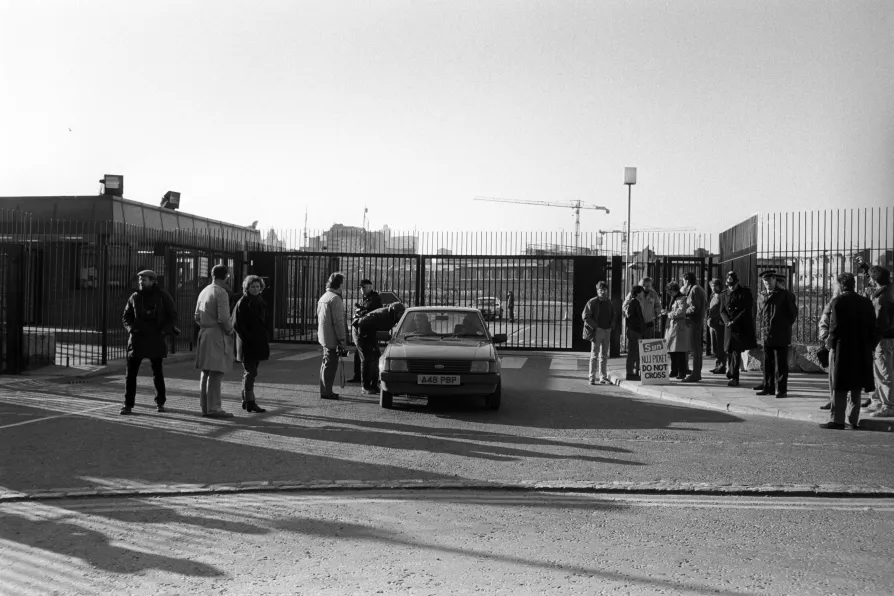
JOHN LANG recalls how Murdoch used scabbing electricians and even devised a fake newspaper to force a confrontation with printers – then sacked them all
![[Pic: Andrew Wiard]](https://msd11.gn.apc.org/sites/default/files/styles/desktop/public/2026-01/19860503_a_wiard_0003.jpg.webp?itok=mR5zV0nE)
The once beating heart of British journalism was undone by technological change, union battles and Murdoch’s 1986 Wapping coup – leaving London the only major capital without a press club, says TIM GOPSILL
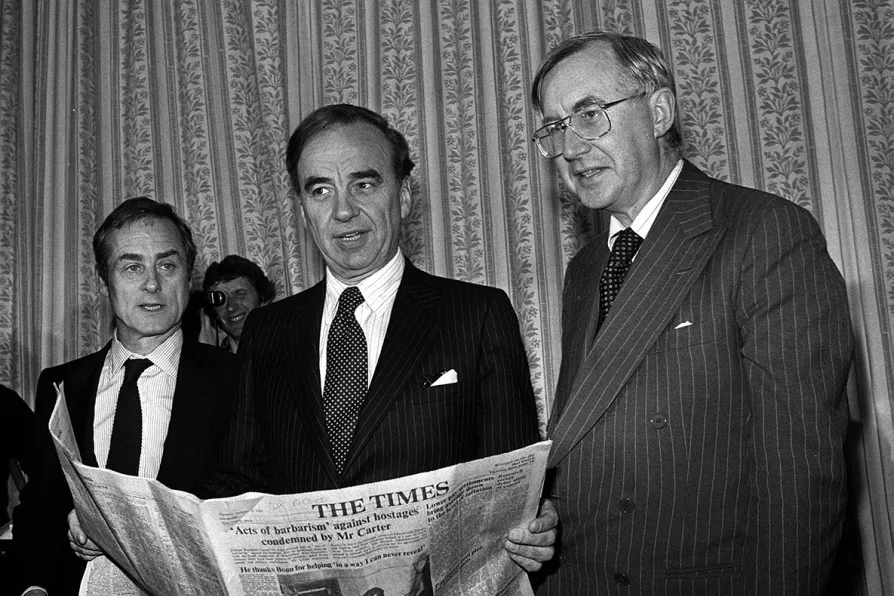
Four decades on, the Wapping dispute stands as both a heroic act of resistance and a decisive moment in the long campaign to break trade union power. Lord JOHN HENDY KC looks back on the events of 1986
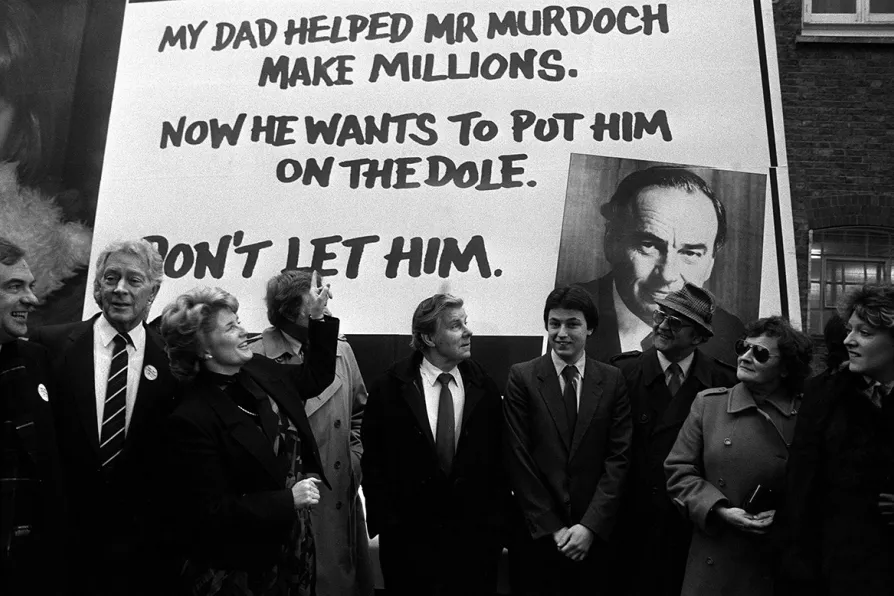
Enduring myths blame print unions for their own destruction – but TONY BURKE argues that the Wapping dispute was a calculated assault by Murdoch on organised labour, which reshaped Britain’s media landscape and casts a long shadow over trade union rights today