
While riding the No 3 bus in Glasgow MATT KERR has ample time to dissect the moribund Scottish Labour decline into near oblivion and watch intriguing bus passenger dynamics


Women workers won’t settle for less
As women dominate public services yet face pay gaps, unsafe workloads and rising misogyny, this International Women’s Day and TUC Women’s Conference must be a rallying point, says ANDREA EGAN
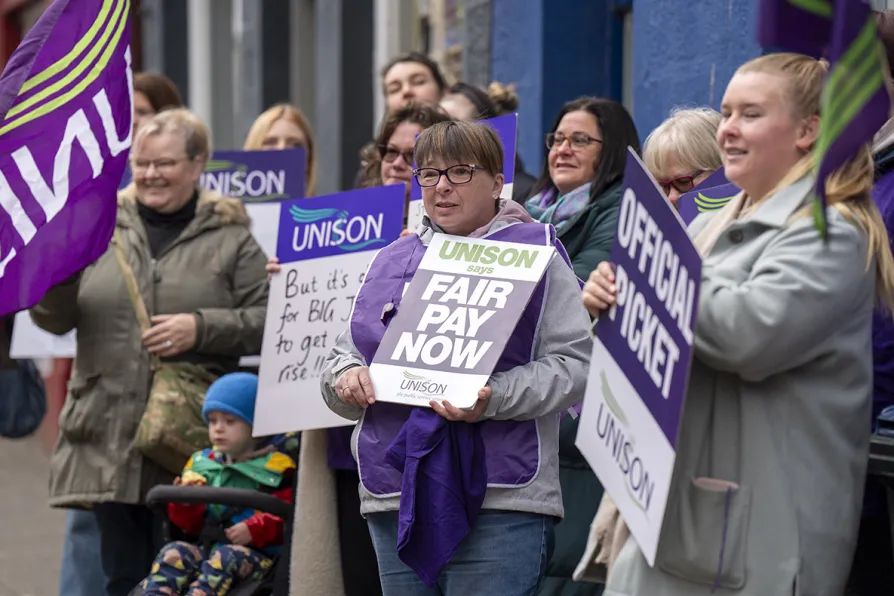
 Striking school support workers take part in a demonstration outside First Minister John Swinney's constituency office in Blairgowrie, October 24, 2024

The best wildfire service may begin with the community, argues KOMAL RAJ ARYAL
Dignity is important to all humans, argues the Marx Memorial Library and Workers’ School, but it does not come about automatically. In a less than perfect world, dignity can accompany suffering, but the collective dignity of working people is achieved through acting together to change the world.
The US aim to reshape the existing order in the Middle East needs to be resolutely resisted, argues PAYAM SOLHTALAB
Concessions to Washington by the post-Maduro leadership in Caracas are designed to preserve the core of the Bolivarian Revolution not betray it, argue Roger D Harris, Francisco Dominguez and Mara Paez Victor. How the solidarity movement responds is critical
ALMA EGAN suggests four days out that bring the region’s history of protest to life





INTERNATIONAL Women’s Day and the TUC Women’s Conference are opportunities for women in the labour movement to come together and discuss the challenges ahead for working-class women.
Women make up the majority of the public service workforce, yet we bear the brunt of unsafe staffing levels, low pay, discrimination and impossible workloads.
The average pay disparity between men and women is a massive 12.8 per cent. In education and for the health and social care sector, where women outnumber men, the gender pay gap is 17 per cent and 12.8 per cent.
Meanwhile young people are seeing a wave of misogyny across society. One study has shown nearly three quarters (73 per cent) of young social media users have witnessed misogynistic content online.
It’s not enough for us just to oppose the “glass ceilings” that prevent the individual advancements of some women in the workplace, important though that is.
No, we have to demand better for all women. That means standing alongside the migrant women who are currently being threatened with changes currently being pushed through by the government. These would see low-paid public-sector workers, including social care staff, forced to wait 15 years before being given settlement rights in the UK.
It also means standing proudly and unequivocally in defence of LGBT+ rights. So when transgender women are threatened by the Supreme Court’s ruling on the definition of “sex” in the Equality Act, we have to stand alongside them. We cannot hide from the legal implications. But we can fight to change the law when it comes to legal gender recognition. Just like we’ve always fought to amend legislation attacking our class.
And we need to challenge a system that enforces cuts and chronic underfunding to the services and people we care about. When governments fail to invest in childcare, families and public services, women are first to feel the impact. We can’t wait for anyone else to fight these battles for us.
Our basic rights as workers are fundamental to improving our rights as women. So we shouldn’t be thinking it’s job done with the limited improvements the government’s making to workers’ rights.
There’s no doubt the Employment Rights Act is delivering important changes and that’s testament to our movement. We have to see the act takes effect without any further dilutions. But we can’t ignore the omissions of the ERA. They include the failure to re-establish collective sectoral bargaining or create a single status of worker.
And we are yet to see the detail of the improvements to maternity pay and leave, and parental leave that the Act promises. It’s not good enough to just tell ourselves that focusing on correct implementation is enough in itself.
I truly believe if we’re serious about making advances as women and as workers, we have to be on the front foot. Our role isn’t to simply focus on the “the art of the possible,” but rather to turn what seems impossible into a reality.
So this International Women’s Day, let’s reject efforts to divide us. We shouldn’t settle for anything less than we’re worth. We must stand together as women trade unionists and fight for a transformation of society that uplifts the rights and dignity of all women.
Andrea Egan is general secretary of Unison.
