RITA DI SANTO contemplates two films about journalism that opened this year’s festival


 Latest editorial

The nuclear vs renewables conundrum
BRENT CUTLER recommends a sober examination of the real risks and true merits of nuclear energy, and an exposure of the capitalist system as an obstacle to human betterment
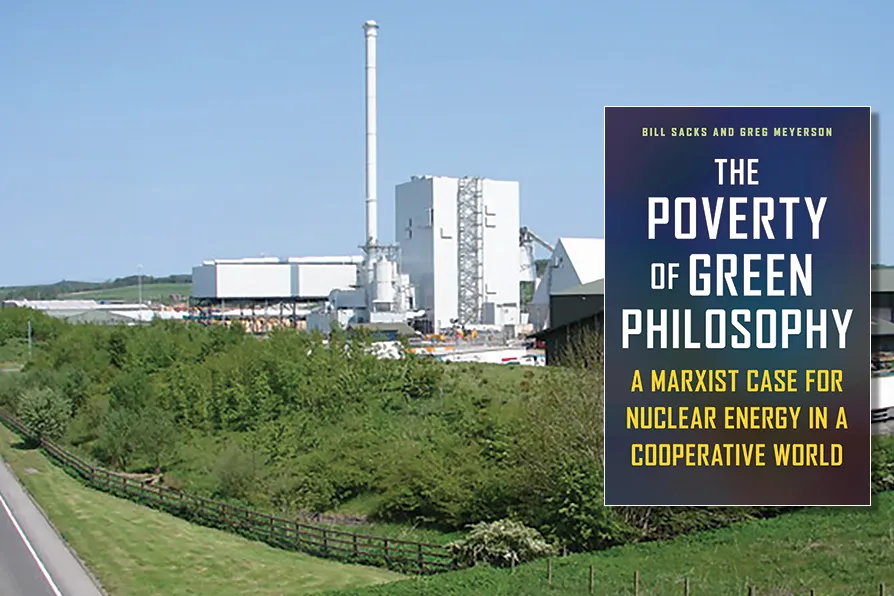 Steven's Croft Biomass Plant plant near Lockerbie, Dumfries and Galloway, Scotland Pic: Chris Newman/CC

GEOFF BOTTOMS applauds a world-class production King Lear that pits late feudalism against a rising bourgeoisie
MARY CONWAY keeps up with the sheer pace of a drama about the terrible gap between sanitised reporting and real-life turmoil of race and gender
New releases from Brian Fallon, Antony Szmierek and Hollow Hand
APURBA CHATTERJEE explains how British artists in India used the “picturesque” to reshape colonial landscapes and celebrate imperial power
PAUL DONOVAN welcomes a revival of Reginald Rose’s classic play that reminds us of the fundamental need for trials with juries





The Poverty of Green Philosophy - A Marxist Case for Nuclear Energy in a Co-operative World
by Bill Sacks and Greg Meyerson
Open Universe £20.99
IN THIS detailed study Sacks and Meyerson deliver a Marxist case for nuclear energy. They also undertake a critique of green philosophy; both its eco-socialist and eco-modernist (pro-capitalist) variants.
Their argument centres on the failings of renewable energy. The authors are no-climate deniers, they accept the existence of anthropogenic global warming (AGW); the process of man-made climate change since the Industrial Revolution.
The authors’ claim that although solar and wind power are free and in abundant supply, they are highly inefficient; resulting in a very low energy return on investment (EROI).
Their study points to the high input of land required for both solar power and wind farms, combined with a low output. They argue that waste from solar panels is highly polluting and that both these forms of renewable energy lack the efficiency of nuclear power.
The precious metals required for the production of solar panels would result in price rises for materials already needed for the production of other consumer goods such as computers and mobile phones.
Perhaps the crux of their argument is that nuclear fuel can be reused while uranium can be extracted from seawater; making its supply almost endless.
Strong Nuclear Force, the most powerful energy in the known universe, holds together the nuclei of atoms. If released through nuclear fission it can produce enormous levels of energy, with a subsequently high EROI.
Sacks and Meyerson attempt to reassure us about the safety of nuclear power plants and concerns over radiation. The accidents at Three Mile Island (1979), Chernobyl in 1987 and Fukushima in 2011 were not the same as nuclear bomb blasts but steam turbine explosions. While the corresponding damage done by radiation has been exaggerated.
Meanwhile they remind us that radiation is emitted from numerous sources including rocks, various foodstuffs including bananas as well as mobile phones, microwave ovens and building materials.
They make coherent case against the green left by arguing that an economy based entirely on renewables would result a net drop in energy use and a subsequent decline in economic growth and living standards.
As one would expect they are highly critical of the Small is Beautiful argument put forward by the British statistician and economist EF Schumacher (1911-1977) who favoured small scale, handicraft industry over large-scale production; claiming that capitalism had destroyed locally based handicraft industries.
Central to this view is that nuclear power, with its highly centralised power plants, is inherently capitalist; while renewables, which tend to be much more dispersed, are inherently socialist.
The authors advocate control over the nuclear industry by a socialist state: in other words socialism means scaling up not scaling down.
It should be pointed out that renewables are still in their infancy compared to both nuclear and fossil fuels. The first wind farm in Britain opened in 1991 whereas the use of nuclear power dates back to the 1950s.
Why not advocate greater research and development into renewables, with a view to using them alongside nuclear power? Meanwhile with climate denialism on the rise, a critique of it might be a good idea.
Still the book presents some excellent arguments about the failure of capitalism and the obvious need to de-carbonise energy production.
