
PETER MASON applauds the revival, 39 years later with the same team and cast, of Manfred Karge’s version of Brecht’s 100-year-old play, Mann Ist Mann

The Institution and the Prole Art Threat
KEVIN DONNELLY outlines how the bourgeois institutions inhibit our ability to to view art in revolutionary ways, and suggests some tactics to overturn it
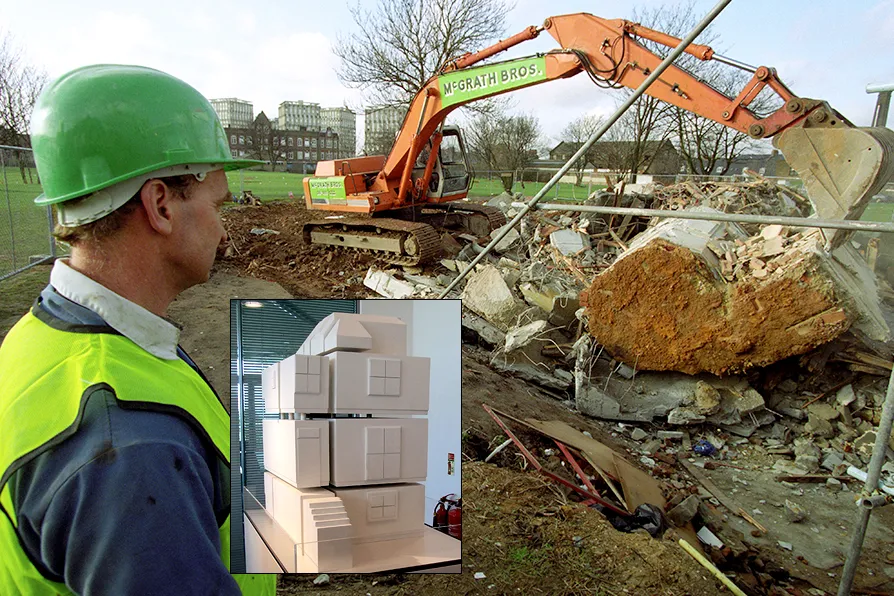
 ART CRUSHED BY COUNCIL: Rachel Whiteread’s sculpture House, a cast of the inside of a house, erected where the house had stood on Bethnal Green, Tower Hamlets, was demolished by order of the Lib Dem local council in 1993 [Pic: Denna Jones/CC]
MAYER WAKEFIELD applauds a fearless attempt to bring to the stage the 1984 toxic gas disaster in Bhopal, India
ALEX HALL applauds the account of a dogged, traumatic and punishing campaign for justice that has lasted from 1998 to the present day
NICK WRIGHT laments the political bias of an epic attempt to tell the history of the liberation of France from the Nazis, that excludes both the decisive contribution of the Soviet Red Army, and of the French communist party itself
JOE GILL traces the ideology and method of contemporary imperialism back to the greed, hubris and violence of the late 15th century Portuguese





ON the album Slates by The Fall, there’s a track Prole Art Threat, in which it is “safehouse time.” The lyrics are somewhat elliptical, but also straightforward enough to suggest that working-class art is considered a “threat,” and that what constitutes art (elitist, bourgeois) needs to be protected within the “safehouse” of arts institutions associated with the political establishment.
These institutions in turn form part of a social network of galleries, critics, auctioneers, museums, curators, academic/governmental institutions — and artists, which constitute the “art world”; much of which is dominated by the wealthy white men who control capital, and which is therefore inscribed with patriarchy and the values synonymous with the private ownership of property.
These monopolies not only have the power to define what is and isn’t considered art – a banana taped to a wall for example – but also to commodify it, and to control how we “consume” art, whether that is quiet contemplation within the sterile environment of the art gallery or the silent darkness of the theatre. All of which limits the epistemic impact that art may hold for us, and therefore inhibits our ability to view art in new and revolutionary ways.
The thing is, it hasn’t always been this way, and if you were to attend an event back in the 18th century you would have a quite different experience. Back then, the audience often had a more organic, “disruptive” relationship with art. This raises a number of questions, not least of which is how cultural producers can (re)connect with working class life; taking art out of the cosy, insular, elitist “art world” and into the streets.
Paul Gilroy might provide a starting point. For example, in There Ain’t No Black In The Union Jack (Routledge, 2002) he discusses the need to establish autonomous organisations, which create new “cultural forms” and which are sites of “oppositional practice” and “cultural struggle.” Another key thinker who could inform this process is Henri Lefebvre, who, in The Production of Space (Wiley-Blackwell, 1991) sets out how, in radical urban politics, “artistic intervention” has the power to disrupt the material and political dimensions which constitute how “space” is regulated in working-class communities.
However, all this is easier said than done, and in going down the “legal” route in trying to identify a “space” in which your “autonomous organisation” can operate, you are likely to encounter a number of barriers; including the hostility of local politicians, the increasing privatisation or lack of public space, and corporate interests to name a few.
Take accessing the empty premises of a local shop for example. You would think this would be easy during an economic downturn. I tried this in Leeds through my youth and community work, and what I found was that most of the premises weren’t owned locally but by financial institutions in London, and who didn’t give two hoots abut providing affordable access for community arts projects in the city.
This also points to politics as being the root cause of the problem; a hedge fund outfit is hardly going to support an operation it perceives as being run by a bunch of lefties, no matter how uncontroversial the art produced is, or how much it benefits the local community. No, for the bourgeoisie who run these institutions, “art” needs to be placed in a setting conducive to the (re)production of their values.
Which raises the question – how do you transform a “prole art threat” into a “prole art reality”?
New technology might be one answer. In Disordered Attention: How We Look at Art and Performance Today (Verso 2024), Claire Bishop focuses on the ways artists have responded to new technology and social media, as in how iphones, for example, can “disrupt” performances, creating a “hybrid” way of “seeing” art, in contrast to the “single-point perspective” of conventional art forms and institutions which “steer and hierarchise” the attention of the audience.
In other words, turn the space of the institution into sites of resistance. Take the streets into the “art world.”
In many ways, these new cultural norms resonate with older, “unruly” cultural practices, reconfiguring audience participation, in which viewing art becomes “at once present and mediated, live and online, fleeting and profound, individual and collective.” This also resonates with the Cultures in Resistance initiative, the aim of which is to “provide a mechanism to challenge and change cultural, and therefore political formations.” To “disturb and disrupt” as one of the organisers put it.
All of which represents the potential to create new cultural forms (and norms) which offer a truly revolutionary, collective experience; and against the art establishment and its monopolisation of art as a reactionary, money-making scheme, and in which some artists are complicit.
