WILL STONE samples the 20th anniversary atmosphere of this eclectic end-of-season indie festival


 Latest editorial
Traitors to their class, but not to the people
JOHN GREEN suggests that a new, biased, and highly readable re-hash of the story of the Cambridge Five be taken with a large pinch of salt
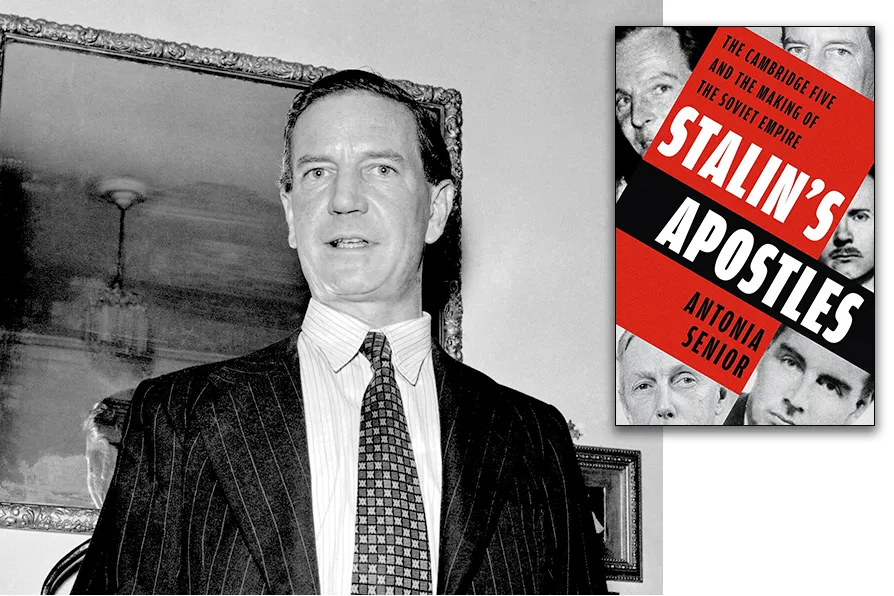 Kim Philby at the press conference in 1955 in which he defended himself from accusations of spying, regarded as a masterpiece of misinformation [Pic: Public Domain]

Comics are not just superheroes and spandex – it can be public art, telling public stories, suggests HARRIET EARLE
The bard serenades the Diggers of Wigan and their festive followers
ALEXEI SAYLE speaks to Angus Reid about a lifetime of protest, how to hone political art – and what to do now
ANDY HEDGECOCK, JAMES WALSH, LEO BOIX and MARIA DUARTE review Just An Illusion, Everybody Digs Bill Evans, Blue Film, Oasis: Don’t Look Back in Anger, and Runner
MARIA DUARTE recommends a nerve-wracking reconstruction of the 72 hours before the Normandy landings





Stalin’s Apostles
Antonia Senior, PublicAffairs, £25
YOU would have thought there is little more to write about the Cambridge Five given the plethora of already published books about them. But here we have Antonia Senior adding more grist to the mill. She studied under Christopher Andrew, the quasi-official biographer of MI5, and is a leader writer for the Times, so to expect a fresh take would, perhaps, be naïve. Even the title betrays her unipolar perspective.
Senior writes fluently and persuasively, managing to extract every last drop of dramatic tension out of this much-worked, but still riveting history.
We shouldn’t forget that those who opted to work for the Soviet secret services at this time, during the 1930s onwards, were experiencing a Europe coming out of a deep economic recession and threatened by rising fascism. Observing how Western nations appeased and flirted with fascist regimes, with the only viable opposition coming from the Soviet Union, the choices these men made have a certain logic to them.
Is it any surprise that many political aware and progressive individuals were prepared to do their utmost to help counteract the fascist threat? According to Senior and her ilk, however, they were merely fanatical, cynical, disloyal and mendacious traitors and dupes of Stalin.
During the 1930s a significant, if small group, of Cambridge students became attracted to the ideas of Marxism and joined the Communist Party. Senior depicts the disavowal of their often privileged backgrounds and espousal of Marxism solely in terms of religious fervour rather than perhaps considering that these highly intelligent and well-educated students had genuine and valid reasons for their revulsion at capitalism and their dedication to socialism.
In her role as an obsessive evangelist for the anti-communist cause, she reverses the mirror: “These men were motivated by the conviction that the violent expansion of communism across the globe… was justified; they were untroubled by Stalin’s own vision of a muscular, imperialist role for the Soviet Union”; when Philby and Arnold Deutsch, his recruiter, met it was “A meeting of two men of faith – a Damascence bliss for the already converted.” Philby was “hardened into communism… caught in the wave of Marxist fervour that engulfed Cambridge”; “after all the talking at Cambridge, here [Philby visited Vienna in the 1930s] was blood on the cobbles. Here was the smell of cordite and the thrum of danger. Here was the possibility of glorious martyrdom.”
And about Maclean, she writes: “Like a good Presbyterian’s relationship to God, the new recruit’s dedication to his political faith must be personal and absolute… the Marxist school insists that individuals are mere cyphers.”
The Bolsheviks were, she goes on, “Like millenarians waiting for God, the small band of revolutionaries who seized Russia in 1917… the premise of Bolshevism was that inevitable revolutions can be midwifed by violent professionals” and so on in this vein, ad infinitum.
Senior’s narrative is interlaced with her own commentaries on Marxism, Stalin, the Soviet Union and amateur psychological speculation as integral to her own crusade against this “demonic ideology.” She rallies dubious characters like Malcolm Muggeridge to justify her position.
In many ways her book actually lends credence to the justifying arguments used by the Cambridge 5, in that she, perhaps inadvertently, also exposes British and Western duplicity, establishment arrogance and privilege, combined with deep-seated anti-Soviet attitudes.
The allegation has always been that the Cambridge 5 did enormous damage to British interests by their treachery, but as the top CIA man Peter Sichel said in a recent documentary, the spying agencies on both sides during the Cold War made little difference to the eventual historical outcomes. And one could argue that the Cambridge group were, in the main, unmasking the fascist links and the perfidy of Britain’s own ruling class against the interests of the country as a whole. Yes, they were traitors, but only to their class, not to the people of Britain.
Senior’s book adds little that is new to this story, but it is an engaging read if taken with a large pinch of salt.
