Committee for the Defence of the Iranian People’s Rights general secretary GAWAIN LITTLE discusses the impact of the US-Israeli war on the Iranian people and economy


 Latest editorial

Earthquake deaths: the dividing line on fault lines
The low death toll and damage from a recent earthquake in Taiwan highlights global inequality in preparing for natural disasters, write ROX MIDDLETON, LIAM SHAW and MIRIAM GAUNTLETT
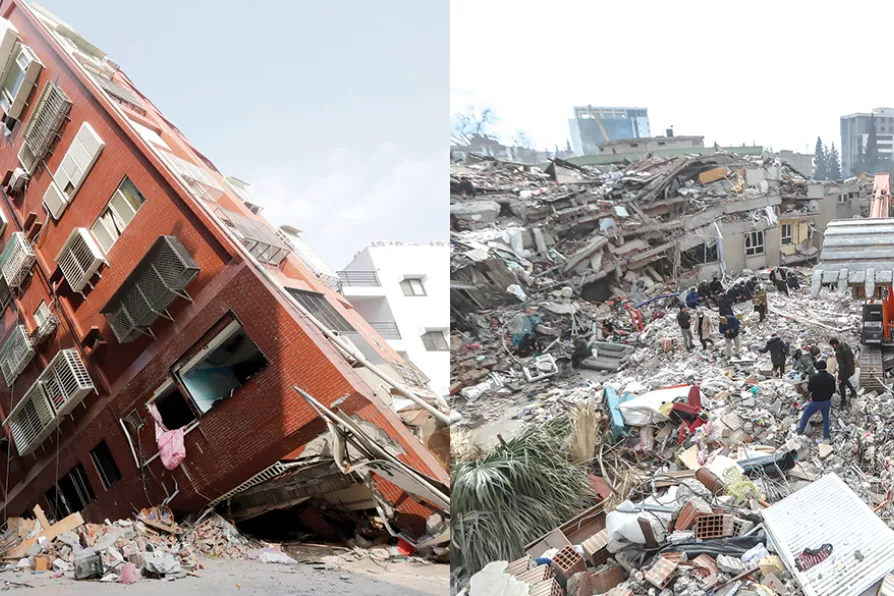 DAMAGE LIMITATION: (Left) A powerful earthquake strikes Hualien City in eastern Taiwan, last Thursday; (right) Earthquake aftermath in Kahramanmaras, Turkey on February 10 2023
Capitalism has extracted itself from crisis before, argues PRABHAT PATNAIK – but through methods no longer available. So it is turning to authoritarianism, militarism and neocolonialism
The five young men killed in the A66 crash were responsible for a devastating tragedy — but the crash should force us to ask difficult questions about wider society, argues RENATA MEDEIROS MIRRA
Britain funds the policing of black culture 16 times better than the culture itself. The Diamond Jubilee is the moment to end that, argues CLAUDIA WEBBE
Despite Andy Burnham’s declaration defending the continued partition of the island, all major international and internal trends are converging to make Irish reunification inevitable
Humans are part of the ‘animal kingdom’ – and of nature in general – but also distinct from it and labour (work) is part of what makes us unique, declared Engels. His insights 150 years ago into how our species came to be and how we differ from the rest of nature, are as important today as they were then, says the MARX MEMORIAL LIBRARY





IN a video taken just after a magnitude 7.4 earthquake struck the eastern coast of Taiwan on April 3, the Taipei 101 skyscraper is shown oscillating lightly. Despite the fact that tall buildings are particularly susceptible to seismic damage, the building only experienced minimal swaying during the earthquake.
Elsewhere in Taiwan, 28 buildings collapsed and at least 125 experienced some form of damage. It wasn’t simply luck that protected Taipei 101; the 1,670-foot tall building has been specifically designed to minimise damage from natural disasters that are endemic to the region, such as earthquakes and typhoons.
When an earthquake happens, its energy is dissipated in the form of seismic waves, which have a variety of frequencies (rates of vibration). These seismic waves cause the ground to shake.
Buildings have a natural rate at which they will vibrate, referred to as their resonant frequency, like the natural frequency of a child going back and forth on a swing. When seismic waves of this resonant frequency shake the ground beneath a building, the wave will be amplified, causing stronger shaking and more damage.

Similar stories