
The UK Prime Minister may have the regal touch in northern England, but he’s been wrong-footed on the constitutional challenges posed by the Celtic Alliance of first ministers from Scotland, Wales and Northern Ireland, argues KENNY MacASKILL

What is Political Ecology?
Marx and Engels incorporated in their writings a critique of the way that capitalism destroys the environment but it is only in the last half century that environmental concerns have become an integral part of the fight for socialism, writes the Marx Memorial Library and Workers’ School
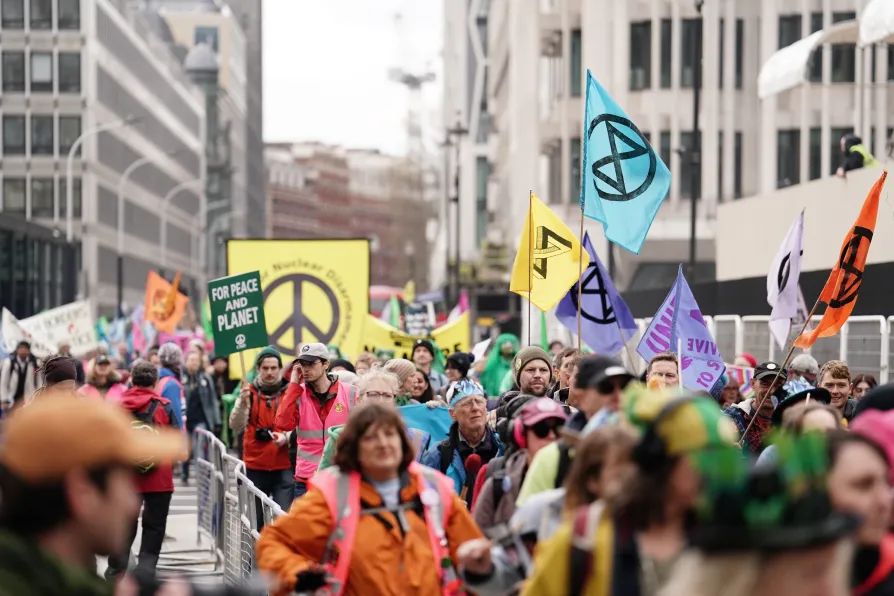
 Demonstrators take part in a rally in London, on the last day of Extinction Rebellion's four days of action that they have called "The Big One", April 24, 2023


NEIRLAY ANDRADE, a member of the Communist Party of Venezuela’s political committee, outlines her party’s position on the crisis facing the country
A look at Taylor Wimpey’s accounts shows why Labour’s market-led housing strategy won’t deliver more, cheaper homes, as promised, says SOLOMON HUGHES
DAVID HORSLEY remembers the remarkable life and death of US black revolutionary George Jackson, whose politically passionate prison letters were published as Soledad Brother
Cuban trade union federation CTC leader OSNAY MIGUEL COLINA speaks to Ben Chacko about life and work under a crippling US siege
A part of the British empire’s network of slavery, today the Caribbean island of Nevis faces a new form of exploitation in the form of crypto-colonialism, CLAUDIA WEBBE writes
Challenges from the unscrupulous misuse of AI to steal actors’ voice and physical likenesses is being met with a firm union response, writes LYNDA ROOKE





“WHAT cared the Spanish planters in Cuba, who burned down forests on the slopes of the mountains and obtained from the ashes sufficient fertiliser for one generation of very highly profitable coffee trees — what cared they that the heavy tropical rainfall afterwards washed away the unprotected upper stratum of the soil, leaving behind only bare rock! In relation to nature, as to society, the present mode of production is predominantly concerned only about the immediate, the most tangible result; and then surprise is expressed that the more remote effects of actions directed to this end turn out to be quite different, are mostly quite the opposite in character.” Friedrich Engels, 1876; The Part Played by Labour in the Transition from Ape to Human.
Karl Marx’s monumental work Capital is subtitled “a critique of political economy” — not (merely) “a critique of economics” or “a critique of capitalist economics;” Capital is so much more than that. It is a devastating critique of capitalism itself; how it functions and why it must be changed.
So what about “political ecology”? It’s now over 50 years since the publication of German Marxist playwright, poet and philosopher Hans Magnus Enzensberger’s A Critique of Political Ecology — one of a number of mileposts in the growing awareness amongst socialists that capitalism is inherently destructive of the environment to the extent — as we now know — that it threatens the future of our planet and our existence as a species.
The term “political ecology” was first used in 1935 in a (non-Marxist, largely apolitical) Nature Ramblings column in a US popular science weekly, The Science News-Letter. It was later popularised by the Marxist anthropologist Eric Wolf in a study of the relationship between local inheritance and ownership practices and the wider environment and was subsequently used by other academics.
However Enzensberger was the first to develop the concept in a wider political frame in relation to an emerging awareness of global ecological crisis. Enzensberger challenged the then (1974) largely apolitical and indeed, reactionary nature of the nascent “ecology movement” in the West, and also the (then) neglect of environmental issues within much Marxist discourse.
Yet Marx and Engels both paid attention to ecological issues in their writings. One concern then was the impact of capitalist agriculture on soil health and of the failure to recycle sewage on water quality. They also challenged the claim of Thomas Malthus (a prominent economist for the East India Company, then Britain’s biggest multinational company) argument that “civilised society” was threatened by overpopulation — specifically the working classes producing too many children.
That argument resurfaced a century later in William Vogt’s bestseller Road to Survival (published the same year as Orwell’s 1984) which argued that unless the “untrammelled copulation” of “spawning millions” was brought to an end, “we might as well give up the struggle.” Vogt made his political position quite clear, declaring that it was necessary to get rid of the “sort of thinking […] that leads to the writing and acceptance of documents like the Communist Manifesto […] it tricks Man into seeking political and/or economic solutions.”
Twenty years later, as recognition of the problems of world hunger was beginning to be accompanied by a wider awareness of global environmental issues, Garret Hardin’s classic essay The Tragedy of the Commons (1968) advocated “mutual coercion, mutually agreed upon,” arguing that “fortunate minorities must act as the trustees of a civilisation that is threatened by uninformed good intentions.” The “fortunate minorities” were of course the elites of “western” civilisation and the “uninformed good intentions” those of aid agencies and others who sought to alleviate the position of the poor, particularly in “developing” countries.
That argument was rubbished by the Marxist biologist Barry Commoner in his 1971 best seller The Closing Circle. Commoner showed that it was poverty that caused overpopulation, not the other way around.
By this time public awareness of the complexity of human interactions with nature and understanding that something was wrong had been boosted by the publication of Rachel Carson’s Silent Spring (1962).
Carson demonstrated the downside of the “green revolution” and in particular how pesticides used in agriculture found their way into the food chain, poisoning species and disrupting ecosystems. A marine biologist, Carson was not a declared Marxist though she was accused of being “probably a communist” and her work is a good example of a dialectical analysis of the consequences of industrial agriculture.
These arguments were brought to a head by the publication in 1972 of the Limits to Growth — a computer simulation of the future of humanity funded by three second-rank multinationals; Fiat, Olivetti and Volkswagen, through the Club of Rome — an “invisible college” think tank of academics, politicians and business representatives.
The simulation was critiqued by a team at the Science Policy Research Unit at Sussex University, under its director, Chris Freeman (a Marxist) who showed that computer predictions depended on the political, as well as technical, assumptions on which they were based.
The debate was taken up within the left, including the Morning Star and in a series of 1974 articles in Marxism Today. Since then the environment has become an increasingly important issue for all socialists.
So: what is “political ecology”? The answer is: it’s a battlefield, both in theory and practice.
On one side, it’s big business and its champions. For the apologists of ongoing capital accumulation, it’s using ecological jargon to greenwash their activities while boosting their sales and profits; it’s our wonderful government doing its best to help save the planet (we jest). It’s also a major field of research dominated by academic publishing corporations like Elsevier that also service the fossil fuel industry.
On the other, it ranges from courageous Just Stop Oil activists challenging the energy monopolies through an emerging “environmental proletariat” (especially in the global South) for whom economic and environmental struggles are central to survival, to China which, despite operating in a hostile world where to survive it has to “beat the West” at its own game, is today arguably leading the world in new “green” technologies.
And it includes the Marx Memorial Library in its own educational programmes.
Today a Marxist political ecology is as central to radical theory and action — to both interpreting and changing the world — as is a Marxist political economy. Enzensberger distanced himself from Marxism and from socialist politics in his later years, but his 1974 essay put the issue as well as anyone. Let’s give him the last word:
“… capitalist societies have probably thrown away the chance of realising Marx’s project for the reconciliation of humans and nature. The productive forces which bourgeois society has unleashed have been caught up with and overtaken by the destructive powers released at the same time. The highly industrialised countries of the West will not be alone in paying the price for the revolution that never happened. The fight against want is an inheritance they leave to all humankind, even in those areas where humankind survives the catastrophe.
Socialism, which was once a promise of liberation, has become a question of survival.”
Earlier answers (this is number 131), on Marx and Engels’ own writings on ecology and the “metabolic rift,” on climate change, on population and economic growth, on Marxist ethics and on the environment as a “second contradiction” of capitalism can be found on the Marx Memorial Library’s ‘Full Marx’ archive on https://tinyurl.com/FullMarx/.
