A California union’s decision to host a meeting about US policy towards Cuba has prompted a congressional probe and renewed attacks on international solidarity, writes CAMERON HARRISON



Taxing and spending on the way to recovery
A sharp rise in public-sector investment is required to kick-start the economy, argues MICHAEL BURKE
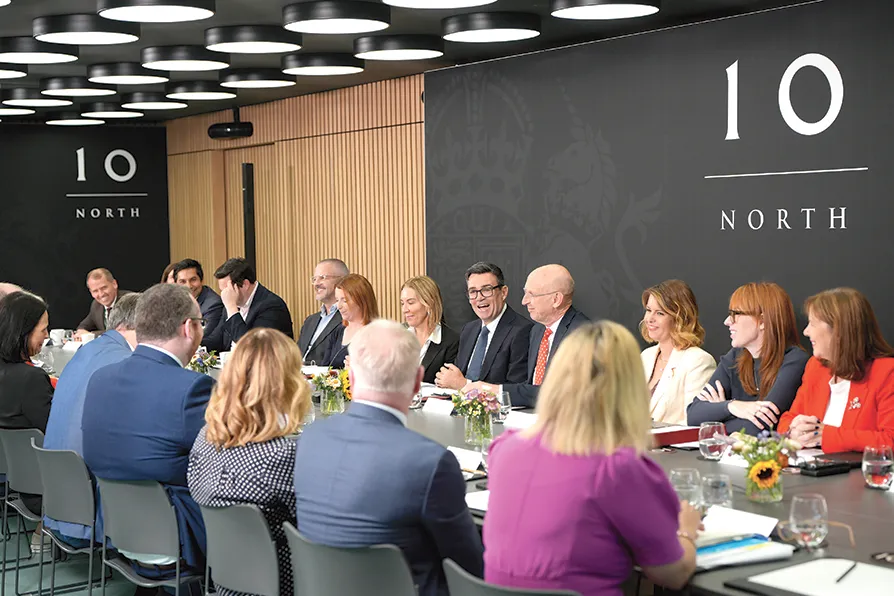
 OPPORTUNITY KNOCKS: Andy Burnham at the National Economic Council meeting at No 10 North in Heron House, central Manchester, July 24 2026

The Baltic state is set to reverse its constitutional prohibition on nuclear weapons and foreign bases as part of accelerated Nato war preparations, warns TOM UNTERRAINER
Long-term underfunding and state neglect, while simultaneously probation services have been undermined, have intensified the prison crises, argues SOLOMON HUGHES
Holyrood incompetence has cost jobs and put the future of Clydeside’s Ferguson Marine shipyard into jeopardy. Its future should have been assured, argues KENNY MACASKILL
With the agitated debate now raging in the media about the early release schemes, Prison Officers Association general secretary STEVE GILLAN gives the view of those who work in the sector
The hounding of the late Jason Arday is an all too familiar experience for many black people. ROGER McKENZIE calls for collective action to combat what can feel like personal isolation





CONTRARY to repeated claims, Britain is not a high-tax economy. But it is a low-growth economy which taxes unfairly. Changes to the fiscal system (taxation and spending) could address both the weakness of growth and the redistribution of incomes. These can be both radical and easily implemented.
First, it is necessary to deal with the mythology. According to the recent report from the Office for Budget Responsibility (OBR), Fiscal Risks and Sustainability, British government revenue was at least 5 per cent less as a proption of GDP over the last 15 years than comparable economies.
This is true against a variety of peer group economies, whether the average of Organisation for Economic Co-operation and Development (OECD), or the average of the advanced economies or the average of the G7.
In fact the current sharp rise in the tax take in the British economy will only take it up to the average of the OECD economies over the next four years, and even then it will still be below the G7 average.
Measured against these peer groups, the claim that Britain is a high-tax economy is simply false.
But there is no denying that the tax take is rising sharply. Here it is important to identify the source of that rise. A hue and cry went up after the October 2024 Budget around claims about an insupportable burden of taxation.
This was probably inevitable from the British media facing the unusual sistuation of the first Budget to be implemented by a Labour chancellor since 2009. (Peter Mandelson wrote a vicious austerity Budget for Alistair Darling in 2010, but they were never able to implement it).
But even the 2024 Budget was much more of a Tory one than commentators care to admit. Far and away the biggest single measure of the October 2024 Budget was to leave unchanged Jeremy Hunt’s freezing of income tax thresholds.
This measure impacts 10 million workers, split between those dragged into the tax net or paying more income tax in total. The misery is set to last until 2028, and by then will be raising an additional £55 billion a year, according to OBR estimates.
This was more than double the projected rise in tax revenues as a result of the empolyers’ National Insurance Contributions (NICs), which generated so much critical commentary.
As usual, austerity was the means by which workers and the poor pay for the economic crisis. Most workers, understand that they are highly taxed, and they are right.
Behind the headline numbers there is a picture of inequality and unfairness in the taxation system which makes Britain the exception, not the rule.
According to the OECD (in its Revenue Statistics 2025) taxes on individual incomes amount to 30.2 per cent of the entire tax in Britain. This is far higher than the average of 23.7 per cent across the OECD as a whole.
It is also above the average of the G7. In Britain, workers are clobbered by income taxes.
In contrast, there are two key areas where taxation is much below the OECD average. The first is taxation on company profits, which are just 9.7 per cent of total tax revenue in Britain compared to 11.9 per cent of the average total of the OECD countries.
The second area is the glaringly low level of social security contributions, where the average is 25.5 per cent of the total tax revenue across the OECD, compared to 19.1 per cent in Britain.
It is important to remember that there are no socialist countries, implementing socialist taxation in the OECD, although in some cases there are vestiges of the social democratic settlement at the end of World War II.
Britain is an extreme, free-market, anti-worker outlier.
So, reforming the tax system to look more like an average OECD country would simply introduce greater fairness into the system and raise revenue in a progressive manner.
There are three obvious steps to take; increase revenue from corporation tax (preferably by removing the vast accumulated tax breaks and subsidies), reform NICs so that it is no longer a regressive tax and abolish the upper earnings limit, and third, gradually unfreeze the income tax threshold on basic rate income tax.
Together these would raise £25bn a year in additional revenue a year, while at the same boosting the incomes of workers outside the higher tax brackets (using UK Treasury estimates of the impact of these reforms).
But policy cannot rely solely on redistribution. For living standards to rise, the whole pie must be increased and growth generated.
Here, government spending can play a decisive role. Usually, in most Western economies this is denied and the Thatcherite mantra that “you can’t buck the markets” shuts down debate.
But government is by far the biggest actor in any modern economy. Not surprising, since it can be responsible for 40 per cent or more of all spending. And it plays the decisive role, as the 2008 global financial crisis showed. It was the state which bailed out the markets, not vice versa.
Government can direct the entire trajectory of the economy. But here, Britain is once again an outlier, even compared to the rest of the G7.
In 2025, Britain had by far the lowest level of investment in the means of production (gross fixed capital formation) in the G7.
For the last five years, Britain’s level of investment has been way below Italy’s, long regarded as a hopeless case for industrial renewal.
The British private sector is not working. But successive governments have refused to increase public-sector investment to offset private sector lethargy. The result is a stagnant economy.
The Reeves/Starmer 10-year investment plan actually represents a cut in the prevailing level of public investment. A sharp rise in public-sector investment is required to kick-start the economy.
Where will the money come from? In the first instance it should come from scrapping the Defence Investment Plan, which will ultimately be a drain of £298 billion in the next four years. Those resources could be shited to genuine, productive investment, with an immediate boost of £15bn.
Investment in infrastructure, rail, broadband, the universities, green technology and housing will improve lives and add to the means of production. It would also create far more jobs than the capital-intensive armaments industry, one of the most jobs-poor sectors of all.
Britain needs redistribution and it needs investment-led growth. Simple yet far-reaching changes to tax and spend policies could achieve that.

Similar stories

Only an ambitious programme of state-led investment can restore growth and improve living standards, argues MICHAEL BURKE

Expanding Britain’s nuclear capability increases the risk of nuclear confrontation. It does not keep us safe – it makes us a target, argues CAROL TURNER

If the government really wanted to address public finances, improve living standards and begin economic recovery, it would increase its borrowing for investment, argues MICHAEL BURKE
The 2025 Budget shores up the PM’s political position with headline-grabbing welfare U-turns, but with no improvements on offer to declining public services or living standards, writes MICHAEL BURKE