TUC president and POA leader STEVE GILLAN speaks to Ben Chacko on the eve of Congress 2026


 Latest editorial
Who is causing Britain’s economic stagnation?
If the government really wanted to address public finances, improve living standards and begin economic recovery, it would increase its borrowing for investment, argues MICHAEL BURKE
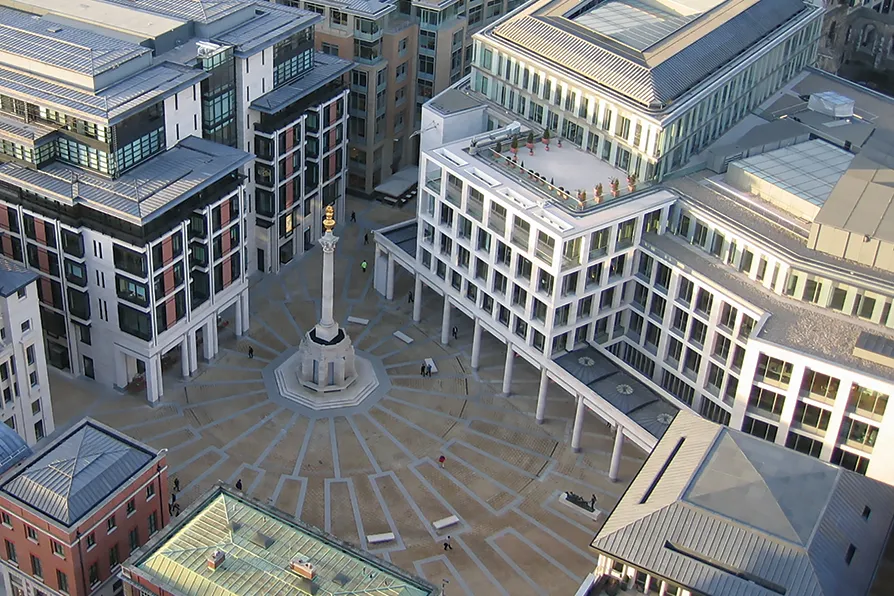 INVESTMENT WITHELD: Paternoster Square, City of London, on the right with the columns is the new home of the London Stock Exchange / Pic: gren/CC

DOUG NICHOLLS welcomes a turning point at this year’s Congress, where many motions call for a co-ordinated plan to revive British industry, a perspective outlined in his new book
HOPE VIRGO of campaign Dump the Scales warns MPs voting today they should be alert to the threat legalised assisted death poses to people with eating disorders
The Together Alliance is hosting two summits, North and South, to build power and plan action against the scourge of racism peddled by the right. DANIEL KEBEDE urges mass participation
The drift toward militarisation in Europe is not inevitable, left-wing and peace movements can preserve sovereignty and prevent war, says DÁIRE HUGHES MP
Whatever differences exist among international sympathisers of the Bolivarian revolution about its current trajectory, they should unite against the imperialist power that is the source of an enforced retreat, argues ROGER D HARRIS
Trade unions need to step up and force a turn in the policies of the labour movement to effectively confront the far-right threat, argues NICK WRIGHT





BRITAIN remains close to economic stagnation, with the recent trend in GDP growth close to 1 per cent and multiple official forecasts pointing to an extension of that trend over the next few years.
There is a widespread denial about the state of the economy in our media and even among the three largest political parties. Every marginal improvement above the 1 per cent trend is greeted with fanfare, while every dip below it is quietly buried.
But even for the minority of commentators willing to accept that economic stagnation is the new normal in Britain, there is also widespread confusion about why torpor dominates, and how to end it.
There has even emerged a minority who argue that growth is not necessary at all, or even that its pursuit is partly responsible for our multiple crises.
These are largely otherwise progressive voices, although how they also aim to simultaneously raise living standards, improve public services and shift to sustainable energy without growth remains a mystery.
Rather than dodge the issue of the cause of the crisis it is more useful to face it head on.
The crisis is in some ways a classic “crisis of capitalism.” There are many forms that economic crisis can take, but some are unique to capitalism and are not exhibited in preceding social systems, nor in its successor, socialism.
One obvious one, which is starting to re-emerge in Britain currently, is the issue of unemployment. Unemployment was barely known in previous societies, where everyone who was able worked, as this added to the prosperity of that society.
Unemployment is a phenomenon that developed as a recurring feature of capitalism and tells us something about its fundamental character. Generalised commodity production is production for profit, not the satisfaction of human needs.
Because that is the case, production can slow, or be cut back sharply if profits cannot be realised. In the current period, production had slowed, which accounts for the stagnation of the economy. Yet in recent memory we have also experienced periods when production is cut back, which we call recessions.
The slowdown has taken place over a prolonged period. It seems likely that the cumulative real GDP growth of the British economy in the 18 years since the Great Recession began in 2008 is just 22 per cent. This is well below an average annual growth rate of 1 per cent, once the effect of compounding is taken into account. By contrast, the growth of the British economy in the 18 years prior to the Great Recession was 53 per cent.
This now seems like a Golden Era by comparison, although that was very far from the case. The post-World II era can be divided into two distinct periods, pre- and post-Thatcher. In effect, the growth rate of the economy in the first period was effectively double that of the second period.
The Thatcher is widely and falsely characterised as a period of strong growth. It was not. It was a period of sluggish growth, high unemployment and deindustrialisation, with GDP artificially boosted by the sudden inflow of revenues from the North Sea.
But since 2008 we have been living in the post-post-Thatcher period, or Thatcherism without the North Sea. The prescriptions for the economy, deregulation, privatisation, anti-union laws, reliance on finance, all came home to roost.
A remarkable feature of the current period is that, despite all the obvious failing of that model it is still championed by the leadership of our three largest political parties.
Key testimony for the utter failure of the Thatcherite model is the actions of the capitalists themselves. Their steadfast refusal to raise their rate of investment is the cause of the current malaise. Under current conditions, anticipated profits are insufficient to tempt them into increasing investment. It is this investment strike which is the cause of the crisis.
The question then arises: why don’t the capitalists invest, as this would lift the economy as a whole and improve their conditions for profitability?
The simple answer is that, just as capitalism does not operate in the interests of society as a whole, neither do capitalists operate in the interests of capital in general. They are in competition with each other. This means they will not take on the role of prime mover in increasing investment unless they can anticipate profitable returns on their own capital.
In addition, where one sector or another diverges from the general trend in experiencing boom, without a general change in the conditions for profitability, this results in the redirection of existing investment from other sectors, not an aggregate increase in private investment.
This trend can be seen clearly in current US economic data, with large-scale investment in AI-related projects, yet no significant increase in total private investment.
For the dominant voices in the debate on the economy, all of this is so much Marxist nonsense. Animal spirits will finally come to the fore and the private sector will come to the rescue.
This is all asserted without any reference to profitability or the conditions affecting investment. We will just have to continue to hope the private sector will change its mind on investment.
In many progressive circles on the economy the questions of capitalism, class, profits and private-sector investment do not feature. So, while aims for the improvement of society are often widely shared, there is little common ground on the causes of the current crisis and therefore just as little on solutions.
Yet the main answer is staring at us (there are lots of subsidiary problems that also need addressing). The government is not just the largest non-private actor in the economy, it is the largest actor in the economy by far.
The level of public-sector investment in Britain is not far behind all the private sector investment in the economy put together, £231 billion in 2024 versus £298 billion. No grouping or federation of businesses is half so important as the public sector, which is by far the largest single employer too.
The logic which suggests that one private company increasing its investment would oblige others to match it does not operate under conditions of competition. But government does not compete with the private sector and increasing in its investment would genuinely oblige private firms to follow suit.
Currently the British government can borrow for a period of 10 years at a real interest (after inflation) of 1 per cent. The average private rate of return on investment in Britain is 12 per cent.
If the government really wanted to address public finances, improve living standards and begin economic recovery, it would increase its borrowing for investment, just as it previously promised. It is ridiculous, Thatcher-style ideology not to.

Similar stories

Growing instability in the US economy and financial markets could have serious consequences worldwide because of the central role of the US dollar and financial system, argues MICHAEL BURKE
A sharp rise in public-sector investment is required to kick-start the economy, argues MICHAEL BURKE

Only an ambitious programme of state-led investment can restore growth and improve living standards, argues MICHAEL BURKE

The growing argument that welfare must be sacrificed for ‘security’ is built on nothing but myth, argues MICHAEL BURKE