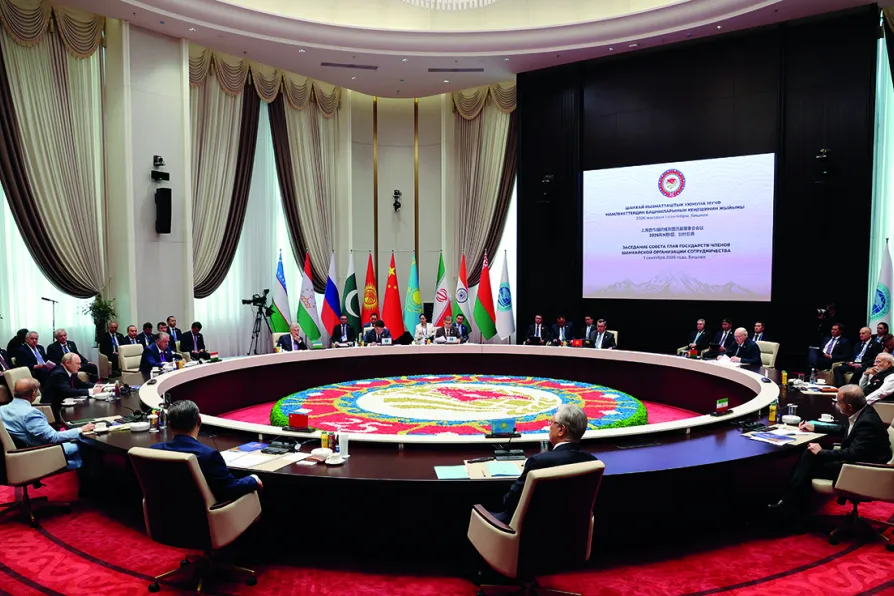
The 25th anniversary meeting of the Shanghai Co-operation Organisation in the Kyrgyz capital may offer a glimmer of hope that international relations do not need to be defined by endless confrontation, writes KENNY COYLE


 Latest editorial

How to overcome Starmer’s rotten economic legacy
Only an ambitious programme of state-led investment can restore growth and improve living standards, argues MICHAEL BURKE
 Prime Minister Sir Keir Starmer tours Palantir Technologies headquarters with company employees and British military personnel in Washington DC, February 27, 2025
The artist, who has just died, is embedded in the subconscious of the Palestinian people
The five young men killed in the A66 crash were responsible for a devastating tragedy — but the crash should force us to ask difficult questions about wider society, argues RENATA MEDEIROS MIRRA
Britain funds the policing of black culture 16 times better than the culture itself. The Diamond Jubilee is the moment to end that, argues CLAUDIA WEBBE
Despite Andy Burnham’s declaration defending the continued partition of the island, all major international and internal trends are converging to make Irish reunification inevitable
Humans are part of the ‘animal kingdom’ – and of nature in general – but also distinct from it and labour (work) is part of what makes us unique, declared Engels. His insights 150 years ago into how our species came to be and how we differ from the rest of nature, are as important today as they were then, says the MARX MEMORIAL LIBRARY
Committee for the Defence of the Iranian People’s Rights general secretary GAWAIN LITTLE discusses the impact of the US-Israeli war on the Iranian people and economy





THE performance of the British economy is weak and the outlook is grim. As a result, living standards are not rising and increasing pressure on public services within curtailed budgets means that they are deteriorating.
To exacerbate the difficulties further, Donald Trump’s demand for increased military spending has led to a concerted campaign to raise the Ministry of Defence budget and to cut welfare spending to fund it.
This will be the economic inheritance of whoever takes over from Keir Starmer. It seems likely that these will be problems for Andy Burnham and his chancellor to grapple with. What should be done?
It is very important to begin with reality and not myth-making. Ministers have repeatedly claimed that Britain’s economy is the strongest in the G7 when referring to the GDP growth data for the first quarter of this year. But this is a statistical quirk which does not suggest underlying economic strength at all.
Since the economic bounce coming out of lockdown the British economy has expanded at a rate not much faster than 1 per cent a year. The last six months have been below that level, with household spending, business investment and exports all weakening. The government’s reliance on the private sector of the economy to generate faster growth has been completely misplaced.
There is no puzzle about the source of this weakness. It is the structural dearth of private investment, which has now been evident for almost two decades. Public investment has itself been curbed by austerity policies of successive government. Even so, it has grown six times faster than the growth of private investment since its peak prior to the global financial crisis of 2008.
If the economy is barely growing, it is extremely difficult to raise living standards, or to significantly increase funding for public services sufficiently, especially with an ageing and growing population. Other factors, such as privatisation and outsourcing, place additional, unnecessary pressures on the delivery of public services.
The Labour government also hit household disposable incomes by the “stealth tax” in the October 2024 Budget, in not linking income tax thresholds to inflation. As a result, millions of workers were made worse off, alongside significant cuts to welfare, especially for disabled people.
Austerity has curbed current spending on schools, the NHS, transport and other key areas. Capital budgets have also been raided repeatedly to plug holes in current spending. According to the NHS Alliance, there is already a maintenance backlog of £11.6bn in the NHS. Other departments also have their own backlogs.
The Trump war drive is a new and sizeable factor affecting the Budget and spending priorities. Starmer has recently announced an additional £15bn in spending for the military in the Defence Investment Plan. This we are told will largely be funded from cuts to the investment budget for transport and energy, although other sectors could be cut.
The US has long fought wars across the globe. Trump is determined to fight multiple wars across several continents simultaneously. Clearly, increasing military spending at his behest and for the benefit of the US will not make the world any safer, including people in this country.
But there will also be detrimental economic effects. Military spending is capital-intensive, creating only a relatively small number of well-paid jobs. By contrast, investment in transport and energy infrastructure can be labour-intensive, creating large numbers of good jobs. More fundamentally, investment in energy and transport infrastructure adds to the means of production, raising the capacity of the economy. Military funding does neither and actually constitutes a form of luxury spending, which has no impact on the means of production at all.
Exchanging transport and energy infrastructure investment for military funding is a colossal waste of resources, which will damage prosperity over the medium term.
It is notable that the neoliberal commentators, who always suggest government spending is too high, or that any increase in spending will spook bond market investors, never apply this to increased military funding, the least sustainable funding of all.
But that is not to say that any successor to Starmer can disregard financial markets altogether. Currently, the public sector is borrowing over £120bn a year and nearly the same in financing debt interest. These are roughly equivalent to the entire Department of Education budget. It is highly damaging and unsustainable.
Naturally, the neoliberals want to use these facts as an argument for deepening austerity. In truth, they are arguments for an effective growth strategy, which would lower interest rates on borrowing, cut the deficit by increased tax revenues, and lower debt ratios by increasing the level of GDP. But growth is vital to any of that.
There has been much discussion about the fiscal rules, and whether they should be amended or scrapped altogether. In fact, they are a second order issue at best, as they do not affect the current outsized borrowing and interest payments being made. And, as we see from the extra £15bn for the military, now money can always be found, it simply depends on government priorities.
The harsh lesson of the misbegotten Truss premiership is not that governments can borrow without limit. That idea was comprehensively destroyed. Instead, her brief tenure showed that governments which require very large amounts of borrowing cannot depend on borrowing if investors lack confidence in eventual repayment. It all comes back to growth.
Therefore, the first requirement for Starmer’s successor will be to formulate a workable growth strategy. Given the chronic lack of private-sector investment, that must mean a very substantial increase in public-sector investment.
Talk of an increase in council house construction is a step forward from the Starmer/Reeves strategy of deregulating to encourage private-sector investment, which has predictably failed. But, given the objective constraints on increasing government borrowing, it would be completely misplaced to accept Starmer’s £15bn in cuts to transport and energy to fund military spending. It is the opposite of what is needed for growth.
The same logic applies to the required investment in the productive economy, in all types of infrastructure, technology and education. This would raise the growth rate over the medium term and provide an immediate boost to job creation.
The economy needs a jump-start, and tackling the deficit in public-sector infrastructure is a ready way to do that. Of course, there should be no suggestion of PFI-style arrangements, which are simply organised defraud of the public sector on an industrial scale.
A comprehensive growth strategy is required, led by substantial public-sector investment. Without one, economic stagnation is set to continue.

Similar stories

Growing instability in the US economy and financial markets could have serious consequences worldwide because of the central role of the US dollar and financial system, argues MICHAEL BURKE
A sharp rise in public-sector investment is required to kick-start the economy, argues MICHAEL BURKE
The growing argument that welfare must be sacrificed for ‘security’ is built on nothing but myth, argues MICHAEL BURKE
The 2025 Budget shores up the PM’s political position with headline-grabbing welfare U-turns, but with no improvements on offer to declining public services or living standards, writes MICHAEL BURKE