
Nothing, says ANDY HEDGECOCK, can rescue this undistinguished amalgam of ponderous melodrama and shallow philosophical speculation


Why atomised anger without organisation suits capital
JOHN GREEN welcomes a valuable and incisive analysis of a world become hyperpolitical but without the mass movement institutions to represent it
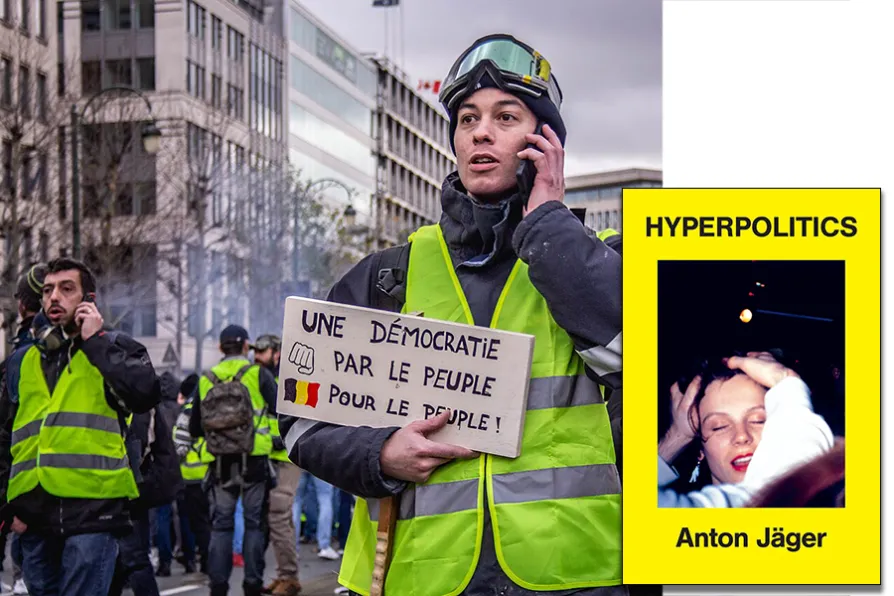
 A gilets jaunes protest in Brussels, Belgium, 2018 [Pic: Pelle De Brabander/CC]

JAMIE BRITTON invites readers to visit 3,500 locals as part of a marathon artistic pub crawl
JAMES WALSH is moved by a provocative and original take on the relationship between ecology and architecture, and a plea to work with, not against, the materials and minerals of our world
An immersive, participatory display by a queer Australian Aboriginal performer, and a rebellious unravelling of traditional Scottish dance





Hyperpolitics – Extreme Politicization without Political Consequences
by Anton Jager, Verso, £11.99
THIS slim book, by Belgian-born, Oxford University Politics lecturer Anton Jager provides a significantly new analysis of the present state of politics globally and how we arrived at where we are.
From a neo-Marxian position, Jager paints a broad-brush picture of the way political movements and structures have changed radically from the late 19th century to today. From a period characterised by large and effective institutions, clubs, associations and political parties to the fragmentary world of politics now.
He examines the consequences of the shift away from traditional politics, mainstream political parties and mass organisations to fractionalised protest and individual responses, increasingly via social media. He cites examples, like that of French philosopher Jean-Claude Michea who was born into a communist family. Not unlike the church, for him the Communist Party provided a unifying culture, an international network of comrades, a sense of community and solidarity. But in today’s world, dominated by electronic media, we have all become isolated individuals, communicating via WhatsApp messages, attending meetings via Zoom and become largely passive consumers of information provided to us via the internet, rather than active participants.
Jager charts the post-war implosion of mass political parties in Europe and the US, as well as the emasculation of trade union movements. Today, few are joining political parties or trade unions, adhering more to sectional, narrow-focus campaigning groups which are no adequate substitute.
Throughout the recent “decade of protest,” the secular decline in US membership organisations has accelerated; unions, clubs, associations, political parties and even churches, exacerbated by the rise of a new digital circuit and tightening of labour laws. Yet, counter-intuitively, discontent runs high, fuelling strong political emotions and anger at police racism, or zionist violence etc.
What we witness today is a preponderance of social media “wars of movement” over institution-building. Take, for instance, the Black Lives Matter movement. It took off in the US like wildfire and mobilised tens of thousands, voicing demands for an end to police violence, racism and inequality, but fizzled out without any of those demands being seriously addressed.
The same happened with the campaign for a decent healthcare system, as with similar movements elsewhere: Syriza in Greece, Podemos in Spain, Occupy Wall Street, the Yellow Jacket movement in France and numerous environmental battles.
Without effective political organisation and robust structures to channel and organise such protest, little is gained. The world hegemon’s public sphere has been reoccupied. The burst of repoliticisation has not increased popular control over government, nor has it put important areas of policymaking within grasp.
“From a Marxist perspective,” Jager writes, “the constant refinement of personal consumption, like the attenuation of civil society, appeared as an imperative of capital itself. Collective life had to be thinned out to clear new inroads for the market… While the internet has radically lowered the cost of political expression, it has also pulverised the terrain of radical politics, blurring the borders between party and society and spawning a chaos of vaguely mandated online actors… When societies enter choppier waters, atomization amplifies their volatility — and the collective incapacity to respond to today’s political and ecological crises.”
Importantly, in his book, Jager doesn’t simply offer an analysis but attempts also to suggest a way forward.
For the left to catch up with its rivals, he says, will require a philosophical reckoning with the historic decomposition of voluntary association. Without a reinstitutionalisation of political engagement, the left will remain hostage to impotent volatility, and its adversaries will continue to enjoy a decisive advantage.
While he realises that we can’t simply return to the “golden age” of mass-political dynamism, with high levels of trade union and political party activism with large, genuine grassroots memberships. That situation was undoubtedly contingent upon specific social conditions, but we certainly need something similar to be generated if we are to effectively challenge the crass class inequality of our societies.
He notes that Westerners have historically emancipated themselves twice: first from the traditional authorities, then from the kind of political commitment required to accomplish that emancipation! That’s where we find ourselves today.
In an equivocal conclusion, he quotes a compatriot photographer who said: “My generation constantly oscillates between the realization that we need to get moving, preferably very quickly, and the feeling that all is in vain. The true challenge — to change things — appears nigh impossible.”
Unfortunately, like many academics, Jager allows elite jargon to cloud the important points he is making, and this could restrict the book’s readership. His text is unnecessarily interlaced with numerous references to philosophers, historians, sociologists and novelists, and cumbersome sentences like this: “The contemporary situation thus represents a recalcitrant hybrid, difficult to relate to historical exampla.” It hardly makes his text an easy read.
This is a pity because he provides us with a valuable and incisive analysis of our political world today.

Similar stories

FRANCIS DEVINE introduces a new collection of essays that draws on Pease McKenna’s example to indicate future paths for the movement
The future does not have to be climate chaos and social breakdown. MARC VANDEPITTE looks at the alternatives offered by the Global Justice Report, co-authored by Thomas Piketty
BEN CHACKO says in different ways, the centenary of the General Strike and that of Fidel Castro’s birth point to priority tasks for the British left in the coming year
After Zohran Mamdani’s electoral win, BHABANI SHANKAR NAYAK points to the forgotten role of US communists in New York’s radical politics