Green Party deputy leader MOTHIN ALI, who will speak at the International Anti-War Conference in London on June 20, says Britain needs to rethink its priorities – and its allies


 Latest editorial
What was the first ‘Communist Manifesto’ – and is it still worth reading?
More than a century-and-a-half after its first publication, the message of the first Communist Manifesto continues to resonate throughout the world, says the Marx Memorial Library and Workers’ School
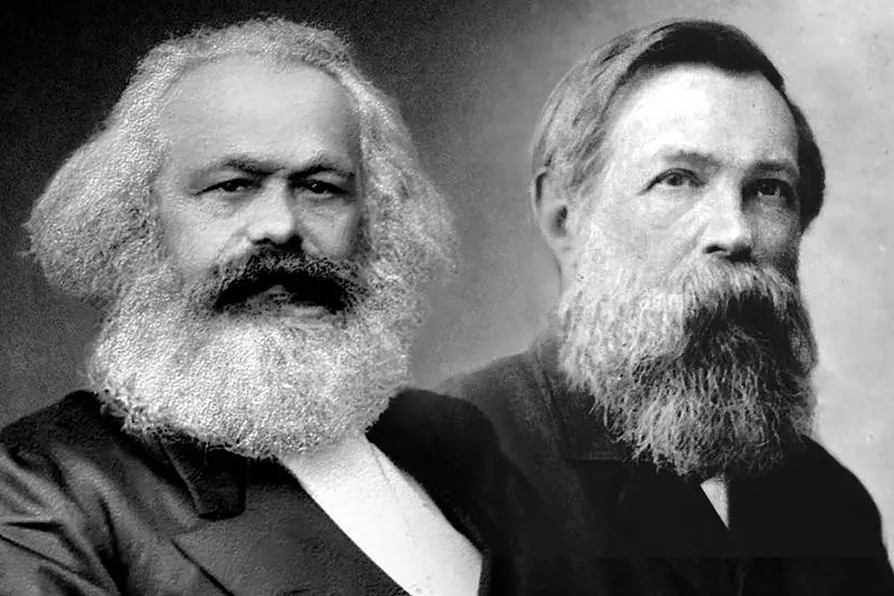 Karl Marx and Friedrich Engels [Pic: Wikipedia/Creative Commons]

From Global Counsel to Arden, SOLOMON HUGHES finds firms linked to discredited politicians are still calling the shots in Britain
KEVIN COURTNEY explains why Reform UK is no friend to workers or trade unions, but just another party of the super-rich
EMMA DENT COAD explains why she is stepping down from the council after 20 years and how the legacy of the fire still haunts the area
While international attention focuses on ceasefire frameworks, Israel is openly advancing plans for a permanent expansion of its control over Gaza, writes RAMZY BAROUD
Researchers PAUL HOLDEN and JESSICA MURRAY are calling for whistleblowers and documentary records to uncover how Labour Together helped build the parliamentary majority that now dominates the Labour Party





PERHAPS the best-known foundational Marxist text (and one of the easiest to read), the Communist Manifesto is a pamphlet written jointly by Karl Marx and Friedrich Engels and first published in February 1848.
Addressed to the working class worldwide it was intended both as a political programme and a call to action. It’s one of the most read books in history and its message continues to resonate today.
The Manifesto was produced during a period of industrialisation, urbanisation and social upheaval across Europe. A growing industrial working class (the proletariat) living often in grim conditions and exploited by a capitalist class (the bourgeoisie) that owned the “means of production” were increasingly in conflict. Revolutionary and reformist movements were spreading across Europe. These culminated in a series of uprisings (the Revolutions of 1848) demanding political liberalisation, democracy, and workers’ rights.
The Manifesto was written for a group called the Communist League, formed in 1847. Its first English publication was in 1850, translated by Helen Macfarlane, a Scottish Chartist (probably with the input of Engels, who had started his own translation) and serialised in The Red Republican, a Chartist newspaper. Subsequent English translations, including what is today the commonest, 1888 edition, were edited by Engels who added his own footnotes.
As published today, the Manifesto begins with a series of introductions to different editions. Each mention changes that have taken place since first publication, from the 1872 German edition (where Engels declares that “the Manifesto has become a historical document which we have no longer any right to alter”) to later German, Russian, English, Polish and Italian translations. The text proper starts with a preamble containing perhaps its most famous phrase: “A spectre is haunting Europe — the spectre of communism.” Politicians commonly labelled anyone pressing for change “communists.” It declares: “Communists should openly publish their beliefs and aims.” Then follow four main sections, each combining historical analysis, critique, and arguing for revolutionary practice.
The first section, “Bourgeois and Proletarians” presents an outline of historical materialism and the economics of capitalism. It asserts that “the history of all hitherto existing society is the history of class struggles.” Capitalism, through the “constant revolutionising of production [and] uninterrupted disturbance of all social conditions” had transformed feudal society, leading to enormous growth in the means of production within a world market.
Capitalists — the bourgeoisie — continuously exploit the proletariat for its labour power (a term entered by Engels to the 1888 English edition) creating profit for themselves and accumulating capital. In doing so, however, the bourgeoisie becomes “its own grave-diggers. Its fall and the victory of the proletariat are equally inevitable,” because “in the view of the authors, proletarians will inevitably become conscious of their own potential and rise to power through revolution, overthrowing the bourgeoisie.” Of course, it didn’t turn out quite like that.
Section 2: “Proletarians and Communists” defines the role of communists within the broader workers’ movement: “Communists are not a separate party opposed to the other working-class parties and have no interests apart from those of the proletariat as a whole. Representing the common interests of all workers, communists call for common ownership of the means of production.” Marx and Engels use the phrase “abolition of private property” but make it clear that this means “bourgeois property” — land and capital; it excludes personal belongings.
Section 3: “Socialist and Communist Literature” is a lengthy critique of other socialist theories. “Reactionary” (including “Feudal,” “Petty-Bourgeois” and “German or “True”) socialism; “Conservative or Bourgeois” socialism and “Critical-Utopian Socialism and Communism” are all examined and rejected, for being coercive, conservative, idealistic, reformist or otherwise disconnected from the realities of class struggle.
Section 4: “Position of the Communists in Relation to the Various Existing Opposition Parties” is the shortest. It declares that “in short, the Communists everywhere support every revolutionary movement against the existing social and political order of things.” It concludes with perhaps the Manifesto’s most memorable words:
“Communists disdain to conceal their views and aims. They openly declare that their ends can be attained only by the forcible overthrow of all existing social conditions. Let the ruling classes tremble at a Communist revolution. The proletarians have nothing to lose but their chains. They have a world to win. Workers of All Countries, Unite!”
The Manifesto was first published just weeks before the uprisings of 1848 erupted across Europe. These took various forms and their character was as much nationalist or liberal as they were socialist. While the pamphlet circulated widely among radicals, it initially didn’t have massive influence; Marx himself later joked that it was “forgotten” after the revolutions failed.
But by the late 19th and 20th centuries, as socialist and labour movements grew, the Manifesto became one of the most influential political texts in history. It served as a foundational document for the international socialist and communist movements, a reference text for revolutionaries and political leaders that emerged in socialist states such as Russia, China and Cuba and in anti-colonial movements worldwide. It became a symbolic and theoretical touchstone for critiques of capitalism and for calls for social justice.
Reading the Communist Manifesto in some ways can feel like looking into a bygone age. Marx and Engels addressed it to factory workers in early industrial Europe. Today a majority of workers in Europe (and in the West more generally) are employed in the service economy — in retail, education, health or other “personal” services, as well as in the financial or information sector. That economy is itself heavily dependent on the super-exploitation of workers in what has come to be called the global South. Their expectation of imminent revolution — that capitalism as a system would collapse under its own contradictions — hasn’t been realised at least in the way they anticipated.
In imperial “core” nations, capitalism has to some degree adapted and accommodated working-class demands through the provision of education, health, welfare and other public services — the “social wage” — although as economic crisis is resurgent, these are increasingly under attack. Successful socialist revolutions have emerged through anti-colonial struggles, from China to Cuba, Vietnam and elsewhere, and these continue in Africa and Latin America today.
Even though the Communist Manifesto was written over 175 years ago, its insights still resonate. The Manifesto’s predictions of continued economic crises, of automation and the transformation of the labour process, job insecurity and the alienation of workers and their families which can be offset by collective action to change things remains as relevant today as it did then.
Its call for workers to unite remains a touchstone for labour movements and socialist politics worldwide.
Tuesday March 3 at 7pm sees the first of a new series of online events; Introducing a Marxist Classic on The Communist Manifesto — register at www.marx-memorial-library.org.uk/event/530. The full text can be read at https://tinyurl.com/ManifestoCP which also gives a link to a downloadable pdf. Past Full Marx Q&A can be downloaded from https://tinyurl.com/FullMarx and https://tinyurl.com/FullMarxQA gives you a series of links to read online. And on Sunday March 15 the annual Marx Oration takes place at his grave in London’s Highgate Cemetery. No need to register, just assemble at the gates by 1.30pm.
