ROB WARZYNIAK wades knee deep through a pile of ‘dead canaries’ of Trumpist policies which exacerbated the horrors of US capitalism domestically


Italian voters deal blow to Meloni with No to judicial overhaul
Italians reject controversial judiciary reforms in a referendum that boosts the left, reports NICK WRIGHT
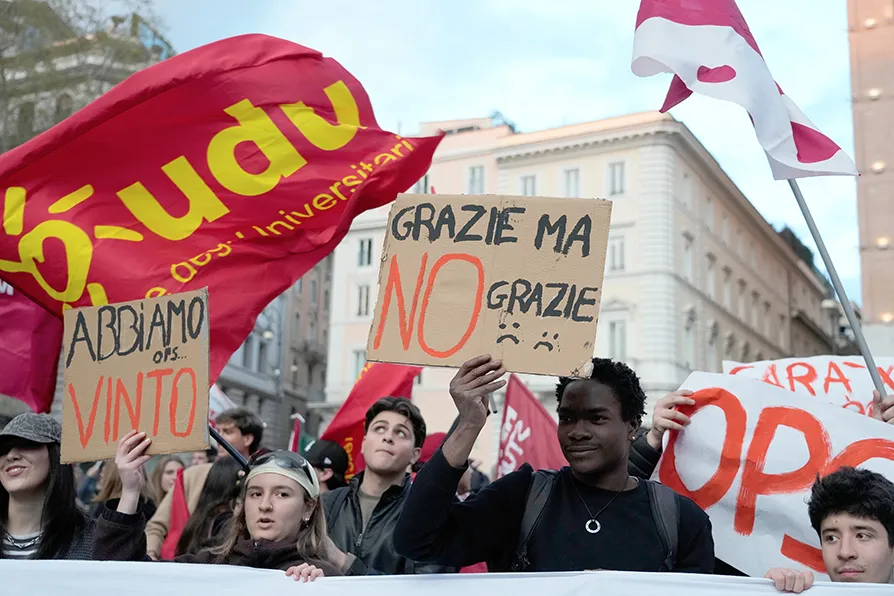
 IN YOUTH WE TRUST: Supporters of the "No" vote celebrate in Rome the outcome of a constitutional referendum that will cancel a justice reform approved by Parliament, placards read: ‘We won, oops!’ and ‘Thanks, but no thanks’

Without evidence or Nato consultations Berlin’s answer to the Leipzig incident is a rupture of relations. SEVIM DAGDELEN examines why
FRANCISCO DOMINGUEZ introduces the background to a conference on defending Latin America’s sovereignty
The glacier collapse in Nepal is yet another warning that a warming planet is making Himalayan disasters more frequent and destructive – but the countries facing the greatest risks are often those least responsible, says LI YANG
Nick Blair is set to benefit from a hugely lucrative contract to ‘virtually’ train the British army for its next war. Like father, like son, writes SOLOMON HUGHES
Even when tragedy strikes, Western media cannot resist the opportunity to turn it into a sordid propaganda opportunity, as the Nepal-China border tragedy shows, writes CARLOS MARTINEZ
Trade unions should be at the heart of the anti-racist push for reparations for the historic legacy and continuing impact of slavery, writes ROGER McKENZIE





ITALIAN voters have decisively rejected prime minister Giorgia Meloni’s keynote judicial reform — knocking into touch the plans of her right-wing coalition — and disrupting her strategy for next year’s general elections that include tweaking electoral law including the direct election for prime minister.
The opposition-backed “No” bloc took close to 54 per cent of the vote against 46 per cent. Turnout was higher than anticipated at almost 60 per cent with the youth vote decisive.
The opposition to Meloni’s plan somewhat energised a parliamentary opposition that has, in general, failed to deal effectively with the alliance of right-wing forces now under the hegemony of Meloni’s Fratelli di Italia/Brothers of Italy.
Social media has been suffused with AI-generated renditions of the Italian national anthem while the extra-parliamentary opposition has countered with demonstrations and its own social media output, mostly built around the Italian partisan song Bella Ciao.
“The Italians have decided and we respect this decision,” Meloni said. “Clearly, we regret this missed opportunity to modernise Italy, but this does not change our commitment to keep working seriously and resolutely for the good of the nation.”
Italy’s latest referendum was designed by the government majority to reconfigure Italy’s post war republican constitution. In particular Prime Minister Meloni argued that the judiciary is systematically “hostile to the executive” and cites decisions which have blocked migration policies, particularly a plan to process some asylum-seekers at a purpose-built detention centre in Albania.
Ministers from each of the rival right-wing government parties have united to accuse public prosecutors of impeding transfers out of the country and for freeing from detention migrants who challenged their detention orders.
Set aside the transparently manipulative immigration gambit; this is a long-running Italian political drama.
Magistrates, and their union, reject the government’s charges as political intimidation. The independence of the judiciary and particular role of investigating magistrates has always been a cause for great anxiety on the right of Italian politics especially where this has, in the past, threatened to expose the links between big business and crime organisations.
Italy’s secret state of competing intelligence and police organisations and their entanglement with Nato operations and the parties of the right lay at the heart of Italy’s unresolved 20th-century political crisis that only began to recede when the Italian left, in the wake of the counter-revolution in the Soviet Union and socialist Europe, lost its unity and cohesion.
The referendum followed a parliamentary vote which failed to get a two thirds majority.
Central to the proposed law was a revision of the system to select members of the Superior Council of the Judiciary (CSM) — this decides the career paths of judges and prosecutors.
Rather than, as at present, being elected, most would be chosen by sortition.
The clear aim of the government coalition was to break the judiciary’s professional culture and open up better chances for judicial figures more compliant to the right.
The Italian left and centre left have long historical experience of the way the institutional right in parliament, the presidency and the coercive apparatus of the state function as the arm of a corporate culture shot through with connections to criminal networks, Nato intelligence and a shadowy realm where the extensive machinery of the ruling class interacts with fascists and criminals.
For Italian magistrates the totemic figure is Giovanni Falcone. He prosecuted 475 mafiosi, convicting 344 of them. This prosecution meant that the state could no longer ignore the role of criminals in the state apparatus and politics.
His exposure of police corruption killed him and his wife, and his two bodyguards when half-ton bomb ordered by Corleonesi boss Salvatore “Toto” Riina caught him and his family on the way to Palermo airport.
By coincidence Supreme Court judge Corrado Carnevale — known as the “sentence killer” — who allowed many of defendants of Falcone’s prosecution to walk free from prison died last month aged 95.
And, entirely by design, the key leaders of the Italian right — Giorgia Meloni, Antonio Tajani, and Matteo Salvini — were ostentationally present at the funeral of former Lega/League boss Umberto Bossi — conveniently timed to fill the airwaves on last Sunday’s supposed “day of reflection” to allow Italians to calmly consider their vote. (Lega is a right-wing populist political party in Italy led by Matteo Salvini).
The purpose of the reform is to divide the High Council of the Judiciary (CSM) in two, separate out judicial career tracks, and give the state more disciplinary oversight. The right say it introduces efficiencies and cuts delays but the broader consensus is that the “reforms” will undermine judicial independence.
For the right this is a long standing goal. The authoritarian state that is Meloni’s objective has mobilised a right-wing narrative around migration but its real goals are more focused on systemic changes that would undermine the 1948 constitution which institutionalises equally the establishment of the republic and the victory over fascism and places labour at the centre of Italian values.
In an echo of Starmer-Labour’s reactionary stance on immigration and workplace relations a Yes vote would enable the government to make employers police their workforce for violations of immigration law.
For people in Britain where in the absence of a written constitution the ruling and political classes make it up as they go along, the attachment of the Italian left to the constitution seems unusual.
Its significance lies in the fact that it expresses a principled compromise between the main anti-fascist forces and this is why the right is so keen to weaken both its symbolic power and its practical protections.
It reflects a decisive break with the pre existing monarchical and fascist order, proclaims the democratic order and says sovereignty belongs to the people.
It recognises the dignity of the person, both as an individual and in social groups, expressing the notions of solidarity and equality without distinction of sex, race, language, religion, political opinion, personal and social conditions.
For this purpose, the right to work is also recognised, with labour considered the foundation of the Republic and a means to achieve individual and social development: every citizen has a duty to contribute to the development of the society, as much as they can, and the government must ensure the freedom and equality of every citizen.
The Partito Comunista Italiano — which is painfully working to bring the country’s fissiparous communist movement together — argues that the reform addresses extremely sensitive constitutional issues, undermining the autonomy and self-determination of the judiciary and directly impacting citizens’ freedoms.
Specifically, the separation of the Public Prosecutor from the judiciary disrupts the unity of the legal culture founded on impartiality and autonomy, which today guarantees balance and independence in all phases of judicial action, including preliminary investigations.
Italian communists argue that subjecting the investigating judiciary, even indirectly, to the influence of the executive branch jeopardises the principle of mandatory criminal prosecution and paves the way for a justice system conditioned by political power.
This perspective, they say, is incompatible with the rule of law and the fundamental principles of the Italian constitution.
In casting the referendum in such a way as to make the defence of the constitution expressed in the negative, and the reactionary goal a Yes vote, the governmental right aimed to mobilise the substantially reactionary biases of the Italian media.
This has been countered by a big mobilisation of the left wing and centre-left opinion with impressive demonstrations and a well argued campaign.
The right-wing government has been weakened and Meloni has suffered a rare personal setback.
This compounds the difficulties in her ruling alliance with Lega in trouble after the departure of its lead candidate for the European election. Crackpot paratroop general Roberto Vannucci abandoned Lega and threatens to form his own party.
The disunity on the right reflects different approaches to the EU, contrary stances on Nato’s proxy war in Ukraine and, for Vannucci, a more explicit admiration for Mussolini than is either fashionable or popular in the Lega.
The rump Forza Italia — the much diminished political vehicle of the late TV mogul Berlusconi — has its own leadership crisis.
The campaign has mobilised a broader constituency than the left could manage on its own and the more progressive tendencies in the Partito Democratico found a new voice while Italy’s wannabe Tony Blair and former PD leader, Matteo Renzi, abstained in the parliamentary vote and sidelined himself.
The unions played an active role in the campaign and young people — the Gaza generation — were decisive.
But, positive though this outcome is, the forces that made this possible do not have a coherent government programme or even a formal unity.
Meloni is more adroit than her fascist background might suggest and has seamlessly continued in a corporate cuddle with EU economic orthodoxy.
The political class including sections of the extra parliamentary left are in denial about the corporate neoliberal character of the European Union and thus concede ground to the right; remain bound to an economic policy grounded in submission to the bond markets and remain starry-eyed about Nato while the disparate left now see new opportunities.

Similar stories
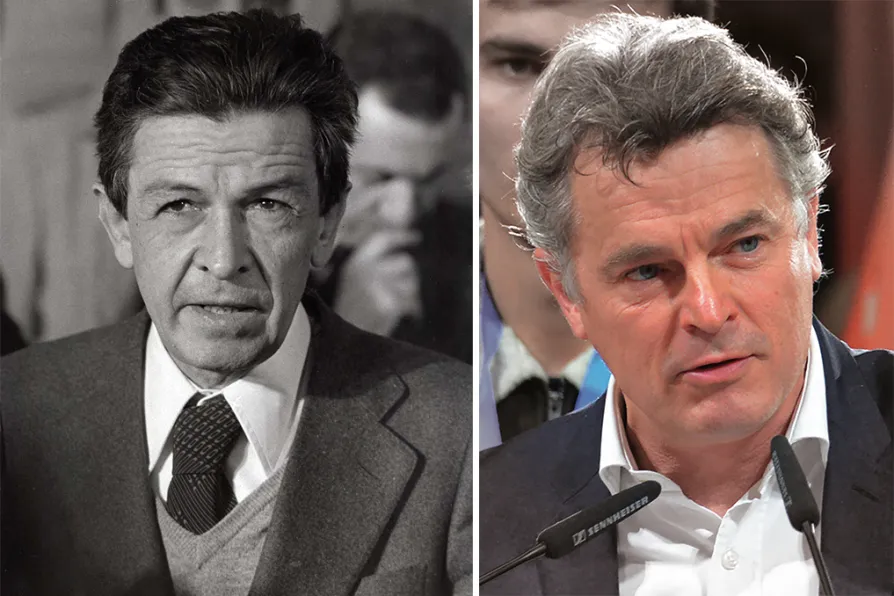
While Italy’s communist tradition remains fragmented and politically marginal, France’s party is attempting to re-establish itself as an independent force rooted in working-class organisation, says NICK WRIGHT

NICK WRIGHT continues his series analysing the trends in European politics

From Reform UK to Trump, Orban and beyond, the far right is organised across borders and growing. Waiting for it to collapse is a fatal error – building an international, locally rooted left alternative is now an urgent necessity., argues ROGER McKENZIE