A California union’s decision to host a meeting about US policy towards Cuba has prompted a congressional probe and renewed attacks on international solidarity, writes CAMERON HARRISON



Erdogan moves against the opposition
CLAUDIA WEBBE looks at how Britain’s Nato ally has upped the stakes in its effort to silence domestic dissenting voices
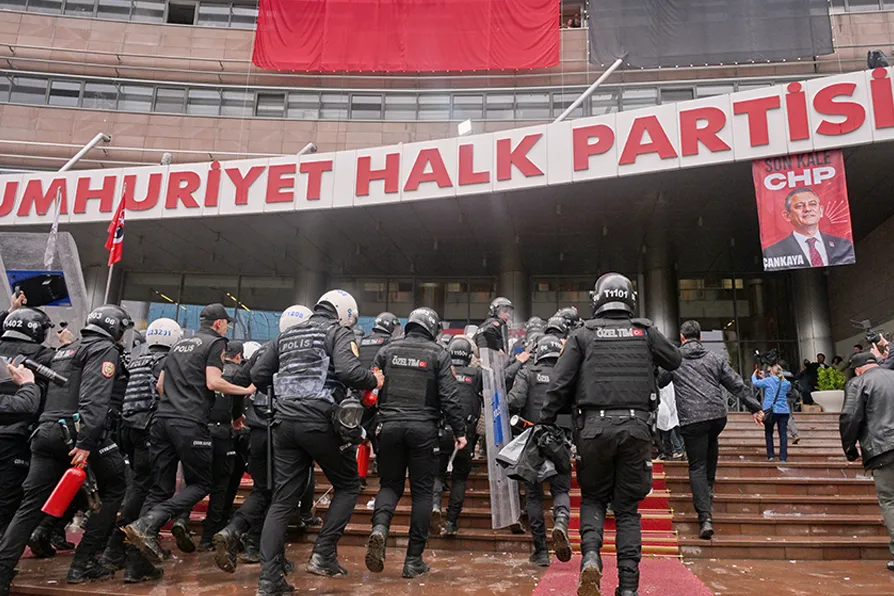
 IRON HEEL: Police officers storm Turkey's main opposition Republican People's Party (CHP) headquarters in Ankara on Sunday
The Baltic state is set to reverse its constitutional prohibition on nuclear weapons and foreign bases as part of accelerated Nato war preparations, warns TOM UNTERRAINER
Long-term underfunding and state neglect, while simultaneously probation services have been undermined, have intensified the prison crises, argues SOLOMON HUGHES
Holyrood incompetence has cost jobs and put the future of Clydeside’s Ferguson Marine shipyard into jeopardy. Its future should have been assured, argues KENNY MACASKILL
With the agitated debate now raging in the media about the early release schemes, Prison Officers Association general secretary STEVE GILLAN gives the view of those who work in the sector
The hounding of the late Jason Arday is an all too familiar experience for many black people. ROGER McKENZIE calls for collective action to combat what can feel like personal isolation





ON MAY 21 2026, an appeals court in Ankara did something that should have stopped the world in its tracks. Without evidence, and without reasoning, and no democratic mandate, the 36th Ankara Regional Court of Appeal declared the election of the leadership of the Republican People’s Party (CHP) — Turkey’s largest opposition party — null and void and reinstated a figure who lost a presidential election three years ago.
Riot police, three days later, fired tear gas into the CHP’s headquarters and they forcibly evicted the party’s elected leadership at the direction of the Ankara governor.
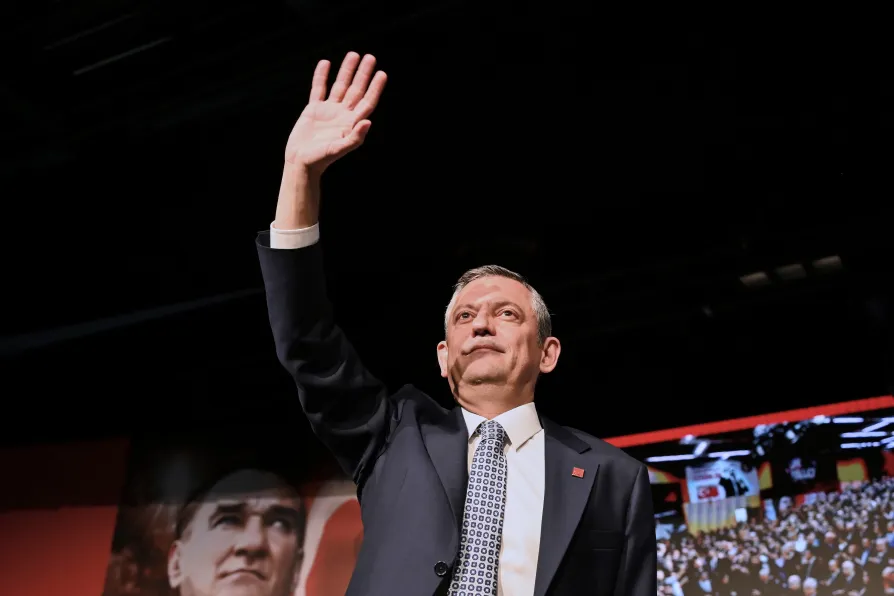
Ozgur Ozel, the now ousted CHP leader, broadcast from inside the building as police officers broke through barricades. “We are under attack,” he said. Arguably, he was not being dramatic. He was being accurate.
What happened in Turkey in the last week of May 2026 is effectively a judicial coup, ie, the use of state-controlled courts to accomplish what the ballot box has refused to deliver: the elimination of credible opposition to Recep Tayyip Erdogan.
This is all happening in broad daylight, in plain sight, within a country which is for all intents and purposes a Nato ally, an EU candidate state, and a partner in Western security architecture.
The silence from London, Brussels and Washington feels like a deliberate political choice to me, and I think it’s morally indefensible.
To understand the gravity of this moment that context is essential. The Ankara administrative court had already dismissed the case against Ozel in October 2025, ruling it had “no basis” in law.
On appeal, somehow, the same set of facts produced the opposite conclusion, one that happened to remove the leader who had spent two years building what is probably the most credible challenge to the ruling Justice and Development Party (AKP) dominance since it came to power in 2002.
This did not happen in isolation. Ekrem Imamoglu, who is Istanbul’s three-time elected mayor, and arguably, Erdogan’s most feared political rival, has been in pretrial detention since March 2025.
Imamoglu was arrested in a pre-dawn raid days before he was due to announce his presidential candidacy. Even his university degree was revoked, by administrative decree before his arrest.
Taken together, this can only be described as an act designed to disqualify him from standing for the presidency. He faces a prosecution demanding 2,430 years in prison in an indictment spanning 4,000 pages.
The European Parliament has formally described his prosecution as “politically motivated.”
Kurdish politician Selahattin Demirtas has been imprisoned since November 2016. The European Court of Human Rights has twice ruled his detention violates Articles 5 and 18 of the European Convention on Human Rights.
Turkey has ignored the ruling twice. The court found explicitly that his imprisonment served to “stifle pluralism and limit freedom of political debate.” He has now spent a decade as what he himself called a “political hostage.”
On May 22 2026, during the same week as the CHP leadership coup, Istanbul Bilgi University was shut down by presidential decree in the middle of the night. The closure was with immediate effect and no reasoning was given.
Some 22,000 students and thousands of academic staff were thrown into profound uncertainty overnight. A law professor at the university wrote on social media: “A university built with 30 years of effort was shut down overnight.”
It is important to note that these are not all separate stories. We must read them as chapters in the same book.
Unbelievably, Turkey’s prisons now hold over 400,000 people, thus operating at 131 per cent of official capacity. As of April 2026, more than 62,000 are in pretrial detention alone, a figure that rose sharply following the crackdown after Imamoglu’s arrest.
The prison population has increased sevenfold since the AKP came to power in 2002.
In 2025, 29 journalists were arrested and the courts had imposed sentences totalling over 45 years on members of the press. Turkey ranked 163rd out of 180 countries in the 2026 Reporters Without Borders (RSF) World Press Freedom Index.
The European Parliament adopted a report in April 2026 which concludes that Turkey’s EU accession process cannot resume due to “democratic backsliding.” The accession process has been frozen since 2018.
The pattern MEPs identified is consistent and documented: the transformation of Turkey’s political system into what scholars call “competitive authoritarianism,” retaining the forms of electoral governance while systematically gutting its substance.
What makes the current moment particularly significant is the speed and simultaneity of the assault. A court removes an opposition leader, then police storm the opposition’s headquarters, and a university is closed.
These events occurred within the span of four days. Rather than gradual erosion, it would appear that this is acceleration of the process of repression.
Given all of this, Turkey’s workers, Kurds, feminists, students and academics have demonstrated notable courage. The protests following Imamoglu’s arrest in March 2025 were among the largest in Turkey’s history.
We saw university students leading demonstrations on campuses across the country. Women have been at the front lines of resistance, from feminist marches on International Women’s Day to the party members who held the CHP headquarters this week.
It is clear that Turkey’s organised left and resistance movements are fighting. In solidarity, they deserve an international movement that matches their resolve.
The trade union movement, human rights organisations, and progressive political parties in Britain have a particular responsibility. Your Party’s parliamentary leader Jeremy Corbyn has already spoken out in solidarity.
Parliament and ministers must be pressed on whether the UK is prepared to use the instruments of its diplomatic and economic relationship with Turkey to defend political freedoms, or whether strategic interests will, once again, function as a veto on moral clarity.
Fifteen CHP democratically elected mayors are currently behind bars in Turkey. These are people elected by millions and yet they are jailed by a government that ran out of arguments and reached for handcuffs instead.
History will remember this week in Ankara. It will remember the tear gas at the CHP HQ on May 24 2026. It will remember the single-sentence decree that closed a university in the night.
And it will remember whether the international community, and the British left in particular, responded with the urgency that solidarity demands, or whether it looked away.
Recep Tayyip Erdogan has made his choice. The question now is what ours will be.
Claudia Webbe was the Member of Parliament for Leicester East (2019-2024). You can follow her at https://www.facebook.com/claudiaforLE/ and https://x.com/claudiawebbe

Similar stories

ANSELM ELDERGILL examines the difficulties surrounding freedom of expression