Labour must deliver its manifesto promises in full and begin the bigger task of restoring workers’ collective power, says MATT WRACK


 Latest editorial
This is not a momentary backlash but a co-ordinated far-right offensive
From Reform UK to Trump, Orban and beyond, the far right is organised across borders and growing. Waiting for it to collapse is a fatal error – building an international, locally rooted left alternative is now an urgent necessity., argues ROGER McKENZIE
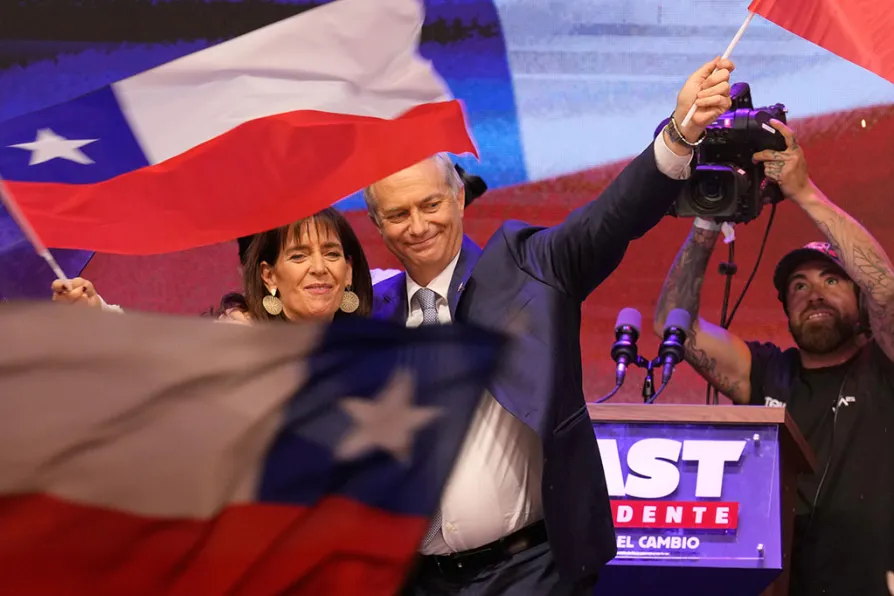 Far right: Nazi’s son and new Chilean President José Antonio Kast
This summer’s fire outbreaks highlighted once again the deadly cost of job, equipment and funding cuts to the fire service. Ten years after the Grenfell tragedy, serious lessons still need to be learned, says STEVE WRIGHT
Live music and musical education are both under attack and threaten to impoverish our culture. The Musicians’ Union seeks allies in the fightback, writes NAOMI POHL
The TUC fell for the illusion of a ‘Social Europe’ in 1988 and backed single-market membership. DOUG NICHOLLS argues that dramatic changes in the EU prove the need for an independent economic policy
As Cuba faces an unprecedented US energy siege and growing threats of military intervention, TUC Congress must stand unequivocally with Cuban workers and their right to determine their own future, writes STEVE GILLAN, POA general secretary and TUC president
By organising for boycotts, divestment and sanctions, trade unionists can turn solidarity into action, writes JESS BARNARD





IT IS wrong to dismiss the rise of the far right as an unco-ordinated temporary local difficulty.
The rise of the far right is a global phenomenon that, while it must be confronted on local, regional and national levels, must also be addressed on a global basis.
We face our own version of the far right in Britain with Reform UK and its various allies, such as those who choose to follow the grifter Tommy Robinson — real name Stephen Yaxley-Lennon.
But they are part of a global wave of far-right politics and authoritarianism that includes United States President Donald Trump, Argentina’s President Javier Milei and also, elected last week, Jose Antonio Kast in Chile.
In the US, the White House has put troops on the streets of targeted, mainly black, cities with sweeping immigration raids. These raids have even led to black or Hispanic origin US citizens being detained in the streets, shops or even dragged from their homes if they could not satisfy the officials they were legally in the country.
But the far right is also on the ascendency across Europe.
It is already in power in both Italy and Hungary.
In Italy Giorgia Meloni’s neofascist Brothers of Italy party won the 2022 parliamentary elections.
She now leads a coalition government and struts the international stage backed up at home by another far-right party, Matteo Salvini’s anti-immigrant League, and the only slightly less right-wing Forza Italia, founded by former premier Silvio Berlusconi.
In Hungary authoritarian Viktor Orban has been prime minister since 2010 and has served four consecutive terms with his far right Fidesz party.
The far right has been in coalition governments in the Netherlands, Slovakia and Finland.
In the Netherlands, Geert Wilders, of the far-right Freedom Party (PVV) won elections in 2023 but failed to win agreement for him to head a coalition with three right-wing parties.
He had to give up his ambitions to become premier as some parties threatened to split due to his anti-Islam positions.
Instead a senior official, Dick Schoof, became prime minister — although that government fell and Rob Jetten, a liberal, was recently sworn in as the country’s new prime minister.
In Slovakia, the nationalist SNS party is part of a right-wing three-party governing coalition led by Prime Minister Robert Fico of the Smer-SD party.
In Finland, the far right Finns Party came second in the 2023 parliamentary elections and is part of the ruling coalition formed by the country’s right-wing new Prime Minister Petteri Orpo, whose National Coalition won the elections.
Other far-right parties have been key influencers in their countries politics and have dragged national political debate in their direction.
In Sweden the far-right Sweden Democrats (SD) came second in the country’s 2022 parliamentary elections. They do not have a representative in government but heavily influences the direction Prime Minister Ulf Kristersson’s right-wing majority government takes — particularly on immigration.
Other far-right parties have secured millions of votes but have not taken over as governments.
In France, a left-wing alliance formed for the 2024 legislative elections blocked the rise to power of the far-right National Rally (RN).
But, RN, whose leader Marine Le Pen reached the run-off round in the last two presidential elections, is now the largest single party in the French parliament.
In Austria the far-right Freedom party (FPOe) topped polls for the first time in 2024.
The party, which was founded by Nazis and is now led by Herbert Kickl, invited the conservative People’s Party (OeVP) to start negotiations to form a government, but the talks broke down on February 12.
But the two far-right parties have formed coalitions to govern five of Austria’s nine regions.
The far right has also made significant breakthroughs in Germany, Belgium and Portugal.
In Germany the far right AfD doubled its score in the Bundestag elections this year, reaching 20.8 per cent, behind the Christian Democrats.
The Christian Democrats ruled out forming a coalition government with the far right party but still appear to be heavily skewing their politics to accommodate AfD policies around immigration.
In the 2024 elections in Belgium, the far-right Vlaams Belang won 31 of the 124 seats in the Flemish parliament and is the largest opposition group at the federal level with 20 deputies.
Portugal’s far-right Chega (Enough) party is the country’s third biggest political force. Chega increased its seats from 12 to 50, with 18 per cent of the vote in last year’s parliamentary elections.
In the 2024 British general election the anti-immigration party Reform UK led by chancer Nigel Farage won just over 14 per cent of the vote and five seats in parliament.
The fact that people are prepared to go to the polls to vote for these authoritarian chancers across Europe and elsewhere is only part of the picture.
These politicians give permission for people to enact their wildest racist and authoritarian fantasies. It also helps to heighten the tensions so that workplaces and communities become far more hostile to anyone who is not immediately considered white or a bone-fide national.
But none of this just appears out of the ether.
Money is flowing internationally from far-right institutions and mega-rich individuals to fund this movement of hate.
With summits like the pan-Christian Right World Congress of Families, through joint proclamations like the red-baiting Madrid Charter, with characters like Steve Bannon jetting around the world building far-right networks with a seemingly bottomless bag of funds.
Recent attempts by Robinson in Britain to tune into the mega funds available from the US Christian far right by holding an ultimately unsuccessful — for now — “Christmas carol service,” is an obvious danger.
There are also far-right academic institutions like Hungary’s Mathias Corvinus Collegium that provide the “intellectual” underpinning for this global movement.
It is a huge mistake to believe we can rely on the past practice of waiting for this far-right global movement to self-destruct as they have often done in the past.
They are far better organised and funded than they ever have been in the past.
Our job on the left is to organise on a local, regional, national and international level more effectively than we are doing.
That of course does mean marches and conferences — both of which we are very good at. But it must also mean going into areas and engaging with people who currently do not agree with us.
Name-calling on its own may be satisfying at many levels but it’s unlikely to shift many people — if any — to our side.
We need to learn to translate our Marxist principles into a language in workplaces and communities that people can actually relate to.
Talking to them like we have swallowed a Marxist dictionary or admonishing them for their wrongness is simply not what’s called for.
The global rise of the far right may seem unstoppable at the moment but I believe we can defeat them if we are organised and reach out to people in a way they can relate to.

Similar stories
Italians reject controversial judiciary reforms in a referendum that boosts the left, reports NICK WRIGHT