Even the oligarchs of the artificial intelligence industries are warning that their creations have the capacity for the ultimate destruction of the planet and its population. ANDREW MURRAY suggests that there might just be other solutions


 Latest editorial
Imprisoned women: Scotland’s practices under the spotlight
NORMA AUSTIN HART reports from a conference on on the rights of women prisoners in the Scottish criminal justice system
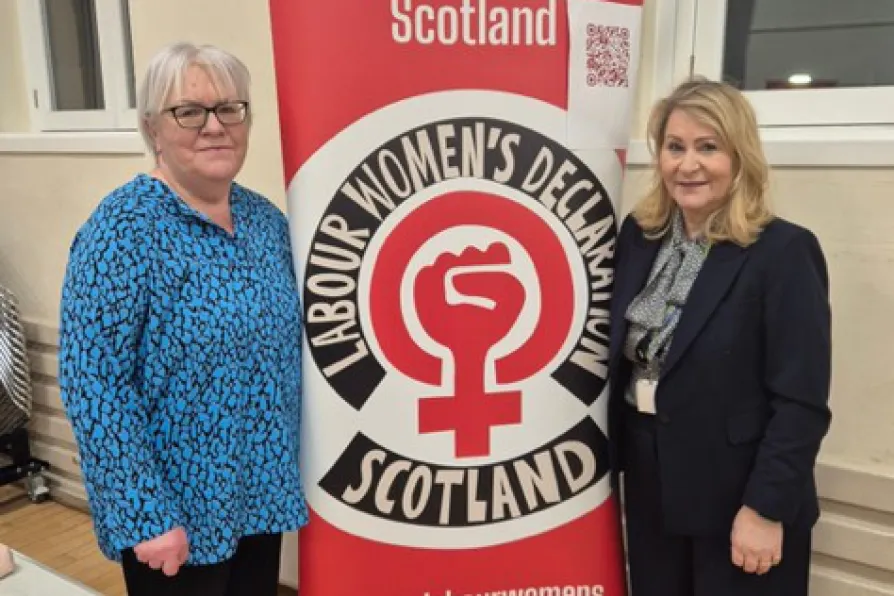 (Left) Johann Lamont and (right) Pauline McNeill
The Labour government must deliver on its commitment to bring back privatised services into the public sector. This not only saves money but also creates accountability and generates wider social benefits, argues ANDY MCDONALD MP
PCS is demanding the long-overdue return of essential services to public ownership, explains FRAN HEATHCOTE
Despite promises of a new era of insourcing, billions of pounds of public contracts continue to flow to private firms. Unions are now calling for urgent action to bring services back in-house, says EDDIE DEMPSEY
Public ownership of Great British Railways has enormous potential to improve our railway network, but that can’t happen unless jobs, employee rights and union recognition is at the heart of the transition, argues MARYAM ESLAMDOUST
If Labour is genuinely committed to supporting working-class students it must act urgently to reverse the funding crisis affecting universities and colleges, JO GRADY tells Christophe Domec
Challenges from the unscrupulous misuse of AI to steal actors’ voice and physical likenesses is being met with a firm union response, writes LYNDA ROOKE





TO MARK International Women’s Day last week, Labour Women’s Declaration (LWD) hosted a reflective event in Edinburgh on the rights of women prisoners in the Scottish criminal justice system.
The attentive audience in Edinburgh heard from four experts: an academic, a co-ordinator of a support project for women in the sex industry, a prison governor and a politician.
Retired leader of the Scottish Labour Party Johann Lamont opened the session by thanking LWD for the opportunity for a nuanced discussion about this complex issue.
Dr Claire Methven O’Brien spoke in a personal capacity about her research into human rights for women prisoners. She has drawn on the layers of human rights standards that apply, both domestic and international, and has found that many of the standards on inhuman or degrading treatment are relevant to women in prison but have not been part of the debate in Scotland.
For example, Article Three of the European Regional Human Rights standards would be violated by requiring a prisoner to undress before the opposite sex — O’Brien talked in detail about the state’s obligation to meet these standards regardless of cost or availability of practical means to resolve the issue.
Progress in achieving the minimum standard is challenged by the absence of case law in this area, exacerbated by it being a very small part of the legal aid population.
Under all these weaknesses is a fundamental misunderstanding of how the state should protect women in prison. The care of women prisoners should not mirror the that of men.
Equality of treatment is not the appropriate measure, women’s needs in prison are different. Their protection should be asymmetric and understood within a human rights framework.
Linda Thompson is the national co-ordinator of the Women’s Support Project (WSP). Their job is to support women involved in the criminal justice system, in particular women involved in commercial sex exploitation.
It is clear that the systemic approach to addressing the abuse of prostitutes isn’t working. The criminal justice system has failed women who are exploited, neglected and unprotected in brothels and on the street. There are numerous infamous examples of men not being held accountable for their part in commercial sex exploitation.
Prostitutes are still seen as criminals by the criminal justice system and at the same time they experience the highest levels of violence and rape.
The WSP’s research shows 78 per cent of women in Child Sexual Exploitation (CSE) have experienced violence. These women are not a priority and they know it and feel it.
The project also has research demonstrating violence against prostitutes is increasing at all levels, including up to murder, most of it remaining unreported and unrecorded.
Men committing acts of violence know that there is a good chance they will never be held accountable for their crime.
The reasons why these crimes are not reported are not well understood. Women working in CSE are desensitised to violence and they are frightened of being criminalised. Perpetrators know this and exploit the system with impunity.
Thompson observed that, unbelievably, prison can offer a break — a break from the world of organised crime, drugs and domestic violence.
Women are frequently caught in a cycle of recovery and return to CSE because of lack of support with housing, custody and addiction treatment and mental health problems on release.
We will not solve this by criminalising women, refusing to remove their convictions for prostitution and limiting the availability of support for exiting CSE.
Thompson emphasised that “sex work is work” as an unchallenged mantra is unacceptable, and encouraged the receptive audience to push back on its use.
The third speaker, Rhona Hotchkiss, a former governor of Dumfries, Cornton Vale and Greenock prisons gave the audience a reality check on the number of women in Scottish prisons.
Scotland has almost three times the number of women in prison now compared to her target as a government adviser 10 years ago (Average Daily Population in 2024-25 was 345 as opposed to 319 in 2023-24; in total 1,005 women experienced imprisonment in 2024-25).
The surprise for many in the audience was not the number but the reason for the number. Many judges now refer women to prison, often “on remand,” because the women will get the support they need in the secure environment that is not easily available outside: mental health and addiction services in particular.
Almost a third of women in prison are serving life or ten years’ plus sentences. Many are there for attacking men who have hurt them. The criminal justice system has to get better at recognising the circumstances of these women.
Poverty is not an absolute cause of criminality in these women but it is a huge influence.
The government and public institutions have to address the multiple causes of trauma experienced by these women. Hotchkiss urged government to make a huge investment in social housing, at the same time relaxing rules on terminating secured tenancies for those serving short sentences.
The government should be able to deliver a universal basic income, fully funded rehabilitation services and fully funded mental health support.
Pauline McNeill, MSP for Scottish Labour, spoke from her experience in the Scottish Parliament as the Labour lead on violence against women and girls.
She supported the Prostitution (Offences and Support) Scotland Bill lodged by independent MSP Ash Regan – known as the Unbuyable Bill, and had been appalled that it fell due to the lack of time given to debating such important legislation.
McNeill spoke powerfully on the facts around violence against women and girls, as rape and attempted rape convictions have increased by 25 per cent in four years, with an increase in reporting. The incidence of sex-based cyber-crime has also increased massively. The vast majority of deep fake images are of women and girls.
While legislation can help, McNeill stressed how much a change in public attitudes is needed.
Picking up on the various contributions, Lamont spoke for many by memorably saying: “If Isla Bryson is the logical conclusion of self-ID, then apprenticeships in brothels is the logical conclusion of ‘sex work is work’.”
Thoughtful questions to the panel concluded the meeting, which really focused everyone on the irony that, despite prolific legislation and debate, the number of women in Scottish prisons continues to increase and outcomes to deteriorate.
With the Scottish Parliament elections on the horizon (May 2026), every political party must be expected to make clear its intentions to reverse this unacceptable situation.

Similar stories

ANNA FISHER explores what would it mean for women’s equality and public safety if Britain embraces full commercialisation of the sex trade

Legal frameworks designed to safeguard women are too often weaponised against them, reinforcing male power and entrenching injustice. The FiLiA Ending MVAWG Team highlight some of the issues

As Ash Regan’s Unbuyable Bill sparks debate in Scotland, the real issue remains unaddressed: a digitalised sex industry and a neoliberal economy that repackages exploitation as empowerment while leaving women’s material conditions unchanged, argues LAUREN HARPER