Cuban trade union federation CTC leader OSNAY MIGUEL COLINA speaks to Ben Chacko about life and work under a crippling US siege


 Latest editorial
How should we tackle the menace of Reform UK?
As debate grows inside the labour movement over how to respond to Reform UK, DIANE ABBOTT argues that silence on racism is politically disastrous
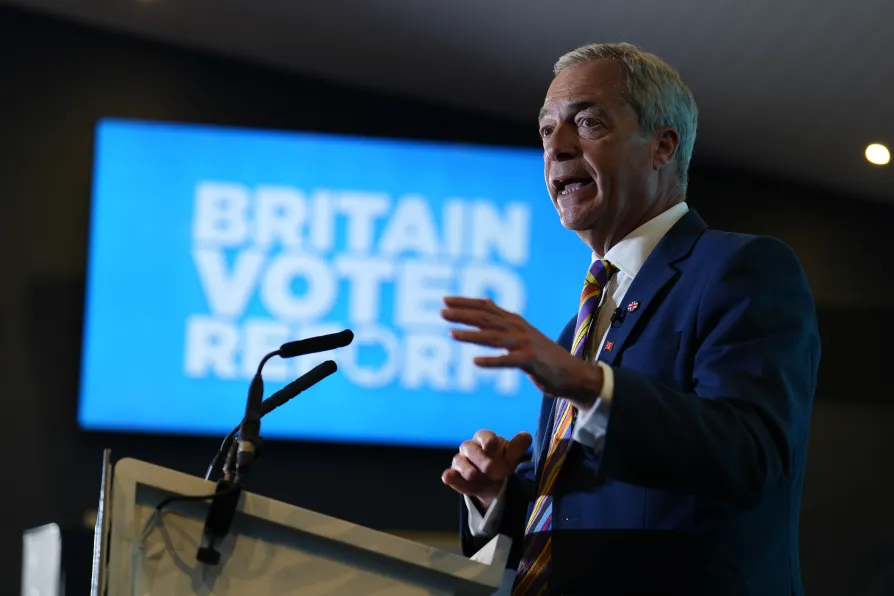 Reform UK leader Nigel Farage speaks to supporters at Chelmsford City Racecourse, Essex, following the 2026 local election results, May 8, 2026

A part of the British empire’s network of slavery, today the Caribbean island of Nevis faces a new form of exploitation in the form of crypto-colonialism, CLAUDIA WEBBE writes
A new book by Victoria Holmes illuminates the many hidden histories of the oppression experienced by Gypsy/Roma/Traveller community, writes ROGER McKENZIE
Even the oligarchs of the artificial intelligence industries are warning that their creations have the capacity for the ultimate destruction of the planet and its population. ANDREW MURRAY suggests that there might just be other solutions
The Labour government must deliver on its commitment to bring back privatised services into the public sector. This not only saves money but also creates accountability and generates wider social benefits, argues ANDY MCDONALD MP
Public ownership of Great British Railways has enormous potential to improve our railway network, but that can’t happen unless jobs, employee rights and union recognition is at the heart of the transition, argues MARYAM ESLAMDOUST
Challenges from the unscrupulous misuse of AI to steal actors’ voice and physical likenesses is being met with a firm union response, writes LYNDA ROOKE





THE advance of Reform UK at the May 7 elections demands the most urgent response from anti-racists, trade unionists, democrats and socialists.
Reform UK is an immediate threat to black people, migrants, refugees, LGBT+ people and Muslims. Its policies are also a severe danger to all working-class people and everyone who wants a better future for the majority in Britain.
It is a party that poses as the friend of ordinary people but serves the rich — including numerous ultra-rich at the top of Reform UK.
Nigel Farage could be the next prime minister and that would be a disaster for the NHS, for education, for union rights and for public services, as well as boosting the vilest racist policies. Already Reform UK’s electoral success gives confidence to fascists such as Tommy Robinson and intensifies the push to scapegoat minorities.
The justified fury at the failures of mainstream parties and the current chaos will give Farage more opportunities.
There is no room for complacency, and no anti-racist or trade union organisation can say, “We have all the answers, just do what we say.” There has to be constant reassessment of what we are doing right and where we can do better.
That’s why I want to respond seriously to a discussion at the recent CWU union conference.
The Morning Star reported on May 10 that delegates had “expressed fear that current anti-racist strategy is ‘alienating working-class people.’ A motion urging the union to provide greater assistance to protests organised by Stand Up to Racism (SUTR) and the Together Alliance was overwhelmingly rejected.”
And the paper quotes CWU general secretary Dave Ward saying: “The current strategy of organisations like Stand Up to Racism is simply not working. It is alienating working-class people.”
But it is not anti-racism that divides working-class people — it’s racism that wrecks black lives, tears up communities and puts forward a fake enemy to distract from the crimes of the rich and powerful.
We desperately need an alternative to war, austerity and racism, one that measures up to the anger felt by many people at the way their lives and neighbourhoods are hollowed out by rampant capitalism.
But you cannot tackle Reform UK just by highlighting its appalling polices on the health service and workers’ rights. To be silent or to indulge its racism is to leave untouched the glue that binds Reform supporters together.
It is to abandon sections of the working class in the supposed name of “class unity.” It will be the road to hell if we say to working-class voters: “You’re right about migrants cutting wages and undermining our communities, but please don’t vote Reform because they will bring back the three-child benefit cap and privatise the NHS.”
It is wrong and it does not work. Silence or complicity on Farage’s immigration policies only strengthens him — as Labour’s abysmal polling shows.
Already we see Labour’s leadership pushing forward new rounds of attacks on migrants in the false belief this will weaken Farage. You don’t beat racists by accepting their terms of debate or half-implementing their programme.
In that context I am proud of the work SUTR has done, but we have also shifted our approach to meet new challenges.
In the summer of 2024, the far right went on the streets after the dreadful murder of three young girls in Southport. It was SUTR, alongside others, who mobilised against the attempts to destroy mosques and burn out refugees.
A year later, it was SUTR which confronted the systematic assaults on refugee accommodation. In both cases while some others stood aside, SUTR took the lead. And we beat back the immediate threat to those refugee hotels from the far right.
SUTR was right to show the active involvement of fascists in these protests — for example, when Robert Jenrick (then a leading Tory figure, now a top Reform UK one) last August attended a rally organised by members of the Homeland Party in Epping, whose members have a history of endorsing racism and terrorism.
Jenrick later posted pictures of himself with demonstrators including founders of neonazi terror gang Combat 18. The numerals in Combat 18 refer to the first and eighth letters of the alphabet, referencing the name of Adolf Hitler.
Then came Tommy Robinson’s very big demonstration in London on September 13 last year. Anti-racists were severely outnumbered. SUTR, co-operating with a broad range of working-class, faith and community organisations and using the power of music, art and culture, was part of the Together Alliance that gathered half a million people in London for unity and against the foul ideology of the far right.
So, when anyone says they want an alternative to Stand Up to Racism, they denigrate that success without actually offering an alternative.
Because ours was a real achievement, perhaps the biggest-ever anti-racist demonstration in Britain. And we have also strengthened our joint work with the Palestine solidarity movement, recognising what we have in common.
SUTR has been central to local Unity marches from Dundee to the south-west of England that have shown active opposition to Reform UK and fascism. We are rooted in communities up and down the country.
And it’s not just the major national initiatives that matter. SUTR’s most recent round-up of local work shows the patient and consistent arduous work that is the necessary bedrock to effective action. This includes a contribution from Lincoln.
An activist reports: “SUTR covered the whole of Castle ward where Reform was predicted to win. We gave out 4,000 of our leaflets in nine days. Talking to people on the doorstep it’s clear working-class voters are desperate for change, and some are gravitating to Reform but are shocked when you point out their politics.” Reform lost the ward by 100 votes, almost certainly the direct result of SUTR’s work.
There is a big task ahead. I hope that all Morning Star readers will join this Saturday’s march to oppose Tommy Robinson and to remember the Nakba.
And trade unions are crucial in the anti-racist and anti-Reform UK campaigns to come. I look forward to the CWU being a major presence in all this work and at the Together summits in October in London and Manchester.
As Paul Garraway, a CWU delegate, this week said: “We can’t cede the streets to the fascists.
“The Together Alliance demonstration proved there’s much more of us than them, and we need to build that.”
Diane Abbott is MP for Hackney North and Stoke Newington.
