A new generation of right-wing politicians have shifted from promoting deregulation to championing anti-migrant politics warns SOLOMON HUGHES


 Latest editorial

To hell with social mobility: it’s workers moving together who will change this country
From childhood summers in a post-industrial village to midnight picket lines in Glasgow, the promise of ‘social mobility’ rings hollow for MATT KERR
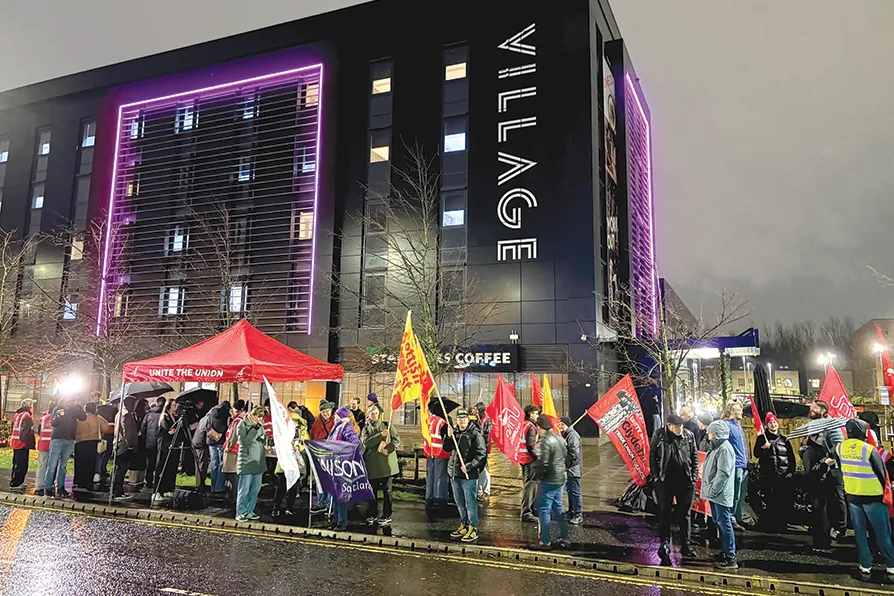 SITES OF RESISTANCE: Glasgow Govan’s Village Hotel strikers have been victorious [Pic: Matt Kerr]

by the Greater Manchester Workers’ and Tenants’ Association
The US relationship with Israel has evolved into a strategic liability, argues RAMZY BAROUD
A champion motorcyclist, trade union organiser and communist, Clem Beckett went from Britain’s speedway tracks to the battlefields of Spain, where he gave his life resisting Franco’s forces at Jarama. GEOFF BOTTOMS pays tribute to this remarkable anti-fascist
The greatest threat to democracy may no longer come from political parties but from unelected tech oligarchs like Peter Thiel and his powerful Silicon Valley network, argues JOHN GREEN
Claiming to ease a fertiliser shortage, the Trump administration has suspended tariffs on Moroccan phosphate imports – deepening US support for the Morocco’s control over Sahrawi territory, writes LUKE ROTELLO





WHEN others would head for the coast of a summer, we would head inland to Muirhead. I used to look forward to the smell of the coal fire and my granny soup when we got in — they were Scottish summers after all.
The nearby Cardowan pit had closed a few years earlier, and while my grandpa was able to treat himself to a few new tools from the redundancy money, even as a sproglet there was a sense that the walls might just be closing in for the next generation.
My youngest uncle lived there too. He’d come of age at just the right moment to catch the tide of unemployment that swept across the communities that built everything, even today, many of us hold dear, a wave his elder siblings had only just been old enough to dodge.
His cynicism and obsession with music and motorbikes at the time made him very much the cool uncle. Always reading, always full of odd facts, and always up for a wind-up.
He once wrapped me in bandages and told me to wander out into the street and tell people I was Howard Hughes. I had no idea who Mr Hughes was at the time, but happily went along with it. He schooled the six-year-old me in how to answer the “and do you want to be a GPO engineer like your Dad?” question from a great, great aunt.
“No,” said I, telling her in my innocence, “I’m going to be a genetic engineer.” A tumbleweed moment before I knew what tumbleweed was, punctuated only by his laughter from next door.
He’d greet the nieces and nephews that were usually deposited in Muirhead over the summer with “are we all spiffing and upwardly mobile today?”
We knew it was sarcasm, but none of us had the slightest idea what he was on about.
Upward mobility was a bit of a thing in the ’80s, it would appear. The phrase has now fallen out of favour, being substituted for the equally vacuous “social mobility.” There’s even a Social Mobility Commission.
If I had ever crossed paths with this commission in the past, I clearly sent it to the furthest reaches of my brain, where even there it takes up too much space, to be forgotten. This week, however, up it popped again.
It started life as the Social Mobility and Child Poverty Commission, but presumably by 2016 when one in every three users of a foodbank was a child, Tory ministers thought it best to drop the “child poverty” part.
Almost a decade on, it published its State of the Nation report this week. The figures it produced are very telling indeed. In 2014-16, 36.1 per cent of 25-29-year-olds moved into “professional careers,” a figure that rose to 48.2 per cent by 2022-24, while 22 per cent of working-class young people are not in employment, education, training or work, more than twice the rate for young people from “professional backgrounds.”
I was stunned to read this. Housing mobility also continues to decline, an odd turn of phrase to show living in a van is becoming a more realistic prospect for most young people than living in a house.
The report also found that areas that survived the industrial vandalism of incompetent industry and sadistic government at the end of the last century continue to live with a legacy of poorer educational outcomes and work chances for the young people growing up with that carnage as a horror story told to them by their grandparents.
The missing link between the “upward mobility” catchphrase and today’s “social mobility” is John Major’s proclamation of a “classless society” when he replaced Thatcher in No 10. Thirty-odd years on, the Social Mobility Commission does at least reference class in its paper, though I can’t help but wonder if it knows why.
The commission aspires to “move away from a narrow focus on moving a select few from the ‘bottom’ into the ‘top,’ to a broader view of different kinds of social mobility, sometimes over shorter distances, for a greater number of people.”
It can only do what is asked of it, I suppose, but the politicians with the usual paltry ambition are asking it the wrong questions. Of course in this world of possibilities, it remains an obscenity that riches lead to riches and poverty to poverty, but a bit of mentoring doesn’t change that.
A new industrial revolution is being visited on a society yet to come to terms with the last one. On the road ahead, it won’t be weavers being replaced by machines, but the very “professional careers” that have been packaged and sold to us as a hallmark of social mobility. As machines become ever smarter, workers face being deskilled but subject to the same old challenge of only being useful to an employer when they either don’t have the will or means to stump up for a machine.
The canary in the mine here was the death of the automatic car wash over recent decades. The few that remain sit like clumsy monuments to full employment in service stations around the country while on waste ground next door migrant workers with degrees spend day after day freezing, cold, and wet, scrubbing cars for next to nothing.
I’m not sure this is the social mobility being imagined.
It bears a closer resemblance to George Orwell’s vision of “a boot stamping on a human face — for ever,” an image with which I’m sure he was very familiar as a snitching ex-colonial cop.
Other futures are however available.
On Thursday night I wandered along to the picket at the Village Hotel in Govan. Fresh from their victories in their dispute over the summer, they’re back to finish the job on pay and union recognition. To see young people who have barely entered the world of work never mind the trade union movement show this confidence, this strength, in the face of Blackstone — a trillion-dollar corporate behemoth — is a thing of beauty and hope.
Just along the road on the same night, their Unite Hospitality comrades at the Vue cinema at Glasgow’s St Enoch Centre stood in the pouring rain. From 11pm until 2am, they picketed the premier of the latest Avatar movie.
There was plenty of support out there for young people looking for a living wage, decent hours and a safe ride home at the end of a shift.
At the very least, the sight of a picket line in the middle of town in the middle of the night aroused the curiosity of passing Christmas revellers somewhat the worse for wear, one volunteering to strikers: “I don’t believe in Germans.”
There’s a man who needs to be more mobile.
The task of those strikers is to win basic decency at work, a modest demand from companies they deliver millions in profit to. Strikes, organisation in the workplace and collective action are never just that though. If they were, employers wouldn’t bother at all.
The sparks of collective action start fires, clearing space to see the bigger picture in all its devastating glory.
I wouldn’t bet against these workers, but whether they win this particular battle or lose, they’ll be back with reinforcements having spread their organisation, energy and hope to cinemas and hotels across the country, not as mentors to lift the heads of a few here and there, but as a beacon to our class.
We all have our dreams, hopes and aspirations, but they know it is rising with your class, not out of it, that will change this world.
To hell then with social mobility, whatever it means, let’s make sure it’s workers — all workers — on the move in 2026.
I’ll see you on the road.
