


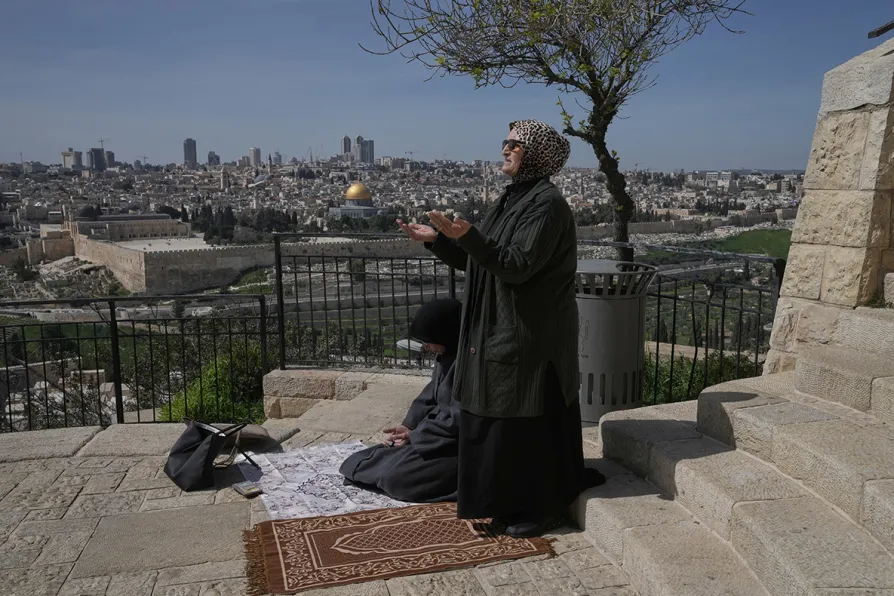
 Palestinian women offer Friday Ramadan prayers in Jerusalem, as the Old City remains closed to visitors under nationwide Home Front Command restrictions banning large gatherings amid the war with Iran, March 6, 2026






THIS international women’s day, the world is descending into war.
For much of the Middle East, now the epicentre of an escalating war on Iran, war without end has been the experience since the “war on terror” began over two decades ago.
Increasingly we are seeing war without limits, as the United States sinks ships in the Indian Ocean and blows them up in the Caribbean, kidnaps and kills the leaders of other states, tries to strangle Cuba and threatens Mexico, Canada, Greenland.
War is a women’s issue. Most combatants are men but most casualties are not. The war on Iran opened with the sickening bombing of a girls’ primary school, killing 175 people; a women’s volleyball team was incinerated shortly afterwards.
These atrocities give the lie to the hypocrites who claim war is a means of liberating women. And they should not surprise us. Throughout the Israeli war on Gaza, the mass murder of women and children has been commonplace.
The specific impact of war on women does not end there. War rips up the rules by which people relate to each other, empowering the strongest and most violent: more than ever now, with the US War Secretary Pete Hegseth explicitly mocking the idea there are rules.
Violence against women and girls is overwhelmingly a male phenomenon anyway, given men are typically physically stronger and more violent than women.
Make that gun-toting men in a context where the usual social norms don’t apply and we don’t need to imagine the results. They are documented in testimony from warzones across the world.
Rape is so standard a feature of wars in Congo and Sudan it is understood as a weapon, part of the arsenal of terror deployed by contending armies. It is encouraged by the brutalisation of soldiers and dehumanisation of victims that accompany war, and may outlast the fighting: militias aligned with the Ahmed al-Sharaa Syrian government are accused of large-scale kidnap and rape of Alawite women since his victory.
Wars create refugees, and women and children are most vulnerable. Failed states like Libya, which has not known peace since Nato attacked it in 2010, have become trafficking hubs, with refugees bought and sold into modern slavery, including sexual slavery and prostitution.
A legal veneer doesn’t protect them: in Germany, where prostitution is legal, 90 per cent of prostituted women have been trafficked. In the Netherlands, illegally trafficked women report police indifference to how they wind up in legal brothels.
Increasing hostility to refugees from governments including Britain’s makes them more powerless still: people whose existence is driven beyond the law cannot defend themselves.
War drives these nightmares. But it makes some men very rich.
Arms companies Northrop Grumman, Lockheed Martin and RTX stocks rose sharply in value just this week because the US started a war with Iran.
Increasingly, the corporate speculators who profit from war make the decisions to wage it. From Donald Trump’s real estate grabs to former Blackrock executive Friedrich Merz, who says international law does not apply to Iran, we are ruled by people who make fortunes from death.
And the bankers and stock market traders who profit from this have names and faces. Many of those names and faces feature in the Epstein files. A culture of trafficking, torture and abuse of girls and women reaches right to the top.
No talk of bad apples can wash this scandal away; no compartmentalised approach, where the Trump or Mandelson gang are baddies linked to Epstein on one level but politicians acting in the public interest on another, can be taken seriously.
The richest and most powerful people on Earth are also among the worst. The capitalist system is an engine of exploitation and violence on a global scale.
The commodification and oppression of women is rooted in that system, and women are the first victims of its wars.
