
Andy Burnham’s leadership will be judged on whether he charts a genuinely different course, argues BECK ROBERTSON


Coastal emigree that delights the palate
Salty fingers are a MAT COWARD staple and he believes they might be yours too
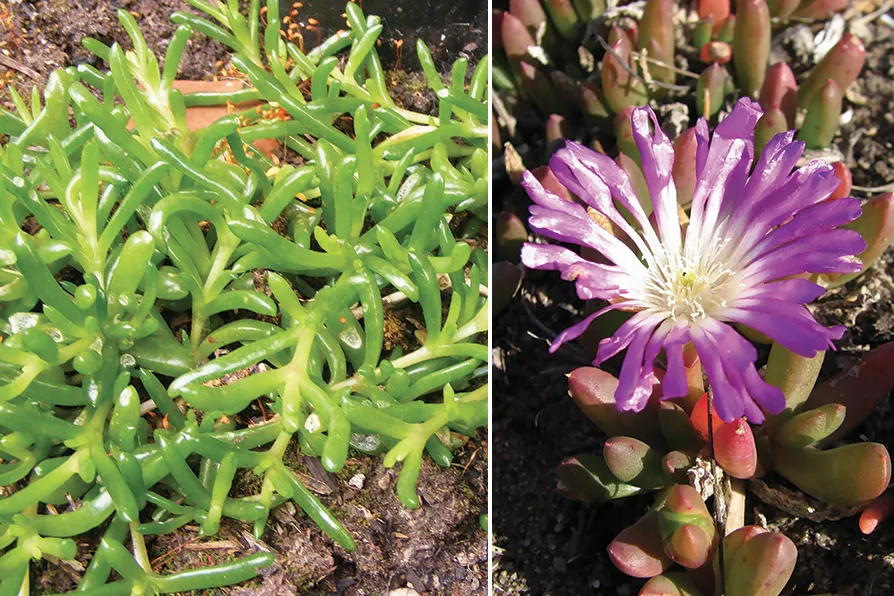
 Salty fingers / Pics (L to R) Mat Coward; Melburnian/CC

While Italy’s communist tradition remains fragmented and politically marginal, France’s party is attempting to re-establish itself as an independent force rooted in working-class organisation, says NICK WRIGHT
Critics of UBI underestimate both its political significance and its economic potential, writes BERT SCHOUWENBURG
As Ontario burns, campaigners are demanding action – not more pipelines, says DAVE McKEE
Innovation in biotechnology is changing how we conceive of meat, say ROX MIDDLETON, LIAM SHAW and MIRIAM GAUNTLETT of SCIENCE AND SOCIETY





I’VE BEEN growing a wonderful vegetable called “salty fingers” for some years but I’ve never written about it in this column before because the plants can be hard to get hold of.
However, a bit of intensive internet work this week tells me that if you look very closely you can currently find suppliers online. They’re usually small nurseries or independent growers, and stocks are often low, so if you want one you need to grab it when you see it.
Disphyma crassifolium lurks under various other common names, including sea jellybeans, purple dewplant, and variations on the theme of “pigface,” apparently because the arrangement of its flowers and fruits reminds people of a porcine phizog. Mine have never flowered or produced seed, perhaps because I crop them so frequently, so I can’t comment.
Salty fingers is a low-growing, creeping, perennial succulent. It’s an introduced plant from hotter, drier countries which has become naturalised in the warmest coastal areas of Britain. Long stems, round and smooth, spread out from the centre covered all along their length with thick, finger-shaped leaves of about an inch.
It’s the vibrantly green “fingers” that we eat. As the name, and the plant’s habitat, would suggest, they taste briny. But the flavour is only part of their appeal; the fleshy, juicy texture means they seem to pop in the mouth a bit like a cross between a jellybean and a grape. Raw or very lightly cooked they make a refreshing and unusual ingredient in salads or as an edible garnish. It’s a bonus that salty fingers also looks handsome, in growth and on the plate.
It’s not an entirely hardy plant, so might need some protection from frost over winter especially in colder regions. An unheated greenhouse, cold frame or cloche is sufficient.
I grow mine in pots, which can be moved under cover from around November to April, and also in the border soil of the greenhouse where it grows enthusiastically and provides good ground cover.
The nursery I first bought my salty fingers from recommended using the following mixture at every watering (and they do benefit from frequent watering to keep the leaves juicy): into five litres of water mix six teaspoons of fine sea salt and 15ml of commercial seaweed extract.
I’ve never heard of this species suffering from any pests or diseases. If they get too hot and dry the fingers will turn reddish and be less palatable, but that’s usually only a temporary problem. If it persists, the plant has probably outgrown its pot and needs moving on to a larger container, in multipurpose compost.
The simplest way to propagate salty fingers is by dividing a large, vigorous clump in spring. Split it vertically with a sharp spade, and replant one of the halves elsewhere. It’ll also grow from cuttings. Use clean secateurs to snip off about six inches (15cm) of stem and stick the cutting into a small pot in a 50/50 mixture of compost and grit.
