ROB WARZYNIAK wades knee deep through a pile of ‘dead canaries’ of Trumpist policies which exacerbated the horrors of US capitalism domestically


 Latest editorial

Bend or break: will Cuba become Donald Trump’s next trophy?
Without energy and without a strategic partner, Cuba is currently fighting for its survival. While the population is literally sitting in the dark, the Trump administration is trying to definitively break the socialist project through economic blackmail. What lies ahead for the island, asks MARC VANDEPITTE
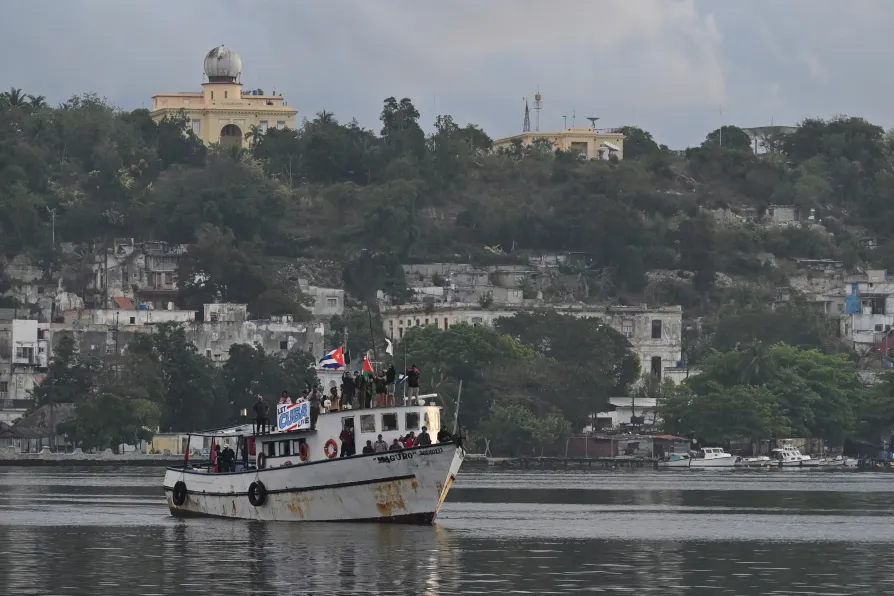 Activists wave Cuban and Palestinian flags from the vessel Maguro, arriving from Mexico with humanitarian aid as part of the "Nuestra America," or Our America convoy, in Havana Bay, Cuba, March 24, 2026
Without evidence or Nato consultations Berlin’s answer to the Leipzig incident is a rupture of relations. SEVIM DAGDELEN examines why
FRANCISCO DOMINGUEZ introduces the background to a conference on defending Latin America’s sovereignty
The glacier collapse in Nepal is yet another warning that a warming planet is making Himalayan disasters more frequent and destructive – but the countries facing the greatest risks are often those least responsible, says LI YANG
Nick Blair is set to benefit from a hugely lucrative contract to ‘virtually’ train the British army for its next war. Like father, like son, writes SOLOMON HUGHES
Even when tragedy strikes, Western media cannot resist the opportunity to turn it into a sordid propaganda opportunity, as the Nepal-China border tragedy shows, writes CARLOS MARTINEZ
Trade unions should be at the heart of the anti-racist push for reparations for the historic legacy and continuing impact of slavery, writes ROGER McKENZIE





SINCE the revolution of 1959, Cuba has been a thorn in Washington’s side. The existence of a socialist project barely 150km from the US coast was unacceptable. Generations of presidents tried to bring the island to its knees through sabotage, isolation and economic pressure.
The Cuban example had to disappear, or at least be damaged to such an extent that it could no longer provide inspiration. This strategy led to the longest-lasting economic blockade in modern history, which still determines the lives of millions of Cubans today.
No strategic partner anymore
For decades, Cuba could rely on external support. First from the Soviet Union and the Comecon countries, later from Venezuela. These alliances formed a lifeline, especially for energy supply and trade. But that time is over.
After the abduction of the Venezuelan president Nicolas Maduro by US troops, a crucial partner disappeared. For the first time since 1959, Cuba no longer has a real strategic partner and stands almost alone. Havana is more vulnerable than ever, and for the White House, the time seemed ripe to deliver the revolution a final blow.
Trump openly declared that he could take over Cuba. “I mean, whether I free it, take it. Think I can do anything I want with it,” he told journalists at the White House in Washington.
To achieve this, on January 29, he imposed a total oil blockade. Countries that still dare to supply oil to the island are put under extremely heavy pressure by Washington. In addition to the energy cutoff, Secretary of State Marco Rubio is systematically trying to dry up every source of foreign currency for Cuba.
More specifically, he is targeting international medical missions. By forcing host countries to expel Cuban doctors, the island loses what is currently its largest source of income, which it uses for the import of medicines and basic food.
Society at a standstill
Cuba is historically highly dependent on imports, due to its past as a monoculture colony and a lack of raw materials. Energy, in particular, is of vital importance.
Before the energy blockade, Cuba consumed about 110,000 barrels of oil per day, of which 40,000 were produced domestically. The rest came from Venezuela, Mexico and Russia. Since January, that supply has completely dried up.
The Cuban government acknowledges that mistakes were made in the past, such as the failed monetary reform of 2021. But no economy can hold up when it has to run on barely 40 per cent of its energy and is simultaneously being financially strangled.
For the Cuban population, this crisis translates into a harsh reality. Cities are at a standstill because there is no fuel for buses and cars. Industry can barely operate, shops are difficult to supply, and food is becoming scarcer.
Healthcare, once a showpiece of the revolution, is under severe pressure. Operations are postponed or cancelled for fear of power outages. Mortality in the first year of life has doubled.
Vulnerable, premature babies die in incubators when the lights go out, even though medical staff do everything they can to keep ventilating them manually. According to the World Health Organisation, the situation is “very worrying.”
Even tourism, long an important source of foreign currency, is collapsing due to unreliable infrastructure. Hotels without electricity do not attract visitors. In this way, the economic stranglehold is tightening further.
The resilience of the Cuban population is currently being tested to the limit in a struggle for survival that has been deliberately created by Washington to provoke social unrest and a popular uprising.
Objective and strategy of Washington
As in the war against Iran, the objectives of the Trump administration are not entirely clear. It also appears that Trump and Rubio are not on the same page.
Many Cubans living in the United States want nothing less than regime change. A hard but influential core will strongly oppose any rapprochement with Cuba and even try to sabotage it. For his future political career, Rubio — himself the son of Cuban migrants — depends on this group of hardliners. He has already indicated that he is aiming for regime change.
A classic regime change, however, seems unlikely. The Cuban political system is firmly anchored and still enjoys considerable legitimacy. In addition, there is little to no support in the US for a military intervention.
For Trump, the pressure from Cuban Americans does not play a role. Moreover, due to the debacle in Iran and the absence of a peace agreement in Ukraine, he urgently needs a political “victory” to stand stronger in the crucial midterm elections in November.
Rubio is a heavyweight in the White House. He is the first person since Henry Kissinger to be both national security adviser and secretary of state at the same time. Yet he is less powerful than Kissinger. Under Trump, his department has been hollowed out, while sensitive dossiers such as the wars in Ukraine, Gaza and Iran have mainly been entrusted to Steve Witkoff and Jared Kushner.
In the Cuba dossier, it also appears that he cannot leave his mark. The focus in the current negotiations between Cuba and the US is not political (regime change), but primarily economic.
Trump has long wanted to do business with Cuba and in 1998 even explored an investment, possibly in violation of blockade legislation. Later, he registered his brand there. For him, what matters above all is a government that imports US products, regardless of the political system, according to The Economist.
With the energy blockade, Washington now wants to force Cuba into economic reforms that benefit US companies. It seeks access to strategic sectors such as energy, ports, tourism and telecoms. In return, it expects far-reaching liberalisation: larger private companies, the opening up of the banking system, and the dismantling of state monopolies.
Political change is thus more a means than an end goal. Washington is not aiming for regime change but is opting for a more subtle strategy, inspired by Venezuela: no complete overthrow, but so-called “regime tweaking” — forced co-operation with limited adjustments to the political leadership.
Signals from Washington suggest that the departure of President Diaz-Canel could be a condition for an agreement.
Cuban response
The starvation does not lead to a mass uprising. According to Daniel Montero, a journalist from Democracy Now, people are mainly busy surviving, preoccupied with the question of what they can still eat. Frustration is growing, but it is not directed against the government; rather, it is directed against Trump and strengthens the will to resist.
Illustrative of this is how Silvio Rodriguez, the island’s best-known singer — loyal but not a bootlicker of the government — symbolically asked for a Kalashnikov rifle to emphasise that he would defend Cuba in the event of an attack.
The government also remains combative. In the past, there were already plans to become less dependent on imported fuel through solar panels and to green the energy supply. Due to the current energy blockade, that transition is now being accelerated.
There is no question of submission to the US. President Diaz-Canel warned that any attempt at regime change will meet with “unbreakable resistance.” At the same time, he announced that talks have started, based on respect for Cuban sovereignty.
Concurrently, the Cuban government is taking a pragmatic stance. About 20 prisoners involved in the violent riots in the summer of 2021 have been released. In addition, far-reaching economic reforms are being implemented.
Foreign investments are being encouraged, and Cubans abroad are now also allowed to invest on the island. This is a remarkable opening after decades of strict control.
Furthermore, Cuba is willing to talk about compensation for nationalised US properties, on the condition that the damage from the blockade is also recognised. These are proposals that show a constructive attitude, but it is uncertain whether and to what extent Trump will respond to them. His unpredictability remains the biggest variable in this conflict.
Will Washington use Cuba as a quick victory to gain domestic political advantage, concluding a deal that creates economic opportunities for US companies? Or will the medieval siege be prolonged to drive the island’s inhabitants even further into despair?
Both scenarios are possible. What is certain is that the Cuban population is paying the price for this ruthless geopolitical game.
International solidarity necessary
Against this background, international solidarity is growing. Countries such as Mexico, Russia, China, Vietnam and now also Spain have already expressed their support and are sending humanitarian convoys to break the blockade.
In recent weeks, more than 100 activists, trade union members, and members of the European Parliament arrived in Havana with humanitarian aid worth half a million euros. In addition, the convoy “Nuestra America” reached Havana with extra goods to support the population.
These “flotillas” not only deliver food and medicines but also send a powerful political signal against US hegemony and arbitrariness.
At the same time, it remains deafeningly silent in Europe, with Spain as a major exception. It is a disgrace that Western governments refuse to condemn this criminal strategy of starvation. By looking away, they make themselves complicit in the destruction of a people.
The coming weeks will be decisive for the Cuban people.
