Labour must deliver its manifesto promises in full and begin the bigger task of restoring workers’ collective power, says MATT WRACK


 Latest editorial
Battle lines drawn after Tesla union defeat in Berlin
A setback for IG Metall at Tesla’s Berlin plant has ignited claims of intimidation and raised fears for the future of collective bargaining and workplace democracy, says TONY BURKE
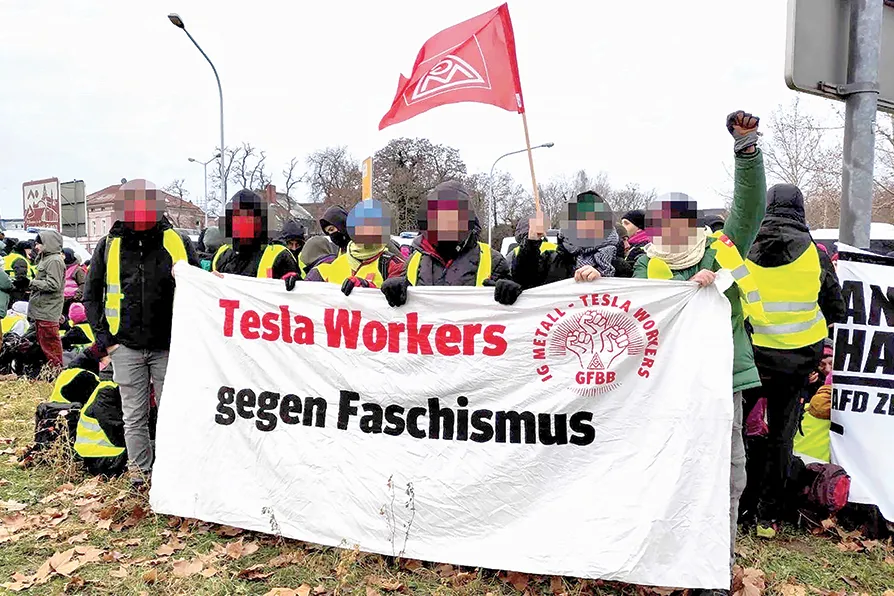 Tesla IG Metall affiliated workers protest on January 11 2025 with a ’Tesla workers against fascism’ banner their faces pixelated by the photographer to prevent identification and repressions by Tesla management / Pic: Shushugah/CC

This summer’s fire outbreaks highlighted once again the deadly cost of job, equipment and funding cuts to the fire service. Ten years after the Grenfell tragedy, serious lessons still need to be learned, says STEVE WRIGHT
Live music and musical education are both under attack and threaten to impoverish our culture. The Musicians’ Union seeks allies in the fightback, writes NAOMI POHL
The TUC fell for the illusion of a ‘Social Europe’ in 1988 and backed single-market membership. DOUG NICHOLLS argues that dramatic changes in the EU prove the need for an independent economic policy
As Cuba faces an unprecedented US energy siege and growing threats of military intervention, TUC Congress must stand unequivocally with Cuban workers and their right to determine their own future, writes STEVE GILLAN, POA general secretary and TUC president
By organising for boycotts, divestment and sanctions, trade unionists can turn solidarity into action, writes JESS BARNARD





GERMANY’S giant IG Metall union’s setback at Tesla’s Gigafactory in Berlin last week, in failing to secure a majority on Tesla’s statutory works council is a major challenge to the German trade movement.
Following the defeat of the Third Reich in 1945 the German trade union movement was re-established (with the help of the British TUC) based on powerful industrial unions, a system of elected works councils (Betriebsrat) in companies with more than five employees — all governed under the German Works Constitution Act coupled with sectoral collective bargaining which forms the core of Germany’s co-determination system of industrial and social democracy.
German unions tend to win the majority of seats on works councils and thus control pay and conditions. However Tesla has been resisting a campaign by IG Metall (the German metals, engineering and electrical union) since having been forced with German law.
Tesla’s Gigafactory director Andre Thierig posted on social media that “the vote by workers was ‘good news’ for the facility situated in Gruenheide near Berlin.”
Thierig boasted: “The union share was reduced from nearly 40 per cent in 2024 to 31 per cent in 2026!” and he added it sent a “clear message” that the workers at the factory were moving “towards an independent co-determination!”
However, IG Metall is not taking the vote lying down and is taking the matter to court in a battle they must win if other new start-ups in Germany including companies in the digi-tech sector are to maintain industrial democracy, independent unions and sectoral collective bargaining.
IG Metall is citing unlawful interference by Tesla in the election and will challenge the result. Section 19 of Germany’s Works Constitution Act, specifically prohibits obstruction of elections through threats or adverse consequences.
IG Metall ran a powerful campaign among workers at the pant but Tesla used US union-busting techniques and the media to force through a vote against IG Metall candidates in favour of the company based “Giga United” slate chaired by the current works council chairperson.
The IG Metall Tesla Workers GFFB slate got 13 seats, while the remaining 24 seats were won by the non-union slate, Giga United and the Polish Initiative slate, which got three seats.
IG Metall says workers faced a sustained campaign of intimidation, being told by supervisors and plant managers: “I can only advise you not to vote for the union list” and distributed badges with the slogan “Giga Yes, Trade Union No.”
They warned workers that the Berlin site could close and that a vote for IG Metall would lead to lower pay.
IG Metall president Christiane Benner said: “The threats and intimidation are too serious not to be resolved in court. Workers at the plant, as well as the candidates for the works council, deserve fair elections without the feeling that they might subsequently be punished for their decisions.”
Jan Otto, IG Metall regional director for Berlin-Brandenburg-Saxony, described the situation as unprecedented: “As a trade unionist, I have never experienced such an attack on democratic co-determination as at Tesla. Elon Musk and the German Tesla management have used all their power to steer this works council election in their favour.
“We will defend ourselves against this by every means necessary. Legal disputes are not our priority, we are focusing all our efforts on working with our members to secure better working conditions at Grunheide.”
The German Trade Union Confederation (DGB) has long called for a strict neutrality in works council elections, arguing the Tesla case demonstrates the urgent need for stronger legal protections. The Tesla result will mean more companies will feel emboldened to interfere in the democratic process.
All eyes will now be on the German courts — anything less than the election result being ruled invalid would mean the an open challenge to the German trade union movement which will have to be met with mass industrial action to defend trade unionism, sectoral collective bargaining and democracy.

Similar stories

NICK WRIGHT returns to Berlin and finds a city in darkness and political turmoil