
The UK Prime Minister may have the regal touch in northern England, but he’s been wrong-footed on the constitutional challenges posed by the Celtic Alliance of first ministers from Scotland, Wales and Northern Ireland, argues KENNY MacASKILL

We need a revolution in our thinking about energy policies
The left needs a bold energy vision – because if it fails to provide one, others will shape the future in their own interests, argues ALAN SIMPSON
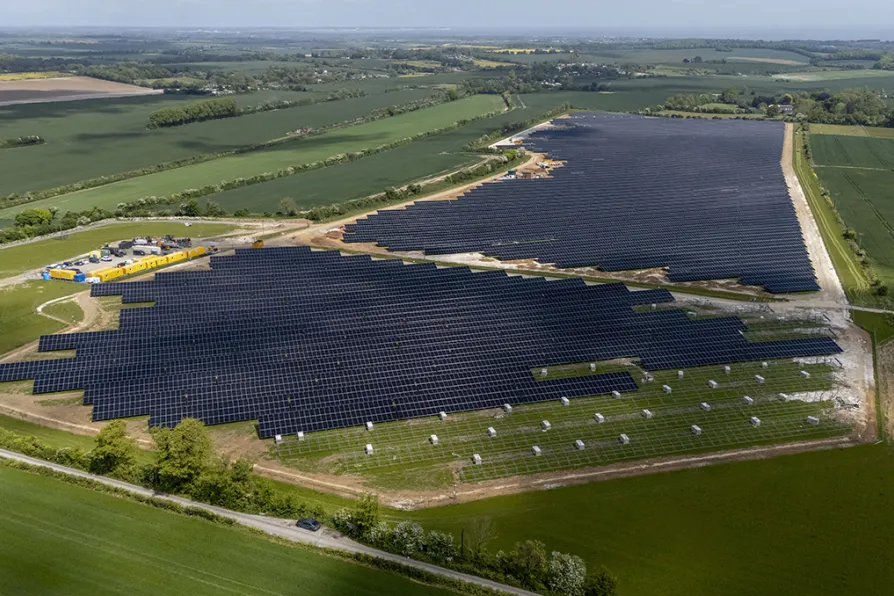
 Chalkpit solar farm near Dover in Kent

NEIRLAY ANDRADE, a member of the Communist Party of Venezuela’s political committee, outlines her party’s position on the crisis facing the country
A look at Taylor Wimpey’s accounts shows why Labour’s market-led housing strategy won’t deliver more, cheaper homes, as promised, says SOLOMON HUGHES
DAVID HORSLEY remembers the remarkable life and death of US black revolutionary George Jackson, whose politically passionate prison letters were published as Soledad Brother
Cuban trade union federation CTC leader OSNAY MIGUEL COLINA speaks to Ben Chacko about life and work under a crippling US siege
A part of the British empire’s network of slavery, today the Caribbean island of Nevis faces a new form of exploitation in the form of crypto-colonialism, CLAUDIA WEBBE writes
Challenges from the unscrupulous misuse of AI to steal actors’ voice and physical likenesses is being met with a firm union response, writes LYNDA ROOKE





While they’re standing in the welfare lines
Crying at the doorsteps of those armies of salvation
Wasting time in the unemployment lines
Sitting around waiting for a promotion.
Don’t you know
Talking about a revolution?
It sounds like a whisper.
THE words of Tracy Chapman’s 1988 song could hardly be more relevant today. We are living in an era of unprecedented upheavals; some inspiring, some terrifying.
Stifling heatwaves, turbulent winds, uncontrollable fires followed by unending downpours. These are just the beginnings of the climate roller-coaster.
At the same time, we are witnessing crumbling traditional structures of employment alongside amazing breakthroughs in medical knowledge and technology. The whole fabric of society is being remade around us, but with little political leadership or clarity about how to navigate the process in ways that are ecologically secure, socially inclusive and economically sane.
Into this space steps the far right. It has always been thus. But the real tragedy is that this is more about a failure of the left than a triumph of the right. In their different ways, Andy Burnham and Zack Polanski are attempting to reverse the process, but they desperately need allies and labour movement struggles don’t always put us on the side of the angels.
Fossil fools
Like it or not, we are in the middle of an energy revolution. Renewable energy will replace fossil fuels. Whether it can do so in time to save us from ourselves is debatable. Like disgruntled drug barons, the Tories were always going to make the case for maintaining existing fossil fuel markets. The tragedy is to see trade union leaders joining them.
Lobbying Labour over new drilling for North Sea oil and gas may make sense for corporate lobbyists and those representing workers in the sector, but it is terrible news for the planet and for tomorrow’s economy.
There’s a lovely poster outside London’s Natural History Museum that puts this in context. Before combustion engines were invented, 1,000 tonnes of horse poo were being dropped on London streets every day. People were paid to clean it up.
As transport became rapidly mechanised and industrialised, there were no trade union campaigns to “protect the poo.” Workers’ rights focused on new sites of mass production. Horse power took on a different meaning and the poo quietly disappeared from London streets.
The same will become true of fossil fuels. Countries that recognise this will be the winners, those that don’t will lose. Leave the Tories and Reform to fight over who should be seen as the true “champions of poo.” For the left, the challenge is to become the voice that will shape a better tomorrow. This will involve some big upheavals.
Not zero
The first thing to avoid is getting caught in the “net zero” trap.
“Net zero” was a benchmark not an answer; a de minimus position to limit climate damage, not to change energy thinking. What the left must do is move the debate forward.
Today’s British energy prices overcharge the public because gas providers set the marginal price and big generators get priority access over renewables. Renewable energy costs may be tumbling but consumers would never know it.
Unlike many parts of Europe, Britain has stuck to a centralised rather than decentralised grid system. This suited the big power generators but it is out of step with radical changes taking place in both energy storage and energy sharing. Decentralised systems are more likely to be the shape of tomorrow and more difficult for enemies to sabotage.
Once you go down this path, the high costs of long-distance, high-voltage distribution also tumble. This is where you bring energy prices down. It is also where you can connect to Burnham’s “politics of place” agenda.
Tomorrow’s energy systems will be more interactive and innovative. Whole communities will become energy generators as well as consumers. With this will come the ability to store and share energy. The skills, apprenticeships and employment prospects will follow suit. But even bigger changes may be waiting in the wings.
A new ‘war of the currents’
The energy economist, Gerard Reid has thrown a curve-ball into the field of energy network thinking in a recent Substack article, “The Quiet Revolution Reshaping the World of Electricity.”
As he points out, “…an increasing share of the devices sitting at the edge of those electricity networks, from LED lighting to smartphones, laptops and televisions, not to mention electric vehicles and data centres, ultimately operate internally on direct current or DC power. At the same time, the fastest growing source of new electricity generation in the world, solar, naturally generates DC power, while batteries also store and discharge electricity as DC.”
Reid’s argument is that this may reopen the century-old “war of the currents” debate between Nikola Tesla, who successfully championed alternating current (AC) and Thomas Edison for DC. This time, he believes, the case for direct rather than alternating currents is stronger.
I am out of my depth in this debate, but, if Reid is right, it would change our whole approach to energy systems. It could become another “poo moment” in energy thinking, with all the implications for skill training, jobs and apprenticeships that follow. There’s nothing like giving the kids a future they can help shape.
But before we get into this there’s a different battle to be fought.
Killing the co-ops?
The Department for Education (DfE) is concluding a consultation on the installation of solar panels on school roofs. It is about as far from Burnham as you can get and could have been drafted by corporate lobbyists rather than civil servants.
Instead of promoting community co-ops, with an emphasis on local schemes, local communities and/or small clusters of schools, the DfE wants to pilot bigger clusters (of 75-100 schools) on a regional basis. Forget local involvement, local jobs and local accountability. Their approach would involve a £10 million capital programme — way beyond the reach of local co-ops — in a programme that would force schemes into the hands of equity finance.
Corporate profiteering would be baked in from the start. Local jobs and apprenticeships would be non-existent and dividend returns to schools (rather than private equity) would disappear. It would become another programme that served the interests of capital rather than climate or community.
This stitch-up is not yet a done deal, but Burnham will need political allies if he is to rescue it.
My worry is that too few politicians grasp this. Too few on the left are engaged in genuinely transformative thinking and too many in the trade union movement are still living “in praise of poo.”
To allow another a corporate hijack of the energy system would not be the left’s finest moment. It would not deliver the democratic accountability, social inclusion or climate security Burnham is looking for.
This would be a surrender more like a whimper than a whisper and it wouldn’t just be Tracy Chapman saying so.
Alan Simpson was Labour MP for Nottingham South from 1992-2010.

Similar stories
In the third of a four-part serialisation from her new book No to Nuclear, LINDA PENTZ GUNTER explains how the world had a chance to build an energy system around renewables more than 70 years ago — instead, it chose nuclear

The real welfare dependency is at the top of our society, says ALAN SIMPSON
The Communist Party of Britain’s Congress last month debated a resolution on ending opposition to all nuclear power in light of technological advances and the climate crisis. RICHARD HEBBERT explains why