
The US administration is endangering lives by reversing environmental protection laws, CHAUNCEY K ROBINSON argues

Bolivarian Venezuela’s unbreakable solidarity with Cuba
Trump’s drive for ‘regime change’ in Cuba has deepened the crisis across the island – while Venezuela has reaffirmed its commitment to Bolivarian solidarity, says FRANCISCO DOMINGUEZ
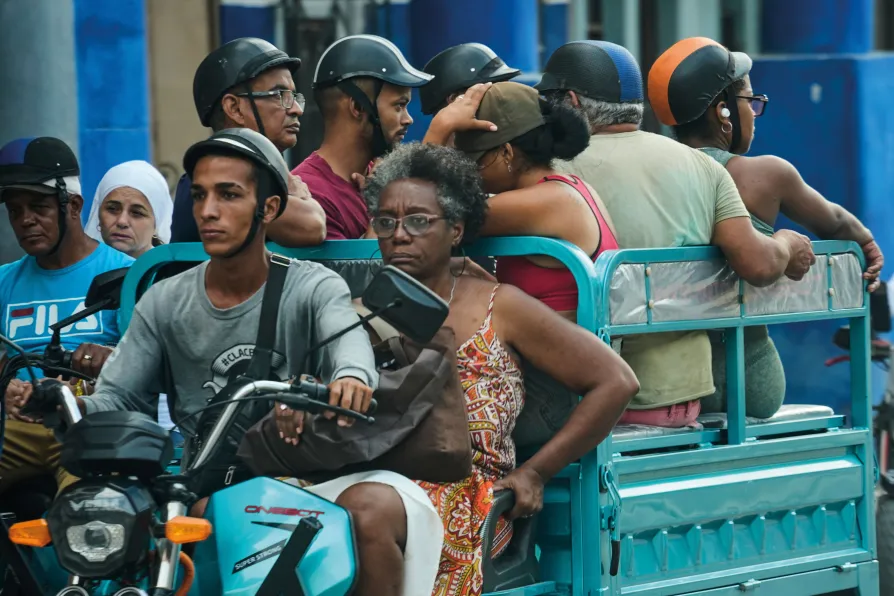
 SANCTIONED: People travel on an electric tricycle in Havana, Cuba
It’s time to stop retreating and go on the offensive to promote working-class interests, argues DOUG NICHOLLS
Marco Rubio wants to defeat socialism in Nicaragua, not restore ‘democracy,’ writes JOHN PERRY
Believe it or not, there was a time when the US government built beautiful homes for working‑class Americans to deal with a housing shortage, writes ERAN BEN-JOSEPH
DIANE ABBOTT provides an analysis of the reasons for EU and British voters’ dramatic swing to the right
Train drivers’ union Aslef general secretary DAVE CALFE speaks to Ben Chacko about his hopes that Burnham’s devolution agenda will include the importance of the railway





BARELY a week after the US military attack against Venezuela and the kidnapping of President Nicolas Maduro and First Combatant Cilia Flores on January 3 2026, Donald Trump, with his usual bombast, told Cuba to “make a deal or face the consequences.”
Led by Secretary of State Marco Rubio, Florida’s Cuban gusanera and US government officials always saw the toppling of Maduro as a key piece in the domino effect required to destroy the Cuban revolution.
Back in November 2025, the US political digital newspaper Politico noted that “Rubio has long sought to push out Maduro. … [His] calculus is that toppling Maduro will weaken the regime in his ancestral homeland, Cuba.”
Seeking these objectives, Rubio has played a central role in shaping Trump’s policies towards Cuba, Venezuela and Nicaragua. Rubio’s strategy fits nicely with Trump’s “Donroe Doctrine” since it specifically (though not exclusively) targets these three radical governments with sanctions, threats and efforts to overthrow them for having strong commercial and political links with non-hemispheric actors (China, Russia and Iran), links that the “Donroe Doctrine” seeks to break by military means.
Currently, Trump needs to separate Venezuela from Cuba. No sooner had Delcy Rodriguez been appointed interim president of Venezuela than a corporate media smear campaign was launched against her depicting her as a “Trump asset,” mendaciously alleging her appointment had been the result of “prolonged negotiations” or that she had participated in meetings with others to conspire to betray Maduro, leading to his kidnapping.
This Trumpian tactic aims obviously at dividing Chavismo. On January 14 2026, Trump doubled down by referring to Delcy Rodriguez as a “terrific person.” But 10 days earlier, he had posted “she is willing to do what is necessary” and comply with US wishes — or else she could face a “very big price.”
This narrative deliberately created the impression that Delcy Rodriguez would not only distance Venezuela from Cuba but would completely abandon it to its own fate at the mercy of a rampant USA that is threatening Cuba with “serious consequences” if it does not surrender.
However, despite the dangerous situation Rodriguez’s government faces, which has led her to make some unpalatable policy adjustments and receive unsavoury US visitors, Bolivarian solidarity with Cuba, though practically constrained — eg no more oil shipments — has remained strong.
Rodriguez’s government’s first political act was to pay tribute to the 32 Cuban combatants who gave their lives while carrying out co-operation and defence missions in Venezuela.
Venezuela’s Foreign Minister Yvan Gil issued a statement the day after the US invasion, praising the 32 Cuban heroes who died as “a consequence of the criminal and infamous attack perpetrated by the government of the United States against Venezuelan territory.”
Gil thanked Cuba’s President Miguel Diaz-Canel and Raul Castro for their support and solidarity, adding that the combatants’ “sacrifice strengthen the historic links of fraternity, sovereignty and shared struggle of [Cuba and Venezuela].”
A week after the US invasion Trump’s renewed his threats against Cuba “there will be no more oil or money for Cuba. Zero!” adding “Cuba lived for many years, on large amounts of oil and money from Venezuela. In return, Cuba provided ‘security services’ for the last two Venezuelan dictators, but not anymore!”
Venezuela’s immediate and unambiguous response reaffirmed its right to the long-standing relations with Cuba in accordance with the UN principle of the “free exercise of self-determination and national sovereignty.”
This was reciprocated by President Diaz-Canel reaffirming support and solidarity with Venezuela and its people and strongly condemning the United States’ military aggression against Venezuela and the kidnapping of Maduro and Flores. Diaz-Cannel stressed Cuba’s decision to continue strengthening the historic bonds of brotherhood and co-operation that unites both nations.
Trump is, however, determined to achieve “regime change” in Cuba and has increased the pressure with more sanctions. His executive order declared that “the policies, practices, and actions of the government of Cuba constitute an unusual and extraordinary threat […] to the national security and foreign policy of the United States.” The EO threatened to apply tariffs against any country that dared to sell oil to Cuba.
Venezuela’s foreign minister condemned Trump’s decision seeking to impose punitive measures on countries that maintain legitimate trade relations with Cuba. He expressed Venezuela’s solidarity with the people of Cuba and called on “the international community to take collective action to address the humanitarian consequences arising from acts of aggression of this nature.”
In February 2026, after further Trump’s threats against Cuba, including a US naval blockade, a solidarity campaign, Love is Paid With Love — the title of Jose Marti’s famous play — was launched in Venezuela. It seeks to raise awareness about the defence of Latin America as a zone of peace and opposes militarisation and foreign interference.
This national campaign is focused on collecting medicines and health equipment; seeking donations to buy solar panels for use in hospitals, schools and laboratories; and collecting non-perishable foodstuffs and arranging sea transport to Havana.
Venezuela has gone further by hosting A Song for Cuba concert in April to protest against the US blockade. The concert, part of the Love Is Paid with Love campaign, brought together prominent singers and artists, such as Grupo Madera (Venezuelan and Caribbean folk rhythms and political lyrics), Elena Gil, Ivan Perez Rossi, the Barlovento Black Theatre, and soloists such as Marta Doudiers, the troubadour Leonel Ruiz, as well as members of the Simon Bolivar Cultural Brigade, all paying tribute to Cuban resistance.
On May Day, Trump imposed further sanctions, ratcheting up the pressure against the besieged island. These included more restrictions under the International Emergency Economic Powers Act, imposing new sanctions on entities, persons, or affiliates that support Cuba’s security apparatus. It also authorises new sanctions on persons, entities, or financial institutions that have conducted or facilitated transactions with persons or entities newly sanctioned.
Widening the blockade, the US also sanctioned GAESA, a mega Cuban state company, and the mining company Moa Nickel, a joint venture with the Canadian firm Sherritt International. Sherritt responded by announcing the immediate suspension of its direct participation in joint ventures in Cuba, exacerbating the economic impact of the US sanctions on strategic sectors.
A week after Trump’s new sanctions, a shipment of nearly six tons of food from Venezuela arrived in Havana as part of the Love Is Paid With Love campaign. It was the sixth such shipment. This was in addition to an earlier shipment of 25 tons of food and medicines from Venezuela that arrived in Cuba in April.
It is clear that Trump is persistently threatening Cuba with a military takeover. Trump’s aggression against socialist Cuba seeks to force the island to capitulate through starvation and desperation. As with other US imperialist endeavours, the US would relish Cuba’s economic collapse, triggering a massive humanitarian crisis, no matter how high the number of casualties.
US sanctions and the oil blockade have targeted and undermined Cuba’s energy system, affecting its ability to provide medical care, and sought to paralyse Cuba’s economic, commercial, and food production arrangements, with appalling effect. In 2025, one in three Cuban households reported hunger, but by April 2026 the Food Monitor Programme reported that 96.91 per cent of the population lacked adequate access to food.
Venezuela’s solidarity (and that of Cuba’s supporters worldwide, including Britain) can only do so much. But there is no doubt as to the strength of the unbreakable solidarity and fraternal links of Bolivarian Venezuela with Cuba. Blanca Eekhout, president of the Simon Bolivar Institute, has stated: “The children of Simon Bolivar will not abandon Cuba, because our America is one. The destiny of one is the destiny of all, and the destiny will be one of victory, unity, solidarity, and love. […] Cuba is hope, it will never be a threat; [Cuba] is dignity and example.”
You can donate to the material aid to Cuba campaign at cubavive.org.uk/donate.
