TUC president and POA leader STEVE GILLAN speaks to Ben Chacko on the eve of Congress 2026


 Latest editorial
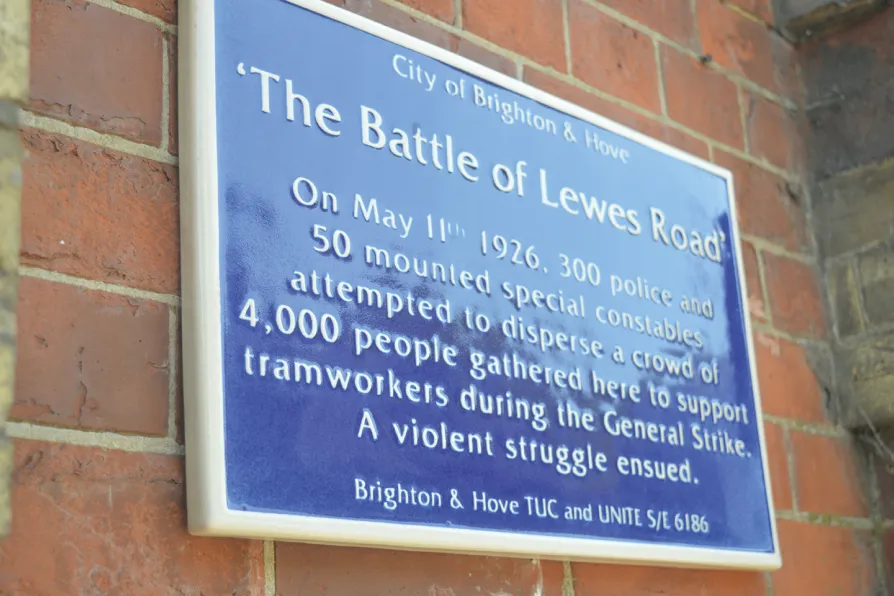
Commemorating class struggle: new plaque marks Brighton’s ‘Battle of Lewes Road’
HENRY FOWLER, national co-ordinator for General Strike 100, continued his nationwide tour of partner organisations by joining campaigners and trade unionists in Brighton for the unveiling of a new blue plaque and a full day of commemorative events marking the centenary of the ‘Battle of Lewes Road’

DOUG NICHOLLS welcomes a turning point at this year’s Congress, where many motions call for a co-ordinated plan to revive British industry, a perspective outlined in his new book
HOPE VIRGO of campaign Dump the Scales warns MPs voting today they should be alert to the threat legalised assisted death poses to people with eating disorders
The Together Alliance is hosting two summits, North and South, to build power and plan action against the scourge of racism peddled by the right. DANIEL KEBEDE urges mass participation
The drift toward militarisation in Europe is not inevitable, left-wing and peace movements can preserve sovereignty and prevent war, says DÁIRE HUGHES MP
Whatever differences exist among international sympathisers of the Bolivarian revolution about its current trajectory, they should unite against the imperialist power that is the source of an enforced retreat, argues ROGER D HARRIS
Trade unions need to step up and force a turn in the policies of the labour movement to effectively confront the far-right threat, argues NICK WRIGHT





ON May 11 1926, a group of volunteers, including students, attempted to break the General Strike by helping remove trams from the depot on Lewes Road in Brighton.
Members of the public, including women and children, refused to disperse and blocked the strikebreakers’ efforts. In response, police officers and “specials” (volunteers recruited during the strike) charged the crowd, leading to injuries and 17 arrests.
One hundred years later, trade unionists, campaigners, councillors and Sian Berry MP gathered to unveil a new blue plaque at Tramway House, now the Brighton bus depot, where this infamous “battle” took place.
Organised by activists from Brighton, Hove and District Trades Union Council (BHTUC) and funded through donations from individuals, trade unions and Strike Map, the plaque campaign was not without controversy. Both the bus company and relatives of police officers involved in the events voiced opposition, including through letters published in local newspapers.
Peter Crowhurst, archivist for the Brighton and Hove Plaque Panel, spoke to the crowd about the role blue plaques play in preserving local and national history.
He praised the tireless work of Christian Hogsbjerg, the lead organiser of the plaque campaign, who has also republished Remembering the Battle of Lewes Road: Brighton and the General Strike of 1926 by Ernie Troy and Andy Durr.
David Knight, the great-grandson of John Lawrence Knight — one of those arrested during the clash — shared his family’s connection to this important moment in Brighton’s history.
He concluded by reading aloud the names of all the workers arrested that day in 1926.
Andy Richards, secretary of BHTUC, spoke of his pride in supporting the organising the commemoration and plaque unveiling. He reminded attendees of BHTUC’s long history, noting that it was founded in 1890 in a room above a pub called The Eagle in the city.
Jacob Taylor, deputy leader of Brighton & Hove City Council and councillor for the ward where the plaque now stands, stressed the importance of recognising labour history and preserving the stories of working-class struggle.
He told the crowd: “Most improvements in workers’ daily lives have not been given from above — they have been won from below.”
Ahead of the unveiling, Sian Berry MP described the General Strike as a momentous chapter in British history, highlighting the solidarity shown by workers who came out in support of the miners.
She reflected on the estimated 4,000 “Brightonians” — workers and protesters alike — who stood up to a major state mobilisation, including mounted police officers threatening the crowd.
That level of courage and solidarity, she said, “continues to embody the spirit of Brighton and Hove today.”
Attendees later moved to University of Brighton for an afternoon of discussion, debate and presentations exploring the General Strike and its impact on the local area.
The first session was led by Judy Cox, author of Revisiting the General Strike of 1926: When Workers Were Ready to Dare.
Cox challenged portrayals of the strike as moderate or polite, arguing instead that it represented a profound class conflict. As she told the audience: “The General Strike was a class war — a moment in which the working class, those who produce the wealth, were in bitter and at times violent conflict with the ruling class.”
We were proud to follow Cox’s presentation by discussing the importance of the General Strike 100 national partnership behind the centenary commemorations and how communities across the country were marking this significant anniversary.
The day concluded with a screening of The Battle of Lewes Road, the acclaimed 1984 documentary produced by the Brighton History Workshop collective.
The screening was followed by a Q&A with film-makers Chris Nichols and Roger West.
Featuring first-hand testimony from eyewitnesses and participants, the film remains a powerful account of the events and of the attempts by sections of the Establishment to erase them from public memory.
The discussion also reflected on the wider tradition of “history from below” championed by the History Workshop movement.
The commemorations continued the following Monday (the date of the anniversary of the battle itself) with a gig at Brighton Electric, next door to Tramway House where the plaque stands.
Our next visit will be to Warwick’s Modern Records Centre to look at their special exhibition.
To explore the wider centenary programme and plan your own visit, head to GeneralStrike100.com.
