WILL STONE samples the 20th anniversary atmosphere of this eclectic end-of-season indie festival


 Latest editorial
The Age of Information Crisis
ANDY HEDGECOCK welcomes an accessible - and optimistic - take on our relationship to new technology
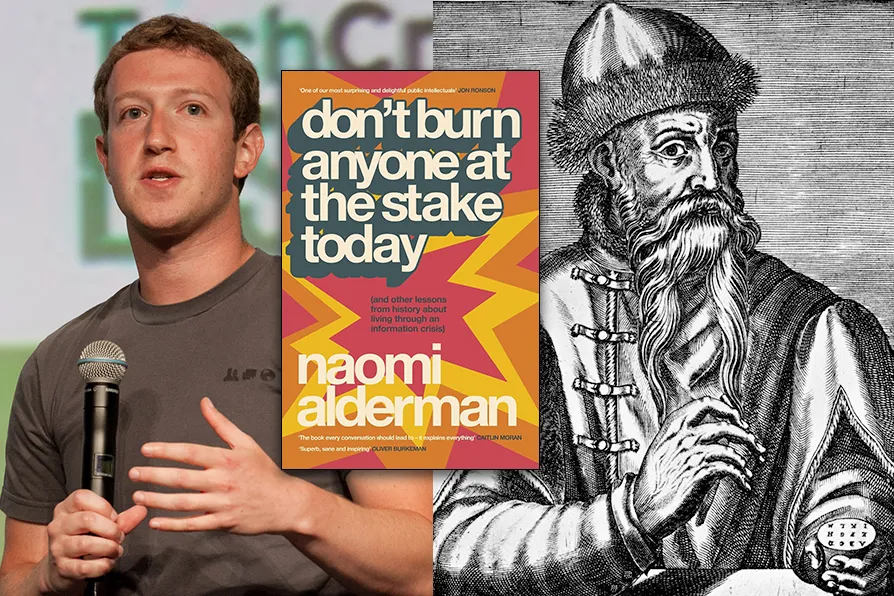 BAD STEWARD/GOOD STEWARD: (L) Mark Zuckerberg, 2012; (R) Johannes Gutenberg 17th century [Pic: JD Lasica/CC; Public Domain]

Comics are not just superheroes and spandex – it can be public art, telling public stories, suggests HARRIET EARLE
The bard serenades the Diggers of Wigan and their festive followers
ALEXEI SAYLE speaks to Angus Reid about a lifetime of protest, how to hone political art – and what to do now
ANDY HEDGECOCK, JAMES WALSH, LEO BOIX and MARIA DUARTE review Just An Illusion, Everybody Digs Bill Evans, Blue Film, Oasis: Don’t Look Back in Anger, and Runner
MARIA DUARTE recommends a nerve-wracking reconstruction of the 72 hours before the Normandy landings





Don’t Burn Anyone at the Stake Today
by Naomi Alderman
Penguin, £11.99
IN August 2021, psychologists at Yale University analysed 12.7 million Twitter (now X) messages and concluded the platform’s system of likes and shares fuelled online aggression. In May 2025, the Guardian asked mental health practitioners and academics for feedback on the top 100 TikTok videos in their field: 52 were deemed to contain misinformation, many others were “vague or unhelpful.”
The internet’s propagation of anger and falsehood are sources of inspiration for Naomi Alderman’s new book, but her response to these techno-cultural shocks is far from pessimistic.
Her opening proposition is that knowing the name of our era is crucial to understanding the turmoil and confusion we’re experiencing. We are, she suggests, living in an epoch that will come to be known as the Information Crisis.
One of the book’s strengths is situating the challenges we face in a clearly defined historical context. Alderman acknowledges humanity has experienced two information crises before the development of digital technology. The emergence of writing in the Axial age (around 3,000 years ago) and the invention of Gutenberg’s printing press in the 15th century led to significant social and psychological changes. These included freedom from the demands of memorising information, and the preservation and transmission of ideas – benefits which enabled people to reflect on their own thinking. Sadly, the price to be paid was the rise of ideological conflict, mob violence and, horrifically, burning at the stake.
From the world of Gutenberg to that of Zuckerberg, the book’s analysis of the double-edged psychological impact of technology is thorough and compelling. In the 21st century the compensation for belligerent encounters on social media is the rise of collaborative working. Similarly, while the internet’s dearth of gatekeepers produces avalanches of uninformed, incoherent and risible propaganda, these irritations are offset by greater opportunities to publish, broadcast and access information.
Alderman’s qualified techno-optimism is based on humanity’s historical responses to the disruptive technologies that have accelerated the reproduction and spread of ideas. The chaotic – and sometimes catastrophic – transformations wrought by writing and printing have led to an expanding “circle of us” in other words, a greater willingness to accept that people with different appearances and ways of thinking are equally deserving of human rights. She predicts the internet will yield a similar pattern of development. We will find new ways of managing and benefiting from our “fast machine(s)”, and meanwhile there must be robust measures to prevent the road to a better future being strewn with casualties.
Having noted that information crises foster the tendency to use force to create agreement, the author sets out a series of potential responses and safeguards. In this respect her insights are less convincing. Her faith in existing institutions – the BBC and public libraries – as bulwarks against misinformation and the “outrage-and-hype” cycles of social media seems misplaced. These are, as she asserts, havens from hard selling and the attention economy, but they face increasing financial and political pressure. Ironically, an argument put forward for further cuts is the level of access to online information in the UK.
The author prescribes positive online behaviour (“noticing when someone is upset […] remembering the humanity of the person I’m talking to”) and proposes antidotes to loneliness (“Your friends would like to hear from you”). These seem glib responses to the targeted, algorithmic manipulations of the tech oligarchs she acknowledges to be “bad stewards of our collective value and values.”
And while Alderman draws on authoritative sources – most notably Walter Ong on the advent of literacy and Elizabeth Eisenstein on the printing revolution – the book lacks notes, detailed references and an index. These are curious omissions in a book that stresses the value of rigorous evidence-based argument as an antidote to the overheated delusions of the social media keyboard warriors.
Despite these flaws, Alderman’s historical analysis of technologically driven upheaval is accessible, entertaining and provocative – essential reading for anyone interested in the complex interaction of people and machines.
