
Washington’s inability to subjugate Iran is an example of how it is trying to preserve a regional order that no longer exists, argues RAMZY BAROUD


Wales faces a childcare crisis
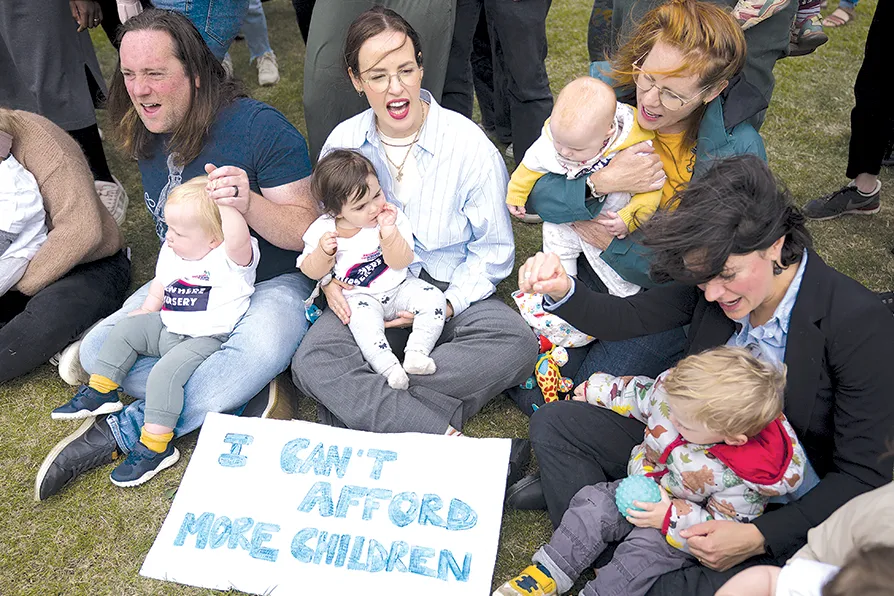
When only wealthier families can afford nursery, childcare becomes a class divide - financially and developmentally. REBECCA CARTER reports
 Pic: Author supplied

US financial instability is exposing the limits of a dollar-dominated global economy — and giving the Global South a historic chance to build an alternative, says MURAD QURESHI
DOUG NICHOLLS says the parasitic finance markets must be challenged or another British government could be toppled
The late country singer’s Imagination Library has put hundreds of millions of books into children’s hands. We should build on that legacy by defending the libraries at the heart of our communities, says BRENDA AITCHISON
Deprivation is a fundamental factor in criminal behaviour that must be addressed but, KENNY MacASKILL argues, there needs to a major rethink in sentencing to tackle overcrowding
MML director MEIRIAN JUMP outlines the recently refreshed library’s busy autumn schedule that ranges from book sales, archival exploration, community work with online education and the ever popular site tours
TONY BURKE surveys the shifting political landscape and the challenges Labour needs to address if it is to prevail in the 2028 federal elections





AS ANOTHER nursery bill landed in our inbox, my heart sank at the sight of the four digits before me — it was the same amount as our mortgage. I found myself counting down to April, when my son would have turned three and we would finally qualify for 30 hours of funded childcare a week in Wales — a sorry situation to be in when families should be savouring those early years of a child’s life, not wishing them away.
But the reality is the same for many families struggling under the financial burden of childcare fees across Wales, which has the highest childcare costs in Britain.
Some find the fees so expensive they decide it doesn’t make financial sense to work, while others decide to cut down their hours, or still work, despite most of their wages being swallowed up by childcare — just so they are not left behind. Others are resorting to credit cards to make ends meet.
One mother, who lives in south Wales with her 16-month-old daughter and husband, is considering moving to England because her family is living in “a deficit every month.”
Ms M, as she asked to be called, works as a Civil Service manager. Her child goes to nursery four days a week, “and even with a promotion to a senior leadership role, by the time you take tax and nursery fees into account, I would be making £4 an hour,” she says. “We are now having to look at moving out of Wales.”
Her family’s nursery fees have recently gone up by £4 a day to £91. She says that her and her husband are “both using credit cards month to month and all savings are depleted. It is actually a little scary to have destroyed our safety nets.”
Ms M added: “If I was designing a system to prevent working parents from having children, I would use Wales as a template.
“With childcare at £1,300 per child per month including relief, one child is financially unsustainable, two is impossible. On reflection, it is unsurprising there’s a birth rate crisis.”
Recent figures reported by the Office of National Statistics showed Wales’s fertility rate had fallen for the third consecutive year to a record low of 1.41.
In the last year, the cost for a child under two to attend nursery part-time has gone up by 9 per cent, costing parents on average £166.33 a week in Wales, according to an annual childcare survey published by children’s charity Coram.
Compared to England — where working families qualify for 30 hours funded childcare a week from nine months — parents are spending about £2,600 more a year to send their child to nursery full-time.
Funded hours (12.5) through Wales’s Flying Start scheme are gradually being rolled out to two-year olds across Wales, starting with the most disadvantaged areas first, but this has been described as a “postcode lottery.”
“You can be living on a street on a really low income and not get any support. And then a family on the street over from you, because they’re in the right postcode, are getting a lot more support than you, even if they’ve got higher income,” says Mabli Jones, head of policy (poverty) at the Bevan Foundation.
In England, the picture is different. Since the new system was fully implemented last year, the cost of a full-time (50-hour) place has dropped by 39 per cent in 2025, according to Coram.
But Lydia Hodges, head of Coram family and childcare, cautions that in England it “isn’t perfect and it certainly needs rebalancing to be fairer for all children.”
To qualify, both parents must be working and earning at least the National Minimum Wage for 16 hours a week. “So, there is still an issue with parents who aren’t in work but actually can’t get into work because they don’t have any childcare, but they can’t get childcare until they’re in work,” Hodges adds.
She argues that when only wealthier families can afford nursery, childcare becomes a class divide — financially and developmentally. “We don’t want this kind of classist system,” she says.
Currently in Wales, more than half (54 per cent) of children living in poverty, live in a household with a child under five, which amounts to around 100,000 children, according to the Bevan Foundation.
“You’re twice as likely to live in poverty if you’ve got a young child in the house,” says Jones. “Your family’s costs go up at the same time as your income usually decreases, because one of the parents — normally the mum — is … either on maternity leave or taking a step back from the workforce.”
Often, maternity pay only covers women for the first nine months, leaving a gap between returning to work and receiving childcare funding. Hodges said: “If you don’t go back until your child is three or four, you’ve been out of the workplace for quite a while. It can feel almost like you’re starting again.”
Jonathan Broadbery, director of policy and communications at the National Day Nurseries Association (NDNA), stressed how early years childcare is “part of the foundational economy.”
“If childcare doesn’t work, then parents can’t work,” he says. “Teachers can’t go to work, doctors, healthcare workers, train drivers — all of these people depend, in some way, shape or form, on availability of childcare.”
Wales’s childcare system has been criticised for its complexity. “It’s a real patchwork,” adds Jones, “it’s just incredibly difficult for families to navigate the system.” Broadbery says that it’s a “minefield” for nursery providers too, with added local complications.
Funding pressures on nurseries are also acute, forcing nurseries to raise their fees. This year, the Welsh government announced a funding rate increase, but prior to this, for three years, it stayed flat, meaning “real-terms cuts” for providers, Broadbery says.
“Between 80 to 90 per cent of providers turn around and say, no, the funding rate that the Welsh government provides does not cover our costs, so that means that either they’re making a loss or that they’re spending more to deliver the funded childcare that the Welsh government have promised parents.”
There is a broad consensus that the early years are being neglected, despite it being such a crucial stage of a child’s development — even the Welsh government acknowledges that “by age three, 90 per cent of [a child’s] brain will be developed.”
Jones puts it plainly: “We should be really prioritising those children in the early years, but they actually tend to be the most forgotten about.”
In countries like Sweden — where children have a legal right to attend preschool from their first birthday, and childcare fees are capped at around £130 a month — research has shown that accessing childcare from an early age has measurable benefits, not only on a child’s learning but their health and wellbeing too — particularly among those from low-income families.
In the build-up to the Senedd elections, the subject of childcare has been a central issue.
The Welsh Liberal Democrats are proposing 30 hours a week universally for all families.
Plaid Cymru and the Greens both pledge 20 hours universally, with Plaid’s offer worth more than £30,000 across the first four years. The Greens would simplify existing schemes into a unified system.
Welsh Labour would phase in 12.5 hours for under-threes alongside 20,000 new childcare spaces. And Welsh Conservatives would align Wales with England’s offer.
Reform UK has made no childcare pledge, and has come under fire after a Senedd candidate reportedly said abuse in Welsh nurseries would “skyrocket” if more women returned to work.
Broadbery’s hope for the next government is straightforward: “We would love to see the government go back to the drawing board and say, right, what are we wanting to achieve for families? Let’s build that system rather than just tagging on to what already exists.”
Hodges echoes this, stressing that “Welsh families will know best what that looks like, and should be consulted as to what would make the biggest difference.”
The Bevan Foundation is calling for universal funded childcare from nine months and is calling on the next government to address pay, conditions and status in the sector, because “there’s a real issue with recruitment and retention of staff and I think they’re doing a really important job, a really hard job.”
Now that my family has qualified for the funded childcare hours, our nursery bill has thankfully reduced. But it’s been a struggle to get here.
Like Ms M, many parents are still buckling under the weight of childcare fees; many can’t work because of them.
Countries like Sweden show us it doesn’t have to be this way: childcare should be treated as a universal public good, made accessible to all, with the sector funded to reflect the essential role it plays in all of our lives.
