
ROB WARZYNIAK wades knee deep through a pile of ‘dead canaries’ of Trumpist policies which exacerbated the horrors of US capitalism domestically


The left’s responsibility in a time of fear
As antisemitism grows, the labour movement must recommit to defence of minorities while navigating the complexities of Gaza and global politics, argues NICK WRIGHT

 COMMUNITY FEAR: A police car in Golders Green, north-west London, following a terror attack last week
Without evidence or Nato consultations Berlin’s answer to the Leipzig incident is a rupture of relations. SEVIM DAGDELEN examines why
FRANCISCO DOMINGUEZ introduces the background to a conference on defending Latin America’s sovereignty
The glacier collapse in Nepal is yet another warning that a warming planet is making Himalayan disasters more frequent and destructive – but the countries facing the greatest risks are often those least responsible, says LI YANG
Nick Blair is set to benefit from a hugely lucrative contract to ‘virtually’ train the British army for its next war. Like father, like son, writes SOLOMON HUGHES
Even when tragedy strikes, Western media cannot resist the opportunity to turn it into a sordid propaganda opportunity, as the Nepal-China border tragedy shows, writes CARLOS MARTINEZ
Trade unions should be at the heart of the anti-racist push for reparations for the historic legacy and continuing impact of slavery, writes ROGER McKENZIE





NO-ONE should underestimate the mood of British Jews in the face of a series of dangerous attacks on Jewish people on the street and the Golders Green outrage.
We are soon to mark the anniversary of the Battle of Cable Street. There is a strong tradition of communal defence among British Jews, but the sense that the state is not doing enough was apparent when the local MP, herself a minister, was confronted by angry constituents.
The left has a particular responsibility here. As a young communist in the ’60s and ’70s I was mobilised to stand guard at synagogues in London and Brighton when the Jewish community was threatened by both organised and lone-wolf attacks by home-grown racists.
Today there needs to be an organised response on similar lines, again something on which the labour movement could well take the initiative.
It is a dangerous situation when the distance between Britain’s Jewish communities and the left has never been greater while ruling-class backing for the Israeli state’s actions is unshaken.
It is an absolute political priority for the left and the working-class movement to make clear that any capitulation to the idea that what the Israeli state does is a justification for any moral ambiguity about the status of Jewish people in our society or any where else.
To attack, relativise or tolerate an attack on Jews because of the actions of the Israeli state is to think and act in conformity with Benjamin Netanyahu’s narrative. Where there is a pattern of young Muslim men attacking Jewish people because they are Jews it is necessary to show how such quintessential antisemitism does exactly the same.
We hear the argument that British Muslims are equally vulnerable to attack and that the response to this by society in general and the state in particular has been inadequate. This is undoubtedly true and the working-class movement and the political left need clarity of thought on these questions, starting with an analysis of the material situation.
Britain’s diverse Muslim communities are vastly bigger than the Jewish population and face particular problems. We need to attend to the specificities of each manifestation of racism and prejudice.
Racism is embedded in our society — as the world’s principal coloniser and slave trader, with our industrial economy primed by these centuries of an exploitative and symbiotic relationship with our colonies.
It is continuously reproduced in all kinds of ways, not least in the service of Britain’s imperial role in the extraction of fossil fuels in Arab lands. It is in this context that the early perceptions that the establishment of Israel was an anti-colonial enterprise ambiguously supported by British imperialism, and would counter the local reactionary Arab regimes, had some currency.
It is important to understand the specific nature of both a generalised racism and its specific manifestations — as Islamophobia (admittedly an inadequate term to describe the full range of anti-Muslim racism) and, in this particular moment, antisemitism.
We think of antisemitism purely in historical terms; as connected with the 1930s, Nazi racial policies and the post-war period which saw antisemitism as a state policy excised and judicially condemned in the Nuremberg war crime trials.
But today this is refracted through the ways millions apprehend the present-day policies of the Israeli state. Hence the mass movement against the Gaza genocide and a broader repudiation of the role of imperialism in west Asia, highlighted by the maladroit policies of Donald Trump.
Keir Starmer and his like echo Netanyahu and posit the global movement against the Gaza genocide as a manifestation of a traditional antisemitism. This narrative has a special purchase on ruling-class circles and Nato states.
One factor is the uncomfortable fact that the main organisations of Britain’s diverse Jewish population — the Board of Deputies and the Jewish Leadership Council – are in their majority unambiguously in support of the present policies of the Israeli government and speak of the Israeli Defence Forces as theirs.
To an extent these bodies are divided and are not fully representative of Jewish opinion in Britain but the presentation of them as such again fits the Netanyahu narrative and catches the politically ignorant or unwary.
We should not be blind to the diverse ways in which the general reaction to Israel’s brutal military expeditions, the Gaza genocide and the settler violence in the West Bank manifests itself.
Antisemitism is deeply rooted in European culture and religion and elements on the right make an equal sign between zionism and Jews. Now, in the US parts of the Maga movement present the long-standing US policy of backing Israel as a conspiracy of Jews manipulating the US in a manner purposed to obscure US responsibility.
We see that where Starmer applies the Netanyahu formula to Britain he calls for a ban on Palestine marches.
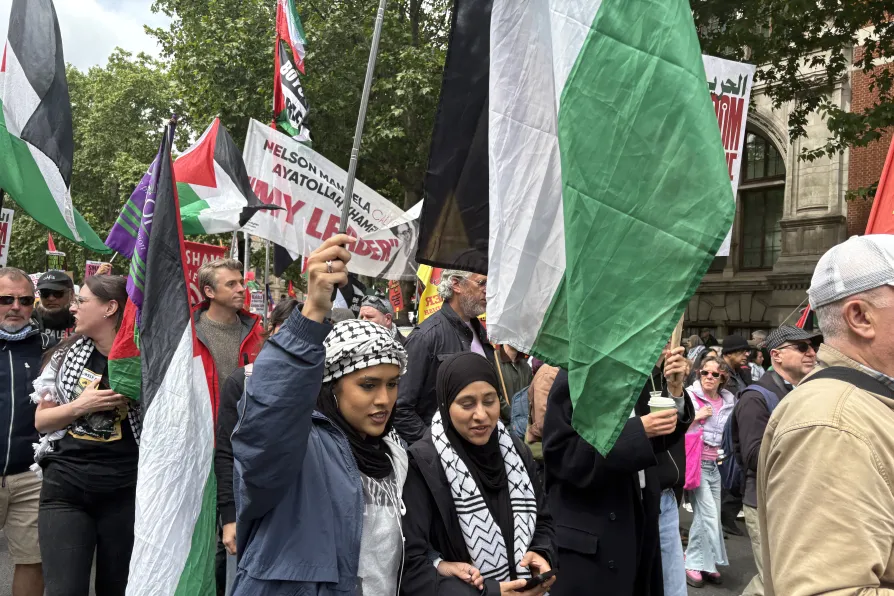
Stop the War’s John Rees calmly dispatched the idea that solidarity with Palestine is antisemitism on the BBC last week. He pointed out that in the dozens of massive Palestine solidarity marches there have been no incidents entailing attacks on Jewish people or institutions and that the marches have never passed by symbolic locations like synagogues.
I have seen Stop the War stewards weeding out the odd demonstrator bearing slogans that might be understood as antisemitic.
In a special category is the slogan: “From the river to the sea.” We need to recognise that it is freighted with a plurality of meanings. Where some see it as calling for the expulsion of Jews from the historic lands of Palestine, others see it as expressing a demand for an end to Israeli “apartheid” and full civil rights for all living between the Jordan River and the eastern Mediterranean.
For powerful elements in Israeli society and government their aim is to expel Arabs from the river to the sea. This is not an argument for a self-imposed ban on the phrase and certainly not an endorsement of the state’s bid to criminalise it as antisemitism. But in speech and thought we need to sensitive to language and meaning for people — not just in Israel and Palestine — who see these questions as going to their very existence.
This takes us to the question of the “two-state” solution to the conflict that is the formal position of the international community — whatever that might be in the era of Trump.
The parallel existence of two states on the basis of the 1967 international agreement with a geographically contiguous West Bank, Gaza and East Jerusalem as the capital of a sovereign Palestinian state is complete anathema to the ruling coalition in Israel.
For some, even in the Palestinian solidarity movement, the projection of a single state, “from the river to the sea,” resolves all the questions raised by the existence of the zionist state. This is naive idealism — as if thought gives material form to an idea — and it is a theoretical postulate that fails to take account of what needs to be done to change the balance of forces.
In reality it is a capitulation to the overarching imperialist narrative which is content to leave the question of an actual Palestinian state as an idea and nothing more.
It is clear that the emerging divisions in the US ruling elite, Trump’s disruption of the neoliberal consensus and the divisions between the imperial powers is opening up new possibilities for a changed balance of forces in the region and that this is bound to have an impact on both the direction of the Israeli state and the Palestinian national movement.
We have to take account of the reality that both a Palestinian nation and an Israeli nation exist.
The Israeli nation itself is constituted by the same processes that dispersed the Palestinian nation. Millions of Israelis are from Jewish families that were driven out of the Arab world and to see them as unproblematically as “settler colonialists” is to denude the term of any analytical power.
Israel did not simply come into existence as a “settler colonial regime” and this is today not a term that sums up the reality in the lands of historic Palestine where a sovereign and politically diverse Palestinian state would exist alongside an equally diverse Israeli state with a substantial Arab, Muslim and Christian minority.
In the same way the description of Israel as an apartheid state has enormous explanatory power but needs to be understood in relation to the many contradictions in Israeli and Palestinian society, including the accommodations reached between the Israeli state and the Palestine Authority and even between Hamas and the Israeli state.
There is the utility, for the zionist state, that the promotion of Islamist trends like Hamas and Islamic Jihad had in fracturing Palestinian resistance. But without recognising that the reproduction of Islamist ideas is itself bound up with Israeli actions, attempts to anathematise Hamas obstruct any possible resolution of the crisis.
Last week more than 4,000 people representing of 80 organisations met in Tel Aviv to build support for the establishment of an independent Palestinian state.
An end to British complicity in the occupation and genocide and Israel and the US war on the people of the region would immediately aid the prospects of peace.

Similar stories
History suggests apartheid ends not through appeals to conscience alone but through sustained economic and political pressure, says HUGH LANNING

Bezalel Smotrich’s measures to extend Israeli property law into the West Bank are a continuation of a decades-long project to dispossess Palestinians and preclude statehood, argues HUGH LANNING

On International Day of Solidarity with the Palestinian People, HUGH LANNING warns that the US-led “Comprehensive Plan” entrenches decades of Western complicity in Israel’s domination and denial of Palestinian land and rights