TUC president and POA leader STEVE GILLAN speaks to Ben Chacko on the eve of Congress 2026


 Latest editorial
Unions need to work together to break Britain’s low-pay culture
DAVE WARD says the Employment Rights Act can be a platform to build back union power — but only if we can agree a common agenda
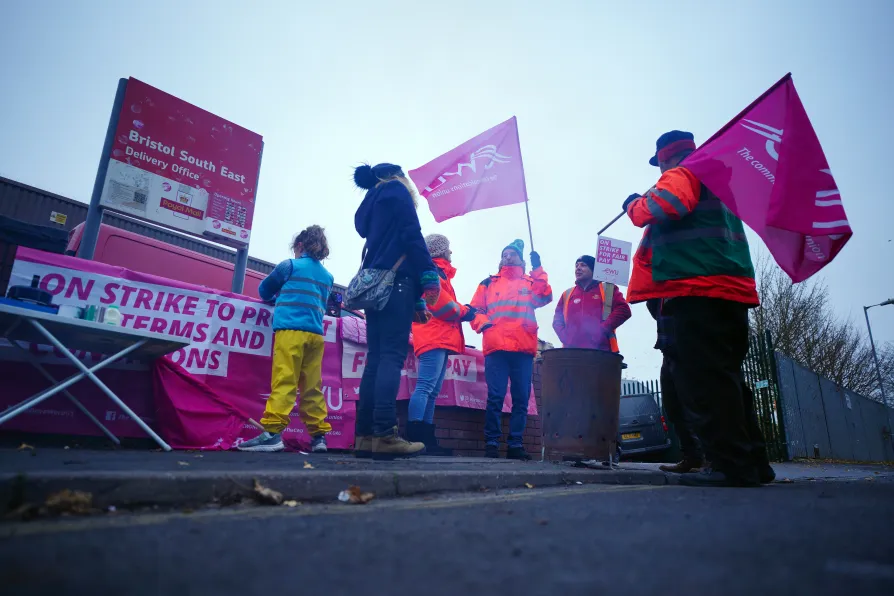 Members of the Communication Workers Union (CWU) on the picket line outside the Royal Mail Bristol South East delivery office in Bristol, December 14, 2022

As Cuba faces the most dangerous moment in its recent history, Britain must do more than condemn the US blockade at the United Nations, writes KEVIN COURTNEY, chair of the Cuba Solidarity Campaign
The Together Alliance is hosting two summits, North and South, to build power and plan action against the scourge of racism peddled by the right. DANIEL KEBEDE urges mass participation
Morning Star assistant business manager BERNADETTE KEAVENEY and international editor ROGER McKENZIE remember attending the 2001 TUC, suspended midweek after news of the World Trade Centre attacks
Whether it’s dented bike frames or broken ferries, MATT KERR wishes politicians had the same steely staying power of elite engineering instead of chasing disposable self-importance
The events of 9/11 reverberated across the United States and then the world. JOHN WIGHT remembers the eerie atmosphere that exposed racial divisions at the heart of Hollywood





A HUNDRED years from the general strike, a lot of people are reflecting on the origins of our movement. Trade unions were first built on collectivism: focusing on what’s in the interests of all of us, what moves everybody forward.
If the Employment Rights Act, secured by our movement through the campaign for a New Deal for Workers, is to be a platform for rebuilding union and workplace power, we need that same approach. To find the key issues that will help us organise and enhance workers’ lives, in a transformed world of work.
Some are pushing for a second Bill, others saying hold the government’s feet to the fire on delivering promises in the first, from online balloting to abolishing ballot thresholds. But it’s not an either-or. We can keep up the pressure on secondary legislation while looking to agree on what’s next: what does a “new deal 2” look like?
In my view it has to focus on three things: ending bogus self-employment and introducing a single status of worker; ending outsourcing and achieving the wave of insourcing Labour promised us; and extending the fair pay agreements and sectoral collective bargaining. These are all essential if we are to tackle the insecure, cheap-labour gig economy which is driving a race to the bottom on pay and conditions for all workers.
And it’s addressing these issues was one of the key reasons that I applied — successfully, slightly to my surprise — to be a Fair Work Commissioner, in an advisory capacity representing the trade union movement.
The biggest thing holding us back as a movement is that too often we don’t see ourselves as a collective. We will not break that gig economy model unless we end internal competition between unions, and start working together, challenging the multinational companies that exploit workers by refusing to employ them properly.
That’s at the root of so much that is wrong with this country. It’s madness, we’re subsidising bad employers, the state paying money it can ill afford subsidising low pay.
Labour says it wants growth. It’s not getting it, one reason it’s doing so badly in the polls. It has to recognise that you won’t get growth unless you change the dynamic in the world of work — underpin it with better jobs on higher pay.
Labour ought to get back to the values it had in 1945 — redistributing wealth and power, uniting all working-class people behind an agenda of decent jobs, good housing, good public services.
Those unions affiliated to Labour should be thrashing out that agenda so we can present it in the clearest possible terms: we want a change of direction, and it must involve specific commitments. If there’s a leadership contest, which looks likely, we shouldn’t let ourselves be courted individually by candidates — we should have a public list of demands we expect them to sign up to. Otherwise it undermines our collective power.
If we had that list of demands, that alternative economic vision, the pressure would be felt across the political spectrum. We would not need to get bogged down in debates about whether we ought to stick with Labour or support other parties, though I don’t see the value in walking away from Labour when it is in government and we have leverage that would count, if we acted collectively. More important than party affiliation is a movement-wide strategy to stand up for working people industrially and politically.
That would help us stand up to the far right, too. We need to defeat Reform UK and the trade union movement has a role in persuading people that it isn’t the answer. But we do that by stressing everything that unites us as a class. That’s not to say we don’t combat racism and sexism and bigotry, of course we do. But we overcome division and hate not through identity politics but through collectivism — how much more unites us as workers than divides us.
That’s why it’s so important we work together, across unions, to raise standards across whole sectors. In the CWU we want to use improved access rights to build membership across the postal-logistics sector and the telecommunications-tech sector. But we want to work at that with other unions: come up with a different model for the sector where we all benefit and all workers benefit — one which leads the trade union movement to start growing again.
We should be looking to a federal approach, something our motions calling for reform of the TUC and its structures in recent years aim at. I’m not going to take sides on inter-union disputes on recruitment but we should ask whether we can carry on with rules and safeguards that give individual unions particular rights, or think about things differently in the interests of the wider collective.
We want to see that sectoral approach from government as well. The scandalous failings in letter delivery at Royal Mail ended up as the subject of an all-party parliamentary select committee hearing, partly because of pressure from our members writing to MPs.
But what are they going to do about it? They need to change Ofcom’s remit: Royal Mail won’t be successful if Ofcom sees its job as promoting competition in a declining market. Ofcom needs to start regulating other parcel couriers, stop using labour costs as a measure of efficiency. That forces the debate onto competition with gig economy employers, which gives Royal Mail the excuse to come to us and say you can only run the service like they do. Do we want to level up or level down?
Our policy is for renationalisation, but there’s a reason our immediate focus is on sectoral bargaining and sector-wide regulation. Nationalising letters as a means of managing decline while hiving off parcels for profit is not a solution. We have to keep them together, or Royal Mail won’t survive: it won’t have the opportunity to grow its parcels service or the other products it could be delivering, with its unique infrastructure, recognition and trusted workforce.
Labour’s failing here is its unwillingness to really stand up for workers against the rich and powerful. That’s also responsible for the party’s other problems and the Mandelson saga shows it. What a disastrous decision, appointing him ambassador.
People get distracted by all the who-knew-what-when stuff. Mandelson was a known quantity. Certainly to us — the driving force for part-privatisation of Royal Mail in the Blair-Brown era. He was saying then that Royal Mail was a basket case, wouldn’t survive without privatisation. Well, how has privatisation worked out?
But I’m not with those who want to sit back and just blame Labour. In the end, it’s up to us to do something about it. Are we going to approach everything through the lens of our own union — or address the challenges facing all workers?
There may well be a new leadership of Labour soon. Could there be a new direction? It’s one we should be setting out now, if so.
Dave Ward is general secretary of the Communication Workers Union.
