ANGUS REID, ANDY HEDGECOCK and MARIA DUARTE review On The Sea, A Useful Ghost, Brunello: The Gracious Visionary, and Pinocchio Unstrung


 Latest editorial

Global fuel security examined
ROGER McKENZIE suggest this book is used as a resource to help spark resistance to the rise of nuclear power
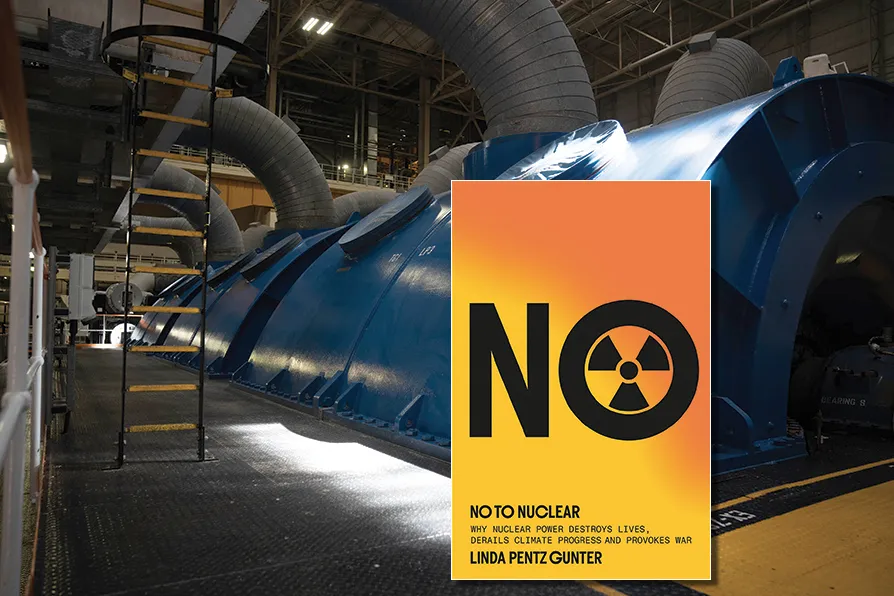 NOT ALL IT SEEMS: A general view of main generator 1, at the Sizewell nuclear power plant in Suffolk.

RON JACOBS enjoys a great tale, told by a US communist, of the lives of working-class New Yorkers
BRENT CUTLER searches a new history of contemporary Iran for an understanding of the Islamic Republic, finding both interesting detail and glaring omissions
MARIA DUARTE recommends the true story of the remarkable woman who sued Donald Trump for sexual assault not once, but twice
KENNY MacASKILL is disappointed by a polemical, rather than factual, account of the Lone Star State and its political path since the civil war
PAUL DONOVAN is fascinated by the lives of Charles and Mary Bagot, and the insight this biography shines on the morals of pre-Victorian society
GORDON PARSONS appreciates fine performances and a feel for ambiguity, but misses the music of the dialogue





No To Nuclear: Why Nuclear Power Destroys Lives, Derails Climate Progress and Provokes War
by Linda Pentz Gunter
Pluto Press £14.99
THE global economy has been sent spiralling into crisis as oil prices have soared because of the duelling blockades imposed on the Strait of Hormuz by Iran and the United States.
The US has seized control of Venezuela’s oil after its illegal and unprovoked attack of January 3 during which its military killed 100 people and kidnapped President Nicolas Maduro and First Lady Celia Flores.
It enabled the US to tighten its economic blockade of Cuba, to which Venezuela supplied a large proportion of its fuel. It also allowed the US to threaten to sanction any country that sold or supplied fuel to Cuba.
The US launched its illegal war alongside the Israelis against Iran in February because Tehran was allegedly trying to get a nuclear bomb. The Iranian claim they were merely developing their domestic nuclear power.
Many have chosen not to challenge whether Iran should even be developing nuclear power. They just argue that Iran has no intention of getting the bomb.
These are all central reasons why the book No to Nuclear: Why Nuclear Power Destroys Lives, Derails Climate Progress and Provokes War, by journalist and peace activist Linda Pentz Gunter, is so timely.
The current geopolitical crisis has sharpened the debate among world leaders about fuel security. But, sadly, that debate has centred on how nations can secure access to oil, develop nuclear power and keep fuel prices down for consumers.
Pentz Gunter, a regular writer for the Morning Star, does an excellent job of presenting in a clear and accessible way why nuclear power is “too slow, too expensive, too dangerous and too connected to the nuclear weapons complex,” to be a choice that we should still be considering.
One of the areas covered in the book, which makes it stand out from many on the subject of nuclear power, is her sensitivity in discussing the impact of uranium mining on indigenous communities.
Pentz Gunter doesn’t just talk about what she rightly describes as the “colonialist practice of uranium mining” in passing. She deals with the impact of the nuclear industrial complex on indigenous communities in the US, Niger, India and Australia in chapter one. By doing so she forces the reader to read the rest of the book in the context of its exploitative nature.
Importantly, Pentz Gunter demonstrates that these communities have not just sat around and waited for their exploitation to continue. They have mounted a continuing resistance that should be an example to those who sit behind their laptops or phones firing off social media posts.
Resistance across for these communities is neither neat nor tidy. It’s a constant battle for survival that should inspire us all.
Pentz Gunter asks the question in her final chapter whether it is too late for nuclear energy? For her own answer to that question I strongly urge you to read the book.
But, when I look across the globe, I see China is by far the dominant global force in renewables and has poured billions into renewable sources like wind and solar and manufacturing electric vehicles.
The Chinese have also been instrumental in getting solar panels over to Cuba to help the Caribbean island in its moment of crisis caused by the deepened US economic blockade.
The choice to move to a heavier reliance on renewables has been forced on the Cubans. But this moment of crisis may yet serve as another example the Caribbean island can demonstrate to the world alongside its world class free education and health systems. Clearly a major contrast at a time when the US has cut hundreds of billions in credits, grants and loans for clean energy technologies.
This is a book you should read and invite Pentz Gunter to talk about. Importantly, use it as a resource to help spark resistance to the rise of nuclear power.
