
APURBA CHATTERJEE explains how British artists in India used the “picturesque” to reshape colonial landscapes and celebrate imperial power


‘Jazz probes, questions and subverts the mores of the day’
CHRIS SEARLE on Mike Westbrook who died aged 90
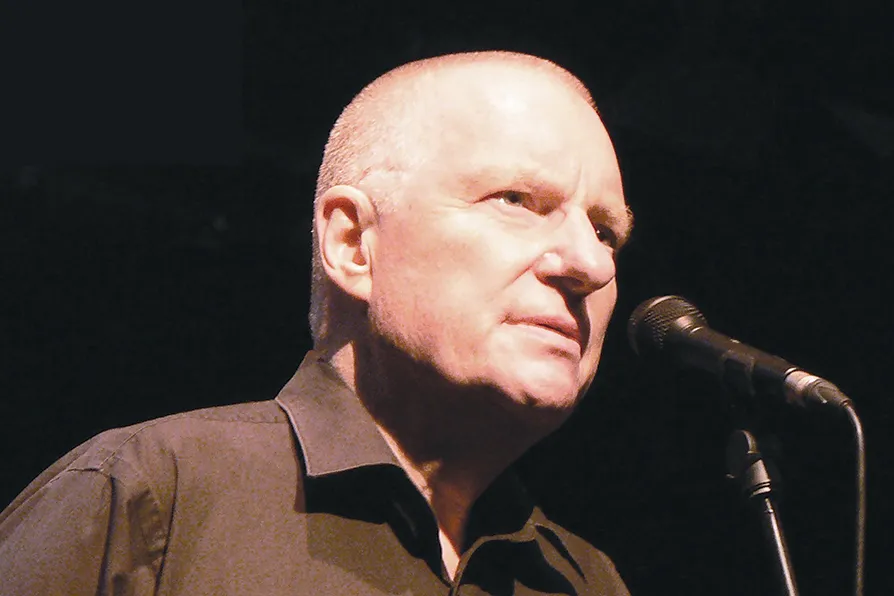
 Mike Westbrook with Phil Minton and orchestra at Toynbee Studios in London on 2008 / Pic: Andy Newcombe/CC
PAUL DONOVAN welcomes a revival of Reginald Rose’s classic play that reminds us of the fundamental need for trials with juries
SIMON PARSONS applauds an exceptional performance of Wesker’s little-known play, by the same actor for whom it was written 45 years ago
ANDY HEDGECOCK and MARIA DUARTE review Late Fame, The Death of Robin Hood, Leviticus, and Gail Daughtry and the Celebrity Sex Pass
ANGUS REID recommends a uniquely accomplished documentary collage that contemplates our relation to the natural world
GORDON PARSONS enjoys Kant’s ‘mind-boggling’ theory of human reality: that we create the reality we experience





IT IS MORE than a century since the first great jazz records by black virtuosi such as Joe King Oliver, Louis Armstrong, Sidney Bechet and Duke Ellington created their pioneering masterpieces. Over those 10 decades, the music that began in the Jim Crow streets of New Orleans has become a true music of the world.
Mike Westbrook (1936-2026), born in High Wycombe who grew up in Devon, lived through most of them as pianist, composer, orchestral maestro, leader of small units like the Westbrook Brass Band, the quasi-jazz rock formations of the 1972 quintet, the trio with his vocalist wife Kate and alto saxophonist Chris Biscoe to his final, summative Band of Bands.
Unique, protean and audacious, his musical lifetime created brilliant syncretisms of jazz: rhythm, improvisation, melodism, inventive harmony all expressed in the Westbrook genius. For him jazz stood for “freedom, independence and focus. Above all it stands for creativity. And when the band gets on the bandstand there is true democracy.”
Just listen to his lifetime of records. From his earliest anti-war sonic essay, Marching Song (1968) which he said came to him in a dream, and his invocations of Blake in Glad Day (1999), originally composed as part of Adrian Mitchell’s 1971 play, Tyger, including his musical settings to such poetry as “Let the slave grinding at the mill run out into the fields / Let him look up into the heavens and laugh in the bright air,” he manifested William Blake’s own freedom surge.
“Jazz is an awkward art form, forever destined to be a thorn in the side of mainstream culture. Jazz probes, questions and subverts the mores of the day. In our divided world jazz acknowledges no barriers. Its enduring strength is that it continues evolving, regardless of the caprices of the music business.”
For me, his greatest record is the Westbrook Orchestra’s tribute to Ellington, On Duke’s Birthday (1984), with its compelling track, East Stratford Too-Doo.
Westbrook was everywhere in east London at the time, bringing his brass band to local community events like our E1 Festival on Bigland Green, Stepney. As they started to play, local residents thought they were the Salvation Army, but soon changed their minds when they heard anthems like Brother, Can You Spare a Dime? and a hilarious satirical version of Brigitte Bardot, Bardot.
He wrote in 2023: “Recalling those street festivals in Stepney and the Isle of Dogs in the 1970s, it seemed to me we were on the threshold of a new Utopia. I remember the sense of liberation when, with the brass band, we took our music out into the streets. The vision of the arts at the heart of the community, of jazz as the music of the people, has never left us.”
One memory: in 1971 Mitchell sent me 50 free matinee tickets for Tyger, with the Westbrook Orchestra in the pit of the plush West End New Theatre. The east London children I took loved it, and at the end of the play, the actors called them up on the stage to dance, Blake’s children all, as the orchestra played out its swinging, pulsating notes.
It was how Westbrook conceived, wrote and played music: “All over the world, often against the odds, musicians continue to challenge convention, to defy orthodoxy. They assert their right to freedom of expression — and prize originality. These are the creators of music for our times. Jazz is the music of change, of hope!”
