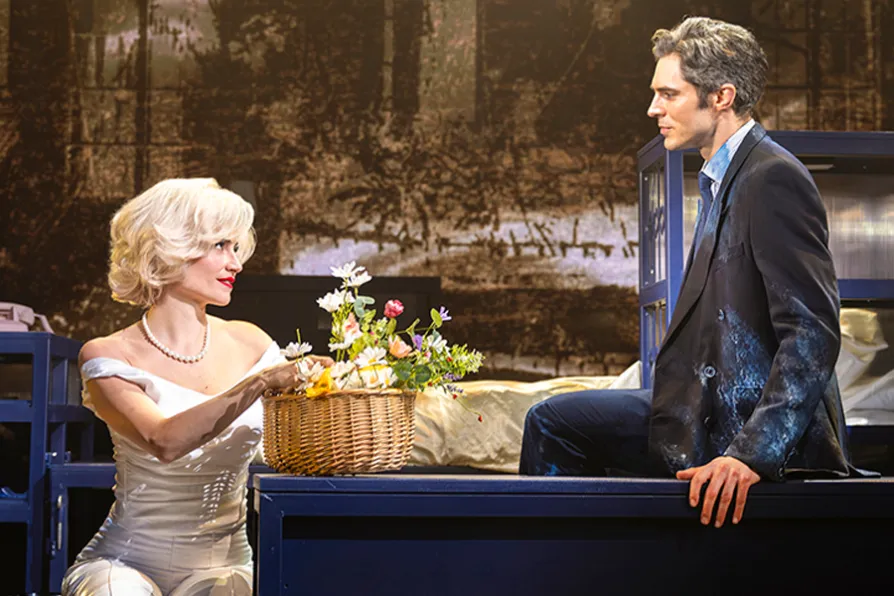
PAUL DONOVAN applauds an intriguing multi-layered depiction, dominated by a stunning impersonation of Marilyn herself


 Latest editorial

Owersettin’ Tzu
FINOLA SCOTT relishes a collection of verse in Scots that, among other things, meditates on the Chinese philosopher Lao Tzu
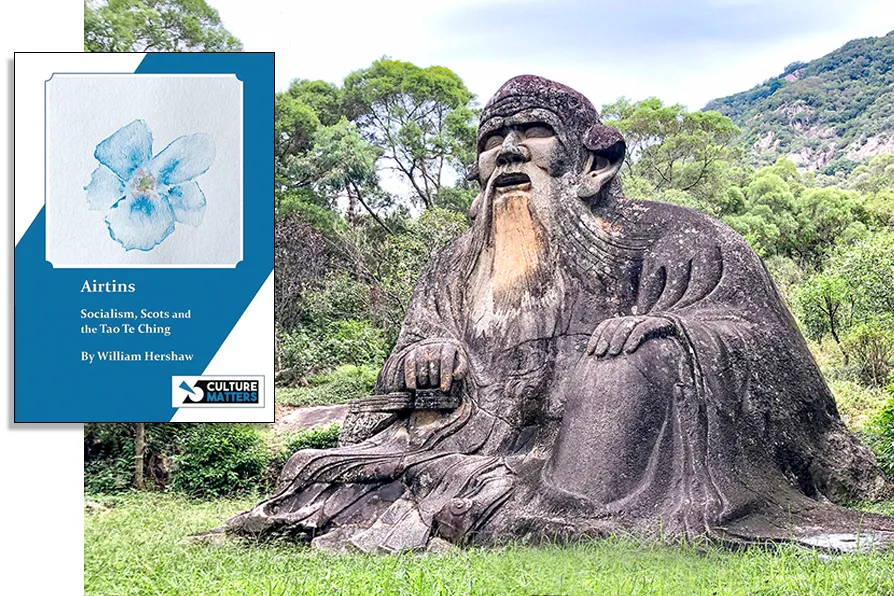 The Laozi (Lao Tzu) sculpture in Quanzhou is over 780 years old and was carved from a single rock during the Song Dynasty (960–1279 CE) / Pic: N509FZ/CC
LEO BOIX applauds an audacious, self-questioning film about grief, friendship and film-making
MARY CONWAY admires a brave and topical study of Armageddon that is, unfortunately, unable to come to a conclusion
ANDY HEDGECOCK, JAMES WALSH and JAMIE BRITTON review Hanging by a Wire, I Want Your Sex, The Pout-Pout Fish, and Rise of the Foot Soldier: Retribution
Chris Searle speaks to US pianist RAN BLAKE
The Bard hands out medals for his Edinburgh campaign and urges us to support The Men They Couldn’t Hang





Airtins: Socialism, Scots and the Tao Te Ching
by Willy Hershaw
Culture matters £12
WILLIE HERSHAW’s collection in Scots is direct, humorous, and self-aware. Airtins reflects on Lao Tzu, a legendary Chinese philosopher, said to have created the Tao Te Ching, one of the foundational texts of Taoism.
The introduction links Lao Tzu’s poetry to Hershaw’s work, as well as making a timely examination of the place of Scots language today. As Hershaw says: “The Scots language lends itself to the expression of universal truths, the expression of compassion, equality and the calling out of political stupidity & hypocrisy.” The poems in this collection certainly do all that.
Written in modern, everyday Scots, the work is accessible, even to non-Scots speakers. Hershaw’s is an authentic voice, his language is indeed of the people. But as he rightly states: “It is a rebel tongue.” This can be seen in many of his poems such as The Puir Fowk which is overtly and powerfully political: “The puir fowk sterve/ while rich fowk forder.” Forder means “advance themselves.”
Repetition is used effectively in these four-line stanzas to carry his strong message. In other poems such as Unlairnin Hershaw refreshingly minces no words, describing folk as “gowpan glaikits” (Staring fools) while his advice is clear and sensible”: “Gin there’s a doubt, dae nocht” (When there’s a doubt, do nothing).
A glossary, conveniently under every poem, means that a simple glance gives the meanings of words that the reader may not know, without disturbing the flow of reading.
This collection reads as a contemplation of society and self. It is almost a dialogue between Hershaw and Lao Tzu, with each of the four sections reflecting on the other. The first section is described as an “owersettin’ of Tzu’s poems.” I love the complexity this word contains. Poems are never simply or literally translated, instead they are reacted to and processed through another writer’s mind and voice. The titles of each section provide a useful indication of their purpose and inspiration.
Delicate, simple paintings of flowers, representing the seasons, by Mary Hershaw, separate each section and introduced its tone. Each illustration is accompanied by one of Hershaw’s neat haiku.
Hershaw’s use of a wide range of forms, from tight epigrams and skilful haiku to longer developed poems, makes it a book to you can either settle to or dip into. I can see myself popping it into my pocket to read on the bus or as a café companion for closer consideration.
The mood, while often serious, is never pretentious or overbearing. Indeed, it’s often self-deprecating. When Hershaw examines human foibles he always includes his own. This can clearly be seen in Nine Vairses where he lightheartedly describes each type of gardener in his local allotment group. Cleverly, he saves the last stanza for himself.
Nature is written about in an unsentimental way, with vivid fresh images of familiar creatures: in Delvin (“Digging over a garden”), the phrase “a lang pink slider” captures the whole creature, where the worm both exists as itself and as a symbol. This skill reflects Lao Tzu’s.
His tribute to daffodils, Feirs, is another such poem. This short poem opens with a vivid picture of the flowers as a group of pals chatting away. Then we’re told they are a gift to ease our days. It’s an image and a thought that I know I’ll remember when I next see their gowden pows (“Golden heads”).
I can think of no better gift than For A Newborn Bairn in Section Two, the section full of neat haikus. Section Three is crammed with memorable owersettins of epigrams — well worth studying and learning. The poems in the last section have a specifically Scots context. What a delight to read an owersettin of Gerard Manley Hopkins!
Aa Musick Is Fowk Musick a sharp accurate comparison of Scottish poet McDiarmid and political hero MacLean, is my particular favourite, and The Coda Of Scottish Rivers, which ends the book, is a tour de force, making a powerful statement about our country.
I heartily recommend this collection to all.
