A new generation of right-wing politicians have shifted from promoting deregulation to championing anti-migrant politics warns SOLOMON HUGHES


 Latest editorial

Armageddon, egg rolls and empty promises
As world leaders posture and local politicians bore, voters are left with a grim choice: despair, disengage — or start imagining something better, says MATT KERR
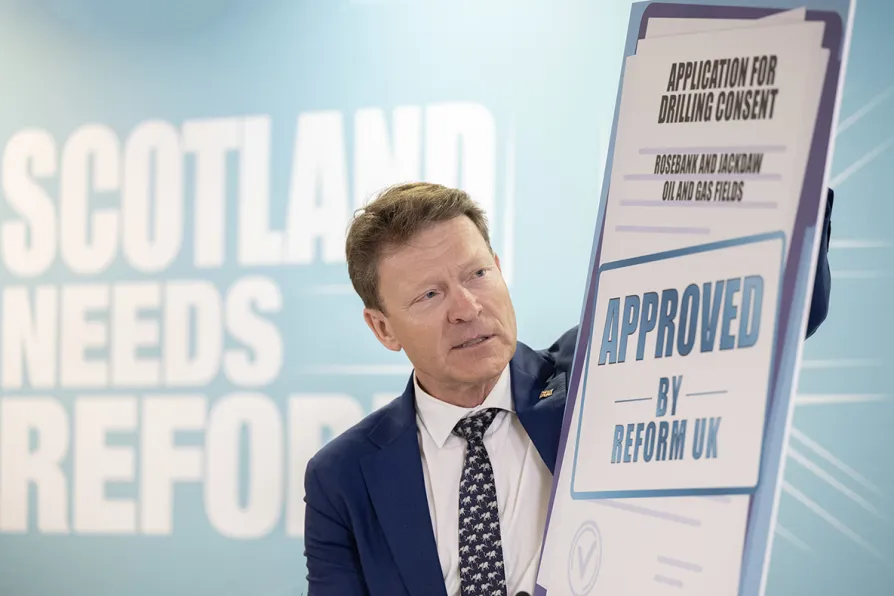 Reform UK deputy leader Richard Tice at a press conference at the Macdonald Norwood Hall Hotel in Aberdeen, whilst campaigning for the upcoming Holyrood election, April 8, 2026
by the Greater Manchester Workers’ and Tenants’ Association
The US relationship with Israel has evolved into a strategic liability, argues RAMZY BAROUD
A champion motorcyclist, trade union organiser and communist, Clem Beckett went from Britain’s speedway tracks to the battlefields of Spain, where he gave his life resisting Franco’s forces at Jarama. GEOFF BOTTOMS pays tribute to this remarkable anti-fascist
The greatest threat to democracy may no longer come from political parties but from unelected tech oligarchs like Peter Thiel and his powerful Silicon Valley network, argues JOHN GREEN
Claiming to ease a fertiliser shortage, the Trump administration has suspended tariffs on Moroccan phosphate imports – deepening US support for the Morocco’s control over Sahrawi territory, writes LUKE ROTELLO





LAST weekend I found myself at a double party. Drink was liberally consumed, and the blethering went on into the wee small hours.
I managed to get into a conversation about what books folk were reading, but I was brought to a shuddering halt by a simple question:
“What was the last fiction book you read?”
That shut me up. Not only could I not remember what it was, for some reason I couldn’t remember any at all. I ducked out about 2am — too tired to sleep and a bit confused.
The next day I watched the President of the United States of America, flanked by his wife and a giant rabbit talking about his love of American eggs and wiping out Iranian civilisation.
He then got down to the serious business of officiating over an egg rolling competition on the White House lawn. The kids loved it.
Still buzzing from the spectacle he swaggered over to the press corps to chat breezily about tearing children limb from limb in some far off land, his voice fighting for attention over the easy-listening airs of a nearby brass band.
Donald Trump’s Armageddon was scheduled Tuesday at 8pm Eastern Standard Time, or Wednesday, 2am for viewers in these islands. He was so excited he couldn’t even leave it to the end of the week.
Should have known the world would end on a bloody Wednesday, I thought, as the the orange beast beat his chest with his tiny fists in frustration at the Iranians virtually closing the Strait of Hormuz and making economies across the West scream.
The sheer temerity of it. The US would never behave in such a way.
No, it’s nothing like the 66-year US blockade of Cuba, not least because Cuba isn’t a military superpower and Fidel Castro never told John F Kennedy that US “civilisation could die, never to be brought back again.”
Not to worry, a ceasefire was agreed and we can all breathe again — except for kids in Lebanon, obviously, because their lives don’t appear to count.
Channelling John Terry’s appearance in full kit to bask in the glow of Chelsea’s Champions League win despite having played no role in the game, our very own guardian of the flame of ineptitude, Sir Keir Starmer duly mounted his charger to make haste for the region.
As he packed his toothbrush, hands trembling with excitement, he strained to bore the mirror into believing that only he — the head of a government that had supported the illegal actions of one side, while actively lying about it — could hold the circle of trust necessary to broker a deal that had already happened.
Meanwhile, back at the ranch, Defence Secretary John Healey felt the need to mumble at considerable length about Russian submarines investigating our undersea cables. The content fell into line with the steady drumbeat of a march towards a war economy culminating in a war to justify its existence; best serious face and crowbarring the word “capability” and its variations at least once into every last sentence.
Don’t worry, even if there is no bread, as long as Healey is the man tasked with rallying the troops for combat, there’s hope for peace — and sleep — yet.
Other cures for insomnia are available, in fact they’re coming to a letterbox near you. This very morning, a clutch of election materials through mine, tragically just as the need for spools for fire melted away with the sun.
Four parties so far, each pitching themselves as the insurgents, even the one that’s been in power in Holyrood for 18 years and 11 months. Highlights so far have been watching half a dozen Reform candidates out themselves as wrong-uns, an in-depth debate about the NHS which involves pointing at each other and saying “NHS good,” arguing over whether councils should be able to have a congestion charge, and agreeing that the public sector is between 11,000 and 15,000 bodies too heavy.
Rolled up in a battered carpet and gagged on “wha’s like us” chauvinism, the election will delivered to shallow grave near you. That’s about as exciting as it’s going to get.
The pitches, such as they are, are crafted not to inspire, but to demoralise, to carry on with that job of convincing the people that there is no history left to make, no world to win.
The shrinking of the state is as inevitable and unavoidable as gravity itself, they say as they point at services failing apart as council taxes rise. The political arena has degenerated into debates on the conference of “rights” on the individual by a governing class without either the imagination or the attention spans to set about delivering on them.
It’s a manner of thinking that catches Holyrood out time and time again, not least when it recently considered assisted suicide legislation.
Not content with writing off the serious concerns raised by people living in a world that actively disables them, humiliates them and tells them they are little more than a burden to be carried, legislators had not even taken the trouble to seriously look at how an already struggling NHS could add a new euthanasia service to its roster or afford it.
Some would call this sort of behaviour “virtue signalling,” and maybe they’d be right. What it is above all, however, is dishonest. The reasons debate on the running of the country has disappeared into abstraction — even on issues such as congestion charge — are many.
There is not just a lack of real-world experience and the imagination to comprehend others’, but an active decision to turn away from the world.
There are exceptions, though sadly many of them are about to leave, no doubt tired of a chamber where each and every chair points to the centre.
What’s left is not just a rudderless government — to point this out is not controversial even among SNP-supporting friends — but a rudderless Parliament which substitutes practical conduct rooted in ideological foundations, for content creation rooted in nothing.
In that world, the manifestos, even the better among them, are made works of fiction by those who would nominally be trusted to deliver on them.
Talk about “fully costed” this or that becomes a platitude more aimed at chilling debate with other parties than actually engaging the public on what they propose.
I have no doubt that researchers had done some work on the practicalities for funding it, but was Labour’s NHS proposal all those years ago sold as something that was necessary or something that was “fully costed”?
The answer was the former and Parliament got down to the job of doing the detail once the principle and mandate had been won. Holyrood either neglects the second phase altogether or parties put the costings — generally plucked out of the air — first not to convince anyone a policy can be delivered, but to manage expectations ever downward.
To point this out is not to call for people to neglect their civic duties — quite the opposite.
The polling booth too often is a place approached with a sigh, if at all; literally a box-ticking exercise ending weeks of campaigning which over the years have largely degenerated into the same.
There may be precious little in this year’s manifestos to set the heather alight, but if you want a better world, gather friends around the hearth and start your own.
Where to begin? Look around you of course, but don’t be trapped.
Look up, imagine what could be and then get to engineering the foundations.
Look at the theory, the history, learn the practice and never forget there’s a world of struggle out there that belongs to all working people.
Elect who you must, but elect tribunes, not managers or messiahs.
And yes, read a good book too…
