ROB WARZYNIAK recalls the emblematic 1906 book, The Jungle, in its analysis of the crisis presently engulfing the US Food and Drug Administration


 Latest editorial

The left without class has failed – what comes next?
One hundred years on from Britain’s only general strike, socialists will gather in London at the Morning Star’s annual conference to discuss how organised labour can once again become the engine of radical change. Editor BEN CHACKO encourages readers to come along and join the debate
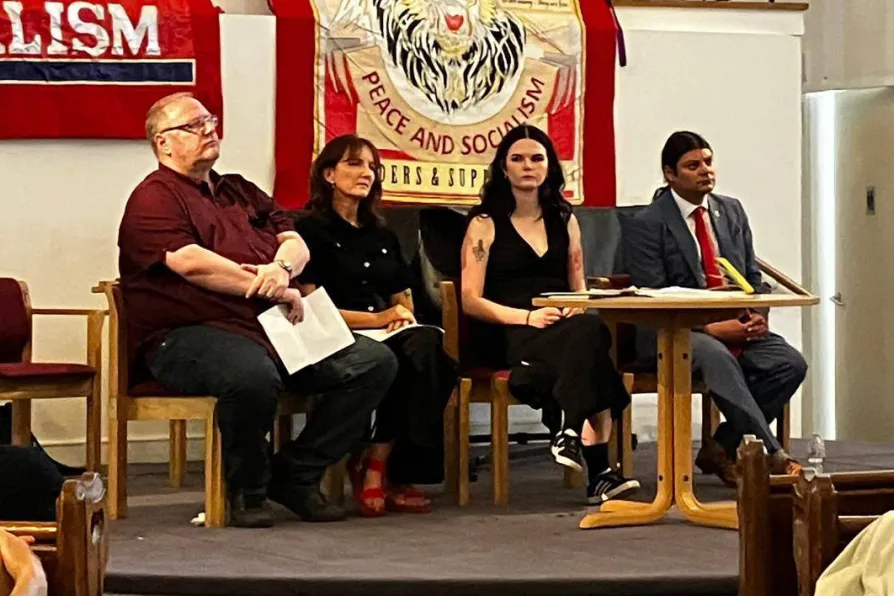 One of the panels at last year’s Morning Star conference

Welsh wanderings showcase fiery destruction, alternative water ways and revive memories of a local mining legend, writes MARK SEDDON
As thousands die in the eastern DRC, a global health emergency is being starved of funds, says S KRISHNASWAMY
MAT COWARD explains how in the 17th century a row over whether to kneel at communion became a battle over religion, class and royal power
Renewed illusions in social democratic reformism are sprouting as a result of Andy Burnham’s rhetoric, but material conditions are already intruding into the debate, argues NICK WRIGHT
Andy Burnham could learn a few lessons from a previous Labour government in the pre-privatisation era on how to tackle water shortages, writes KEITH FLETT





“THE cause of labour is the hope of the world.” Walter Crane’s May Day masterpiece summarises the understanding that has united most socialists for a century and a half: that the organised working class is the revolutionary agent which will overthrow capitalism and build socialism.
Is it still true? We are a century on from the only general strike in British history. Half a century since the peak of trade union membership and power in this country in the 1970s (which, not coincidentally, was also the most equal in terms of income distribution this country has ever been). Today’s trade union movement is half the size in a bigger workforce; the most eye-catching force on the British left today, the Greens, do not come from a labour movement tradition at all.
We have seen lots of attempts to de-centre class in the revolutionary process over the years.
Some grew out of valid concerns that labour movements had paid too little attention to oppression on the basis of race and sex, the persecution of homosexuality, or protection of the natural world (though the foundational 20th-century socialist revolution, the Russian Revolution of 1917, was startlingly advanced in these areas without abandoning the primacy of class conflict).
In Britain, downgrading class politics helped disarm the revolutionary left as battles over “eurocommunism” tore apart the old Communist Party of Great Britain. The later — and directly related — phenomenon of “New Labour” had a similarly debilitating effect on what had been British social democracy, as the Labour Party dropped any notion that it existed to represent the working class specifically.
Nobody on the left could claim the results have been good. Britain is a far more unequal country than it was in the 1980s.
It is less democratic, with a more authoritarian state which enjoys far less public legitimacy — even the Speaker of the House of Commons Lindsay Hoyle has admitted that “faith in democracy” (by which he means the British political system) is weaker than ever.
A higher education now entails a lifetime of debt; it is harder to support a family on a single ordinary wage; the relative cost of a secure home is far higher. Deindustrialisation and the hollowing out of local democracy have increased regional inequalities. The last 15 years have seen an explosion in homelessness and the rise of foodbanks with the return of widespread hunger.
All this can be tied to the retreat of a class conscious left before liberalism, which — in guises such as New Labour — has been comfortable with progressive social legislation, with complex (but generally ineffective) regulation of corporate behaviour, even with some progressive employment legislation — but consistently opposed to working-class power, exercised either through unshackled trade unions and collective bargaining or through public ownership of essential resources and services.
Rebuilding class politics in Britain is essential to turn a page on this depressing story. And a century on from the General Strike of 1926 seems a fitting opportunity for us to discuss how we do that.
That is the theme of the Morning Star Conference 2026, taking place this coming Saturday April 11 at central London’s Hamilton House. But we won’t be talking all day about the General Strike.
Rebuilding class politics is key to addressing every crisis we face.
An immediate one is the threat of the far right — can we build on the magnificent half-million-strong Together demonstration to develop a countering force strong enough to squash the menace of Reform? That will be the discussion that kicks off the conference at 10am.
The class struggle is global. Amid the sound and fury of the US-Israeli war on Iran, in a year that started with the US kidnapping of Venezuela’s President Nicolas Maduro followed by an intense, ongoing effort to suffocate the Cuban Revolution, it would be impossible to ignore the growing threat of world war, especially since Trump’s influence on the right in this country looms large. Trump and the New World Disorder forms the subject of another session.
But a lot of this begs the question — why is Trump so desperate to crush the Bolivarian and Cuban revolutions? How is US aggression tied to the rise of the global South and especially China, and do these developments offer hope for the future? The session Another World is Possible will debate these questions, take a look at the achievements of socialist countries and hopefully cheer us up a bit.
If the need for a powerful anti-racist movement started off the day the need for a revived socialist feminism is no less important.
Women’s rights are a key target of the far right, but even in today’s liberal order violence against women has reached epidemic proportions, harassment is on the rise in schools, and technology (examples include universal access to online porn and sinister new threats from AI) raises new threats to women. Is Britain’s trade union movement a feminist movement and does the British left stand with and for women? Our session Women Hold up Half the Sky will take a look.
That will take us on to our final panel of the day — organised labour 100 years from the General Strike. What are the lessons of that great battle? How do we rebuild fighting unions today? And, in the process, working-class power — not to mend capitalism. But to end it.
Over the last few years the annual Morning Star conferences have become a much-anticipated part of the calendar, bringing together a great range of speakers from the labour, peace and anti-racist movements.
This year is no exception, with outstanding left MPs including Jeremy Corbyn and Diane Abbott, trade union leaders such as the FBU’s Steve Wright, the RMT’s Eddie Dempsey and PCS’s Fran Heathcote, anti-war campaigners like Lindsey German of Stop the War and Sophie Bolt of CND, leading left activists including Sabby Dhalu and Laura Pidcock.
We’ll hear from women organising in unions, Cuban revolutionaries, solidarity campaigners and the new Communist Party leader Alex Gordon — as well of course as from Morning Star journalists and staff, some of whom such as our international editor Roger McKenzie or our political reporter Andrew Murray are respected movement leaders in their own right. We’ll also include plenty of pointers on how you can help keep the only socialist daily newspaper in the English-speaking world, our very own Morning Star, shining as we head towards our centenary year in 2030.
Each session will include time for questions and audience participation — there’s a big struggle ahead and every voice matters. The left has lost most of its battles for 50 years, so we can’t claim to have all the answers.
Join us on Saturday. It’s just a fiver to get in so even if you can’t make the whole day, join us for a session or two. It promises to be a great day — I hope to see you there.
Buy tickets for the Morning Star conference here.
