
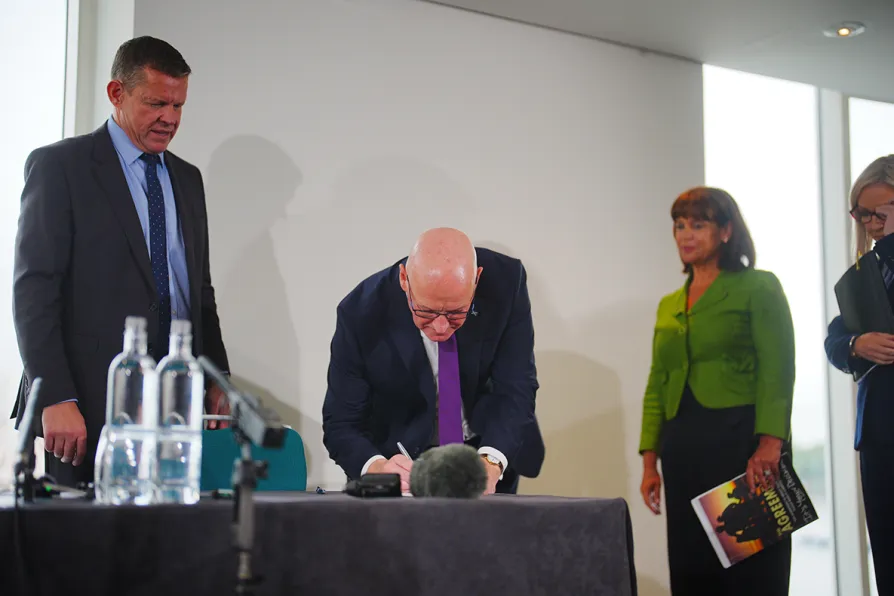
The UK Prime Minister may have the regal touch in northern England, but he’s been wrong-footed on the constitutional challenges posed by the Celtic Alliance of first ministers from Scotland, Wales and Northern Ireland, argues KENNY MacASKILL

The Slow Strangulation of Cuba: US Imperialism, Neoliberalism and the Oil Blockade
CLAUDIA WEBBE says the US is tightening the noose to destroy Cuban socialism — the need for immediate, international solidarity is urgent
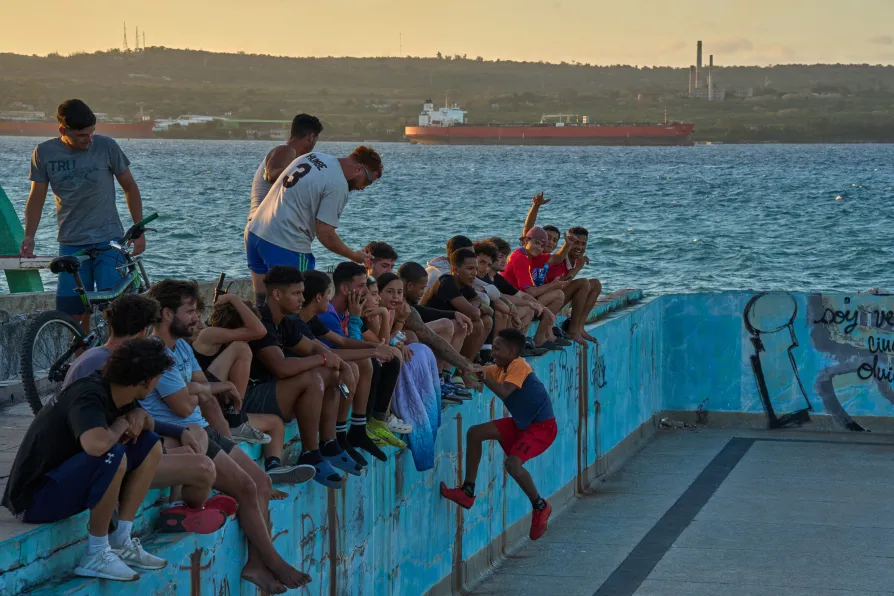
 People sit along the edge of an abandoned swimming pool across from a tanker terminal along the port of Matanzas, Cuba, March 30, 2026
NEIRLAY ANDRADE, a member of the Communist Party of Venezuela’s political committee, outlines her party’s position on the crisis facing the country
A look at Taylor Wimpey’s accounts shows why Labour’s market-led housing strategy won’t deliver more, cheaper homes, as promised, says SOLOMON HUGHES
DAVID HORSLEY remembers the remarkable life and death of US black revolutionary George Jackson, whose politically passionate prison letters were published as Soledad Brother
Cuban trade union federation CTC leader OSNAY MIGUEL COLINA speaks to Ben Chacko about life and work under a crippling US siege
A part of the British empire’s network of slavery, today the Caribbean island of Nevis faces a new form of exploitation in the form of crypto-colonialism, CLAUDIA WEBBE writes
Challenges from the unscrupulous misuse of AI to steal actors’ voice and physical likenesses is being met with a firm union response, writes LYNDA ROOKE





THE logic is always the same. Create a crisis or wait for one. Manufacture desperation, or weaponise it. And then, when a people are on their knees — when the lights have gone out, when the shelves are bare, when the hospitals are running on prayers and the peso is worth less than the paper it is printed on — step forward with your terms.
Open your markets. Privatise your assets. Hand over your land. Take our investment. Accept our deal.
That is what is being attempted in Cuba in March 2026. Not as accident. Not as side effect. As strategy.
For months now, an illegal US oil blockade has been strangling Cuba as Donald Trump tries to finally end a socialist government that has resisted US imperialism for almost seven decades. The latest oil blockade is depriving Cuba of some 100,000 barrels of oil a day, around half of which it used for itself and sold the rest on international markets.
The Economist Intelligence Unit forecasts Cuba’s GDP will contract by 7.2 per cent in 2026 alone. That would represent a cumulative collapse of 23 per cent since 2019. Cuba’s GDP per capita stood at just $1,082 in 2025 — against a Latin American regional average of $10,212. Cuba and Haiti are the two economies in the entire Latin American and Caribbean region projected to contract in 2026.
Between 1990 and 2024, the Cuban economy grew by a cumulative total of just 1.1 per cent. Not per year. In total. Over 34 years. That is not mismanagement. That is what 60 years of the most comprehensive, most enduring trade embargo in modern history does to a nation.
The blockade has now cost Cuba more than $170 billion in accumulated losses since 1962. In the 12 months between March 2024 and February 2025 alone, the damage was $7.5 billion — a 49 per cent increase on the previous year. The United Nations calls the total damage to the Cuban economy, accounting for inflation and compounding loss, in the trillions.
And then, on January 29 2026, Trump signed Executive Order 14380: “Addressing Threats to the United States by the Government of Cuba” and the slow death accelerated into something closer to execution.
David Harvey, the Marxist geographer, defines neoliberalism as a project of class power restoration — the use of state and market mechanisms to transfer wealth upward, to restore the dominance of capital over labour, of the few over the many.
The Washington Consensus — fiscal discipline, trade liberalisation, privatisation, foreign direct investment — was the manual. Latin America was the laboratory. Chile under Pinochet was the prototype.
What did neoliberalism do in Chile? It did what it always does. It required a shock.
The coup of 1973. The murder of Salvador Allende. The Chicago Boys with their briefcases and their Milton Friedman texts, walking in behind the jackboots, privatising fisheries, privatising pensions, slashing social spending, opening ports to foreign capital. Naomi Klein documented it precisely: the bodies and the balance sheets arrived together.
What did neoliberalism do across Latin America in the 1980s? It manufactured a debt crisis, then offered structural adjustment as the cure. The medicine was always the same: shrink the state, open the market, accept foreign ownership, abandon protection. The patient rarely recovered. But the investors always profited.
Cuba refused. For 67 years, Cuba said: no. And that refusal — that magnificent, stubborn, costly, heroic refusal — is the true reason for the blockade.
Not communism as a threat. Cuba as a demonstration effect. Proof that another way was possible. Proof that a small island could have universal healthcare, near-100 per cent youth literacy, doctors in 165 countries, and a lower infant mortality rate than the United States. Proof that people do not need to be offered to the market in order to live.
The empire cannot tolerate that proof. Because if Cuba can do it, then the question becomes: why can’t everyone?
After being known as one of the most unequal countries of Latin America under capitalism, Cuba became, as Elizabeth Dore, a Professor Emeritus of Latin American Studies at the University of Southampton, noted “one of the most equal societies in the world, enjoying for decades a ‘Golden Age’ when most Cubans had adequate food, excellent health care and a good education”.
The US establishment does not want a successful socialist country on its doorstep.
Despite the challenges imposed unjustly on it for decades, Cuba has been an example to the world and, particularly, an embarrassment to its neighbour the United States. So clearly, Donald Trump wants to kill it.
Literally so. Trump’s blockade of fuel and other essentials is lethal, not least in the collapse it has triggered in the Cuban national electricity grid. Cuban tankers have hardly left port for months and those that manage to slip out return empty as neighbours – including now Venezuela since Trump’s abduction of its president – cower under the threat of US retribution and refuse to load them.
The Cuban peso has collapsed. By March 2026, it had depreciated 47.8 per cent against the US dollar in 12 months alone. The euro rate had fallen 65.7 per cent in the same period. Official inflation ran at 14-15 per cent in 2025, but private estimates suggest the real figure was closer to 70 per cent.
Partial dollarisation — the growing role of the dollar as the operational currency for key sectors of the Cuban economy — has been forced into being by the pressures of blockade and crisis. Under these conditions, the 40 per cent of Cubans without access to foreign currency through remittances or tourism employment are structurally cut off from the functioning economy.
The result is a dual currency. And crucially — as the Bertelsmann Transformation Index documents — the inequality this generates risks reproducing prerevolutionary social hierarchies, because the emigrants who send remittances are disproportionately white.
Neoliberalism always has a racial architecture. It always has a class architecture. The market does not distribute randomly. It distributes according to power.
Tourism, once 13 per cent of Cuba’s economy, has effectively collapsed. Cuba welcomed only 1.8 million international visitors in 2025, down from 4.2 million in 2019, when I visited on the 60th anniversary of the revolution.
Hotel occupancy averaged 21.5 per cent in the first half of 2025. For January 2026, initial estimates point to a 70 per cent decrease in international arrivals.
Air Canada, Air Transat, Sunwing, WestJet, Aeroflot — all suspended or drastically reduced flights after Cuba announced a complete absence of aviation fuel. Airlines cannot refuel on the island. Cuba’s airports are running on empty.
Medical diplomacy, which generated approximately $4.9 billion annually, is being systematically dismantled.
The US is revoking visas of officials from any country hosting Cuban doctors, and Jamaica and Guyana have already ended their Cuban medical co-operation agreements under US pressure. The pharmaceutical and biotechnology sector, one of Cuba’s genuine scientific achievements, cannot access global markets under the embargo.
Cuba is haemorrhaging revenue from every direction simultaneously.
On March 16 2026 -the same day the grid collapsed for the third time in a month, the same day Trump said he would have the “honour of taking Cuba” — the Cuban government announced that Cubans in the diaspora, including those in the United States, can now for the first time own and invest in large-scale Cuban infrastructure, banking, agriculture, mining and tourism. The first institutionalisation of public-private enterprises in nearly 70 years of socialist Cuba.
Is this restructuring forced by siege? The Shock Doctrine executed not necessarily with guns — but with oil embargoes and tariff threats and the slow, calibrated extinguishing of the lights.
In plain English: Washington is seeking to shape Cuba’s future in ways that secure access to the island’s assets and preserve its own strategic interests. Some would argue this is precisely what is happening in Venezuela. It is what happened in Iraq. It is the standard template of contemporary imperial restructuring.
Between 40 and 45 per cent of the Cuban population lives in poverty by income measures. Some researchers estimate 89 per cent live in extreme poverty by World Bank thresholds. Seven out of 10 Cubans skip at least one meal per day.
This is not a failing communist state. This is a country under siege — and the besieger has a name, an address, and an executive order number.
This is disaster capitalism in real time. This is the Shock Doctrine. This is neoliberalism deploying an oil blockade where once it deployed the IMF and the structural adjustment programme. The instrument has changed. The logic has not. The response must match the analysis.
First: an international solidarity economy for Cuba — not charity, but structural. Non-aligned nations, the African Union, China, progressive governments across Latin America must build oil supply chains that are legally and economically insulated from US tariff threats. Cuba’s most immediate survival need is crude oil. That need must be met by collective international will.
Second: the global left must expose and contest the terms of any US–Cuba “deal” that would amount to the privatisation of the island’s public assets and the subordination of its economy to US capital.
The experience of Venezuela — where external pressure has been used to lever market openings in the oil sector — shows how imperialism seeks to turn crisis into opportunity. That must not be allowed to happen in Cuba without a fight.
Third: the racial dimensions of dollarisation and market opening must be explicitly challenged. Any economic policies that reproduce racial inequality — that channel wealth to the white diaspora while structurally excluding “Afro-Cubans” — is not reform. It would be the re-inscription of colonial hierarchies in the language of entrepreneurship.
Fourth: the international working class, the feminist movements, the pan-African solidarity networks, the Marxist and anti-imperialist movements of the global South must recognise Cuba not as a distant dispute but as a front line in the global struggle over whether the state exists to serve people or profit.
Fifth: Jeremy Corbyn and Kneecap went to Havana with 20 tonnes of solidarity. That is not enough, and yet it is everything. It is a model. The world must send not just aid but standing — political, diplomatic, organisational standing — that makes the isolation of Cuba politically costly for those who impose it.
The slow death of Cuba is not an accident. It is a programme. It was designed by the same intellectual tradition that designed the murder of Allende’s Chile, the looting of Yeltsin’s Russia, the drowning of New Orleans, the starvation and genocide of Gaza.
It is the logic of capital confronting a people who refused to submit — and deciding that the refusal itself is the crime.
Donald Trump. Marco Rubio. The entire architecture of US imperialism and neoliberal extractivism.
You will not have Cuba. Not its land. Not its labour. Not its sovereignty. Not its dignity.
Claudia Webbe was the UK Member of Parliament for Leicester East (2019 –2024). You can follow her at www.facebook.com/claudiaforLE/ and x.com/claudiawebbe

Similar stories
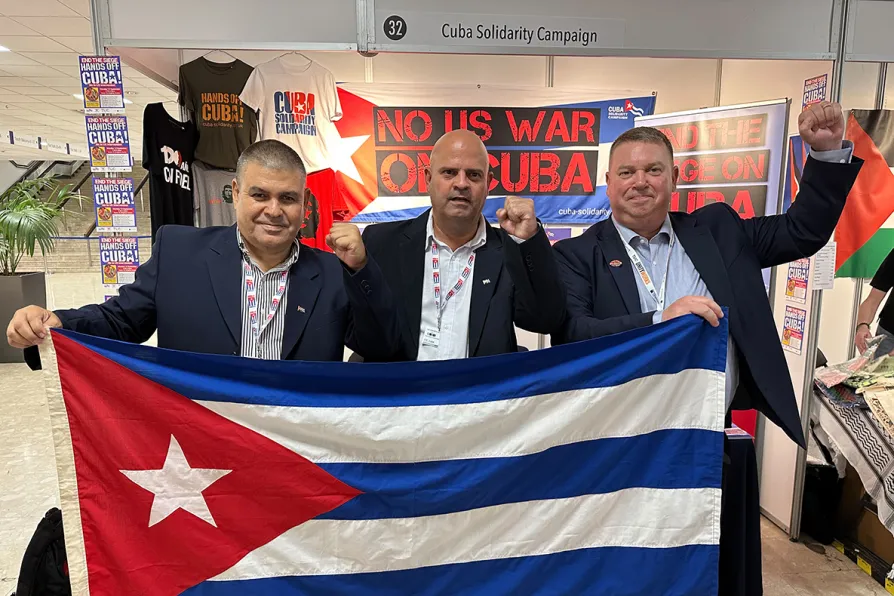
ALEX GORDON, general secretary of the Communist Party of Britain, calls on Britain’s trade unionists to redouble solidarity with the socialist island
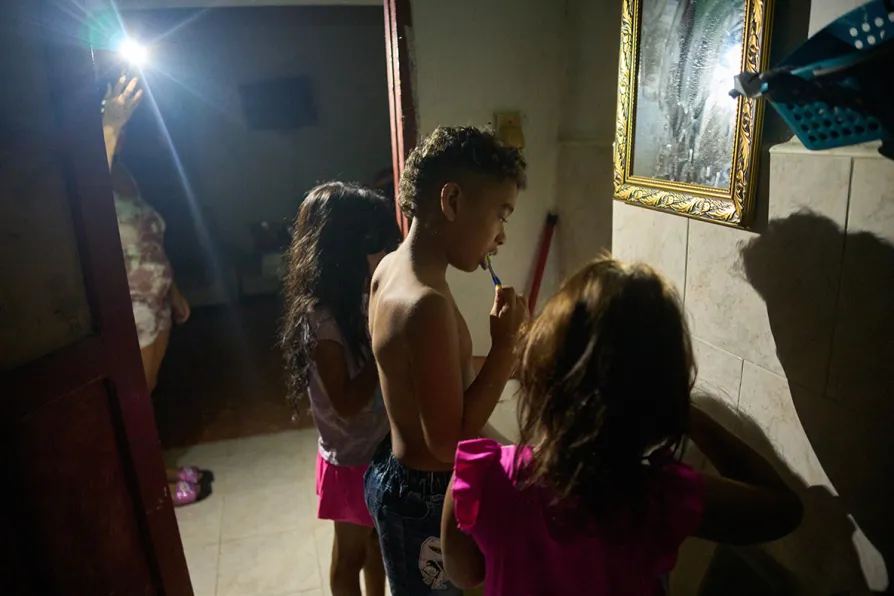
As Cuba faces an unprecedented US energy siege and growing threats of military intervention, TUC Congress must stand unequivocally with Cuban workers and their right to determine their own future, writes STEVE GILLAN, POA general secretary and TUC president
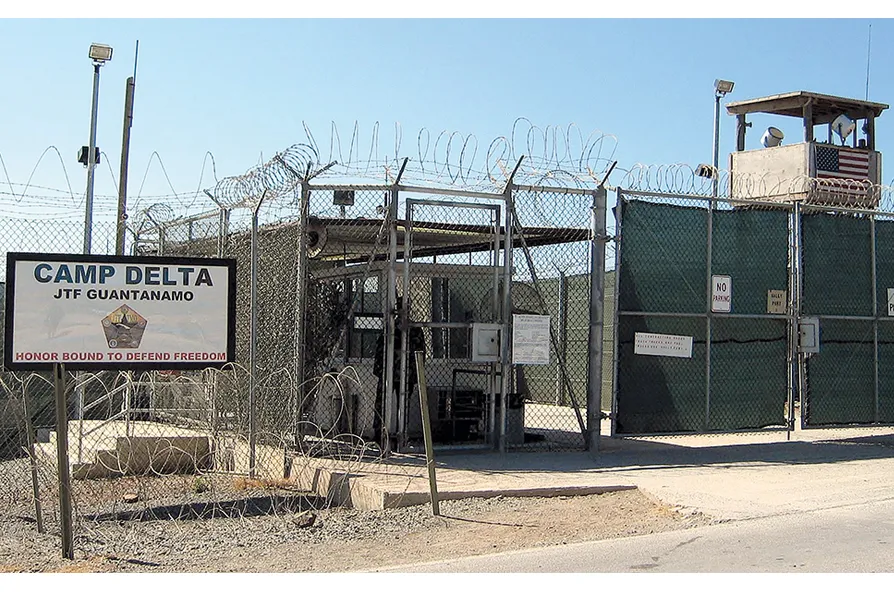
FRANCISCO DOMINGUEZ introduces the background to a conference on defending Latin America’s sovereignty
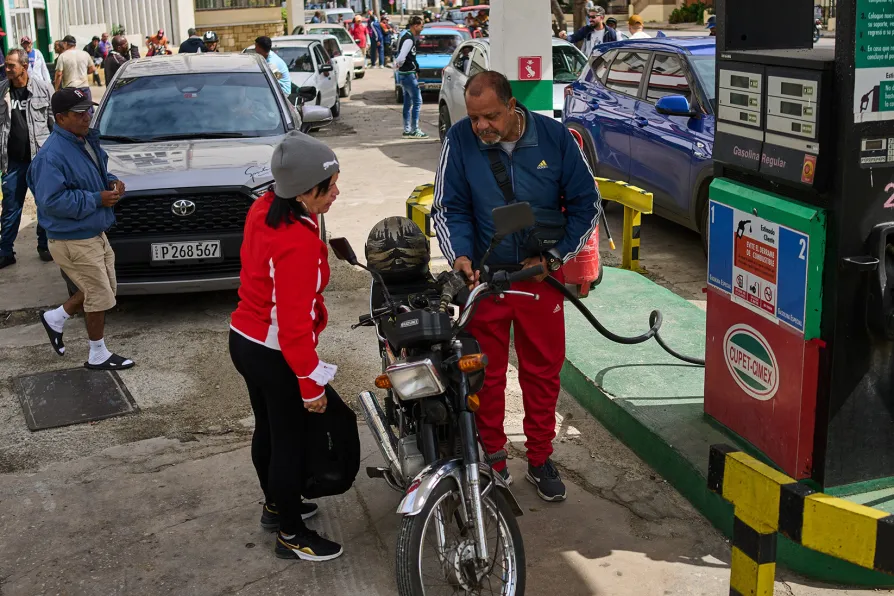
On January 29, US President Donald Trump declared Cuba an ‘unusual and extraordinary threat’ to US national security and tightened the blockade against the island nation MANOLO DE LOS SANTOS reports