GORDON PARSONS recommends an entertaining account of the years between Germany’s defeat in WWI and Hitler’s seizure of power



More Gutenberg, less Zuckerberg!
KATHRYN JOHNSON recommends the work of Norman Kaplan that was a tool in the struggle against apartheid in South Africa
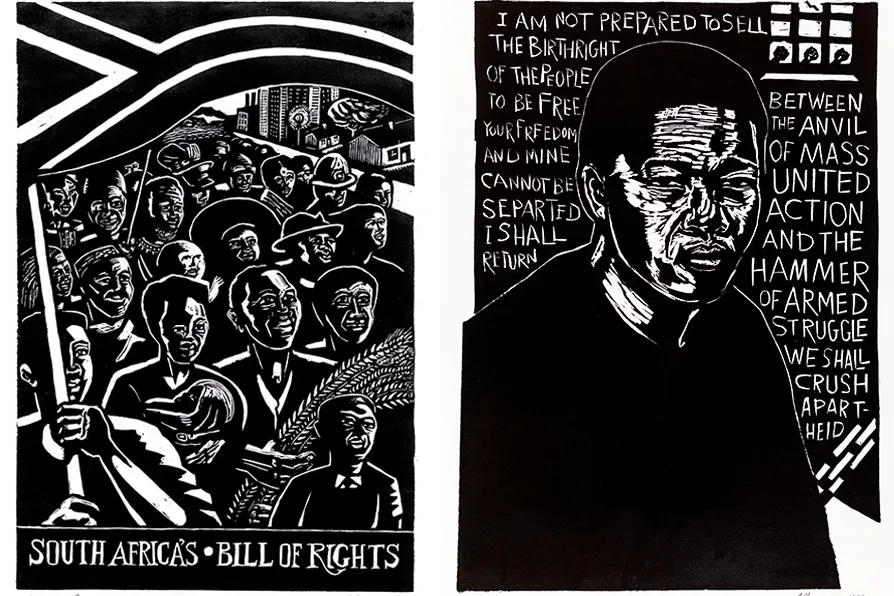
 (L) Norman Kaplan, South Africa’s Bill of Rights, 1996; (R) Mandela – Message from Robben Island, 1985 [Pics: © Norman Kaplan/Steve Russell Studios]
MIGUEL YOSHIDA explains the evolution and influence of the Cuban Casa De Las Americas in joining culture to the revolutionary struggle
ANDY HEDGECOCK is charmed by a skilful adaptation of Tove Jansson’s lyrical portrait of three generations of a family, overcoming grief
ALEX HALL treads warily through a messy, dialectical struggle fought in the mundane machinery of driving licences, criminal law, and birth registries
MICHAL BONCZA, FIONA O’CONNOR, JAMES WALSH and ANGUS REID review Atlas of Disappearance, Love Me Tender, Bouchra, and This Tempting Madness
Flitting between myth and the modern world, Medusa is determined to steer clear of human affairs. When her resolve crumbles, the result is petrifying in every sense





All Shall Be Afforded Dignity
Thin Ice Press, Peasholme Green, York
★★★★★
THE sumptuous ink black and strong white lines of Norman Kaplan’s linocuts were a powerful tool in the struggle against apartheid in South Africa, and portray the hope after it was defeated.
The connections between that protracted fight, and those for peace and freedom today, reverberate as you appreciate the depth and scale of the story packed into the entrance to Thin Ice Press.
As Kaplan said in his message to those at the launch: “I’d be remiss if I did not mention the powerful role printmaking has had in the struggle for truth and social justice against racism, oppression, inequality and fascism. Having been expelled from art school 60 years ago for making prints critical of the South African apartheid government, it saddens and angers me that artists are today facing expulsion, vilification, jail and even death for showing solidarity with the Palestinians facing genocide by the apartheid state of Israel.”
Norman was taught the use of lino at high school but attacks as a “joodtjie” – a bad jew – which had continued since primary school, led him to walk out and the expulsion.
He joined the still independent local art school under a supporter of the banned Congress of Democrats and met his liberating and printmaking mentor, Alexander Podlashuc and his wife, Marianne, both well-known in South Africa. He was introduced to the Weimar satirical magazine Simplicissimus, the work of Kathe Kollwitz, Ben Shahn, Leonard Baskin and Frans Masereel among many other humanist and revolutionary printmakers, and to the townships painter, George Pemba.
He felt an immediate affinity with the link between art, politics and the representation of the struggle for freedom and dignity, making him an activist as well as an artist. His images of the compound, uniformed guards and the dompas — the passbook without which any non-white would be in jail — capture authoritarian power and oppression, while resistance is there in both the act of printing “Mandela” and the content.
Images of Mandela were still banned when it was produced, while the extract of Mandela’s speech when he was sentenced to life imprisonment in 1964 — “Between the anvil of mass united action and the hammer of armed struggle we shall crush apartheid” — reveals the freedom fighter labelled terrorist until he was awarded the Nobel Peace Prize and democratically elected president in 1994.
All Shall Be Afforded Dignity, after which the exhibition is named, won first prize in the call for art to celebrate the new constitution and is engraved in the window of South Africa’s Constitutional Court. The faces in that print are still worn and weary from enduring the brutality, in contrast to the sense of victory in South Africa’s Bill of Rights, and the freedom to work with dignity in The Grape Pickers.
Image
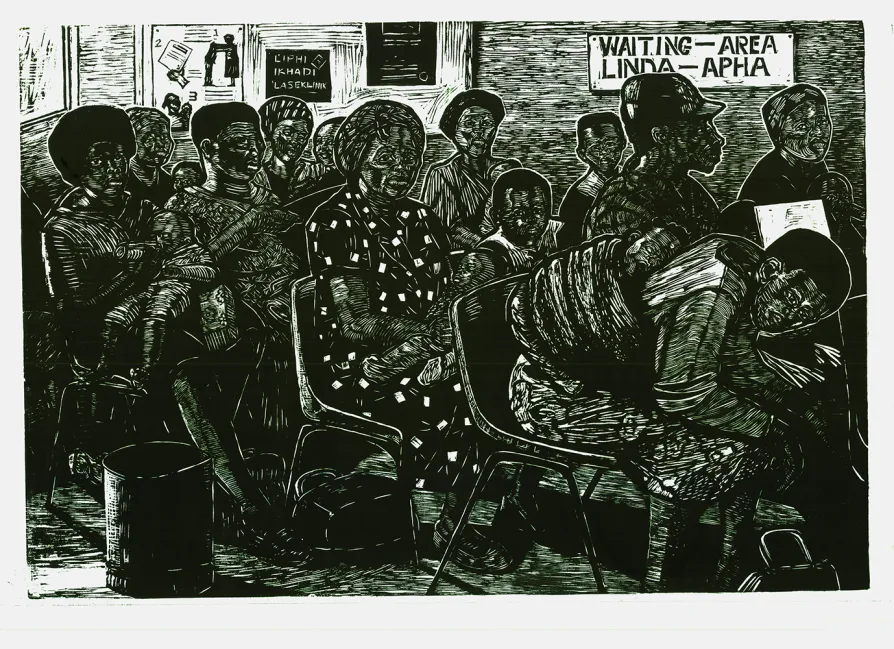
Accompanying the linocuts are Kaplan’s political cartoons, along with items from the Borthwick Institute for Archives of both South African organisation and the city of York’s own involvement in the anti-apartheid movement. The latter includes a postcard of the July 3 1987 march in the city, in solidarity with workers sacked after striking at the South African subsidiary of York-based Rowntree Mackintosh.
Many works here are those produced during his exile in the 1970s and 1980s, usually anonymously, for the anti-apartheid movement. They illustrated clandestine magazines, the African National Congress’ Sechaba, The African Communist and the Communist Party’s newspaper Umsebenzi, and illegal leaflets, prints and posters used in the resistance.
Much of the work was stored away after this activism but has now been shown in galleries around South Africa, Cuba and elsewhere for the 30th anniversary of the defeat of apartheid in South Africa. The current tour has reached London, Norwich, Newcastle, Manchester, Bristol and Oxford, often accompanied by linocut workshops demonstrating the low-cost democratic power of the medium.
Positive feedback from the 16,000 people who have visited the exhibitions show it’s continued relevance today: “How topical this amazing collection is,” writes one visitor, “against today’s backdrop of the Israeli apartheid regime in Palestine. ‘Dignity for all’ includes the right to exist in one’s land without fear for your life.”
The exhibition has been organised by the Anti-Apartheid Legacy: Centre of Memory and Learning, soon to be located at the renovated former HQ of the ANC in exile at 28 Penton Street, London; by ACTSA and the Anti-Apartheid Movement Archives; and by students from the University of York Museum Studies.
Norman recognised the importance of art: “In this age of bland and soulless instant gratification of artificial intelligence that is beginning to dominate all facets of creativity, art is an expression of the human spirit, of joy and grief, love and hate, of wonder, of things beautiful and ugly and above all of love… No algorithm can give love or the experience of a life lived. I say let’s have more Gutenberg and less Zuckerberg!”
Norman Kaplan was born in Port Elizabeth, spent 14 years in exile in Britain but returned to South Africa in 1991. He lives in the Eastern Cape and continues his radical work on current inequality and poverty.
Runs until April 30, admission free. For more information see: actsa.org.
