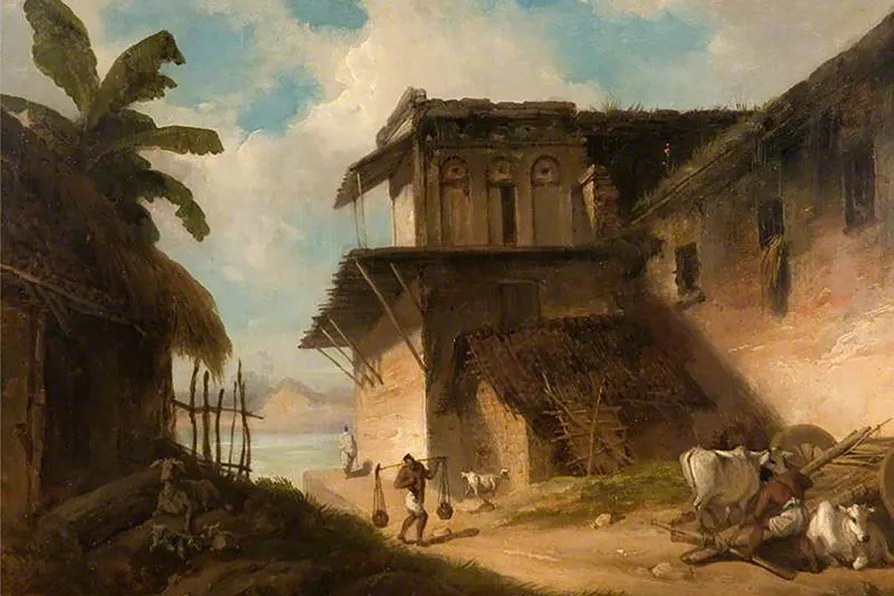
APURBA CHATTERJEE explains how British artists in India used the “picturesque” to reshape colonial landscapes and celebrate imperial power


 Latest editorial

Letters from Latin America with Leo Boix: March 31, 2026
A novel by Mexican Juan Pablo Villalobos, poetry by Mexican Ingrid Bringas, and a biography by Argentinian Mercedes Halfon

PAUL DONOVAN welcomes a revival of Reginald Rose’s classic play that reminds us of the fundamental need for trials with juries
SIMON PARSONS applauds an exceptional performance of Wesker’s little-known play, by the same actor for whom it was written 45 years ago
ANDY HEDGECOCK and MARIA DUARTE review Late Fame, The Death of Robin Hood, Leviticus, and Gail Daughtry and the Celebrity Sex Pass
ANGUS REID recommends a uniquely accomplished documentary collage that contemplates our relation to the natural world
GORDON PARSONS enjoys Kant’s ‘mind-boggling’ theory of human reality: that we create the reality we experience





In The Past Pursues Us Like Detectives, Debt Collectors, Thieves (And Other Stories, £14.99), Juan Pablo Villalobos turns the idea of “going home” into something far stranger — and far more unsettling — than a simple return. In his hands, Mexico is not just a place, but a labyrinth of debts, memories and unfinished business.
The novel, briskly and elegantly translated by Daniel Hahn, follows Juan Pablo, a 50-year-old Mexican living abroad with his second wife and children, as he returns to Lagos, Morelos. Ostensibly, he is there to care for his ailing mother, who requires costly medical treatment. It sounds straightforward enough. But in Villalobos’s off-kilter universe, nothing stays simple for long.
A chance encounter in a pub with an old acquaintance called Everardo sets off a chain of increasingly bizarre and disquieting events. There are pills that materialise and vanish, money that slips through fingers, a suspicious death hovering at the edges and an atmosphere thick with menace. Violence and corruption simmer just beneath the surface, yet Villalobos infuses it all with a dark, almost mischievous humour that keeps the narrative in constant, uneasy motion.
At its core, the novel is a reckoning. Juan Pablo confronts not only his past, but the version of Mexico he thought he understood — and the one that has moved on without him. His friends and family insist, with varying degrees of patience, that he no longer quite grasps the country he has returned to.
“I’d come back home because I felt guilty… I’d come to pay tribute, to settle a debt,” he reflects, in a line that encapsulates the novel’s moral and emotional tension.
There are shades here of David Lynch’s dream logic and Quentin Tarantino’s stylised violence: narcotics, stray bullets and fractured memories blur together in a narrative that resists easy coherence. At times, one wishes Villalobos would push even further into this chaos, and lean harder into the surreal, allow the confusion to spiral more wildly, and perhaps even resist tying things together so neatly at the end.
And yet, restraint is part of his craft. Villalobos knows exactly how far to stretch the thread before pulling it back. The result is a novel that is both unsettling and sharply controlled. It’s proof, once again, that he remains one of the most distinctive and exciting voices in contemporary Latin American fiction.
If Villalobos’s novel is haunted by the past, Ingrid Bringas’s Album de los amores perversos (Dogma Editorial, £10) is haunted by the body — policed, medicalised, desired, erased and defiantly reclaimed. This is a collection that does not ask for permission. It burns through it.
Bringas writes from within the intimate violence of language itself: diagnosis, religion, family, law. Her poems move with a fractured, breathless rhythm: short lines, repetitions and interruptions that mimic both anxiety and resistance. The effect is incantatory, almost liturgical, but always on the verge of rupture.
From the outset, the political stakes are unmistakable. “Nos habiamos convertido en un pecado, delito y enfermedad, / el tiro al blanco… una escala” (“We had become a sin, a crime and an illness, / target practice… a scale”). The reference to the Kinsey scale is not incidental: categorisation itself becomes a form of violence, a way of reducing bodies into legible — and punishable — data.
Throughout the collection, the body is a site of contestation. Therapy rooms, religious confession, and family spaces blur into one another, forming a landscape of control. In one striking poem, the speaker describes electroshock treatment with chilling detachment: “para morir de amor… 85 voltios/ 110 voltios/ tranquilizarse — olvidarse de quien se es” (“to die of love… 85 volts/ 110 volts/ to calm down — to forget who one is”). The clinical language exposes the brutality beneath the supposed neutrality of care.
And yet, this is also a book of tenderness, though never an uncomplicated one. Desire appears as something both luminous and dangerous, a force that insists on itself despite attempts to suppress it.
“El peligro puede ser a veces… dos personas que se aman” (“Danger can sometimes be… two people who love each other”). Love, here, is not redemptive in any easy sense; it is risky, politicised, and often clandestine.
At its most powerful, Album de los amores perversos achieves a raw, almost unbearable clarity. Poems like Ley and Seccion 28 explicitly confront the legal and historical frameworks that regulate queer existence, reminding us that repression is not abstract but codified, systemic and ongoing. “Todas las leyes del mundo querran intervenir este cuerpo revolucionario” (“All the laws of the world will want to intervene in this revolutionary body”).
In contrast to Villalobos’s controlled absurdity, Bringas offers something more visceral, more immediate: a poetics of the body under pressure. Together, they map different terrains of contemporary Mexican writing: one circling the ghosts of the past, the other insisting, fiercely, on the right to inhabit the present.
Outsider Everywhere (Fitzcarraldo Editions, £12.99) by Argentinian writer Mercedes Halfon, elegantly translated by Rahul Bery, turns to a different but equally charged form of dislocation: the condition of permanent estrangement.
Halfon traces the life and afterlife of Witold Gombrowicz, who arrived in Argentina on the eve of the second world war and remained there for decades, suspended between languages, cultures and literary identities. His works — from the anarchic Ferdydurke to the exilic satire of Trans-Atlantyk and the unsettling Cosmos — circle the same obsession: how the self is shaped, distorted and never entirely its own.
Halfon captures this with wit and precision, assembling Gombrowicz through fragments, anecdotes and sharp insight rather than linear biography.
“Hounded by new ghosts, he creates a new mythology,” she writes — a line that crystallises both his exile and his artistic method.
What emerges is a writer who transforms marginality into a strategy, cultivating outsiderhood as a way of seeing more clearly and writing for readers who may not yet exist.
Outsider Everywhere reframes exile as a creative force — restless, ironic, and generative. The result is not just a portrait of Gombrowicz, but a compelling meditation on what it means, in different ways, to never fully belong.
